Text to imageArt stylesStyle guide
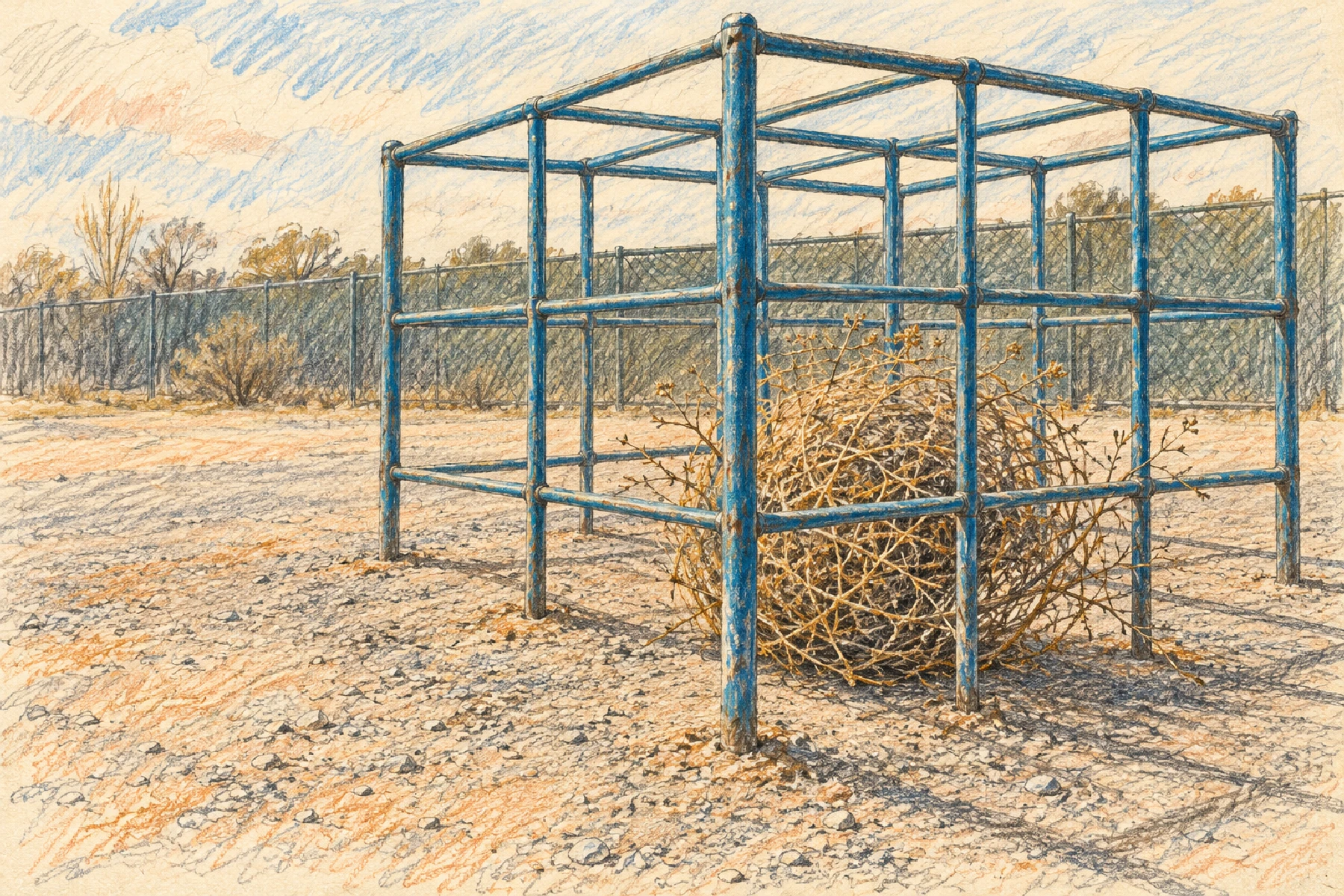
Tumbleweed in a Climbing Frame
An enormous tumbleweed fills a deserted playground climbing frame. Rough pencil lines and loose colored-pencil strokes contrast tangled twigs with open steel geometry, leaving a quiet afternoon in the generous negative space.
Remix this referenceTumbleweed in a Climbing Frame
- Form language
- Reduce rigid forms to slightly uneven bars and branching forms to interlocking angular bundles; retain gaps instead of describing every fragment.
- Contour
- Use searching graphite contours with pressure changes, occasional doubled edges and unfinished breaks; let selected strokes taper to a scratch.
- Mark-making
- Combine quick pencil tangles with broad side-of-pencil color strokes; vary stroke length and pressure so the hand remains visibly present.
- Surface rendering
- Build tone through loose hatching and grain-catching colored-pencil layers, allowing paper gaps and rubbed transitions rather than uniformly filled surfaces.
Priority
Make rough pencil and colored-pencil sketchbook drawing unmistakable through visible, naturally varied hand marks.
What to avoid & what to check
Exact prompt for this example
MODULE OWNERSHIP
subject: Subject count, type, stable proportions and landmarks, resting face geometry, hair shape, physical materials, garment construction and permanent marks. No emotion, movement, color assignment or rendering recipe.
expression: Facial soft-tissue displacement and pupil direction, muscle coordination, regional intensity, asymmetry and onset/peak/release. No head/body pose, stable appearance, skin color or rendering.
gesture: Head/neck/body/limb orientation, joint movement, support, contact and pose-caused occlusion using existing anatomy. No eye/pupil movement, emotion, identity, props inventory or camera.
props: Prop count, type, construction, physical material and scale relative to the subject. Holding/contact belongs to gesture, position to composition, color to palette.
scene: Environment elements, terrain, backdrop/floor presence and structural detail. No canvas positions, camera, lighting, assigned colors or render texture.
camera: Projection, focal-length impression, camera elevation/yaw/roll, viewing distance and crop. No actor pose, world placement, lighting or canvas aspect ratio.
composition: Normalized 0-100% canvas positions, scale in frame, depth/overlap, focal hierarchy and margins. No joint pose, camera projection, rendering, subject/prop inventory or emotion.
palette: Color anchors, hue/saturation/value ranges, colors assigned to parts and approximate color coverage. No illumination direction, shading algorithm, physical material or layout.
lighting: Light-source direction/softness/intensity, ambient illumination, physical shadow direction/length and highlight position. Absence of directional illumination is allowed. No shading technique, palette or material changes.
style: Reusable form abstraction, contour weight/taper/edge quality, medium and mark scale/density/direction, surface rendering and tonal transition technique. No fixed subject proportions, anatomy, identity, expression, pose, palette, light-source direction, camera or layout.
output: Image count, aspect ratio, size, file/alpha requirements and global lettering/logo/watermark restrictions. No background scenery, crop, style, identity or pose.

SUBJECT
inventory: One large dried tumbleweed shrub, with no people or animals.
geometry: An irregular hollow globe of forked stems, with a few long twigs extending beyond its compact branching core.
resting-face: No face or facial landmarks apply.
appearance: Brittle woody stems carry sparse curled leaves and small dry seed clusters; branching details may vary naturally.

PRIORITY


AVOID


CHECK


PROPS
inventory: No separate props.
construction: No prop construction applies.

PRIORITY


AVOID


CHECK


SCENE
inventory: A playground contains a cube-shaped climbing frame, worn gravel ground and a windbreak fence.
structure: Tubular steel rails form open square bays; shallow scuffed hollows interrupt the gravel beneath the structure.

PRIORITY


AVOID


CHECK


CAMERA
projection: Use natural perspective with a moderate normal-lens impression.
viewpoint: Observe from adult standing height, looking slightly downward across two visible sides of the climbing frame.
crop: Use a wide environmental view that includes the complete frame and a generous stretch of surrounding ground.

PRIORITY


AVOID


CHECK


COMPOSITION
placement: Anchor the main cluster around 72% across and 65% down, with the frame occupying roughly half the canvas width.
depth: The twig globe is the focal mass inside overlapping rail bays; the fence remains a distant, subordinate interruption.
spacing: Leave the upper left broadly open, with only a low ground sweep connecting that emptiness to the clustered forms.

PRIORITY


AVOID


CHECK


PALETTE
colors: Use paper cream, graphite gray, dry ochre, faded petrol blue and a restrained dusty apricot.
assignment: Give the shrub ochre accents, the rails petrol blue, and scattered ground passages dusty apricot against cream.
balance: Keep cream dominant, gray structurally present and colored passages muted, with the deepest values in the twig core.

PRIORITY


AVOID


CHECK


LIGHTING
sources: Broad afternoon light enters from the upper left, softened by thin cloud and supported by gentle ambient light.
shadows: Soft, moderately long rail and twig shadows extend toward the lower right across the ground.
highlights: Keep highlights subdued along upper-left rail edges and the exposed outer stems.

PRIORITY


AVOID


CHECK


STYLE GUIDE
form-language: Reduce rigid forms to slightly uneven bars and branching forms to interlocking angular bundles; retain gaps instead of describing every fragment.
contour: Use searching graphite contours with pressure changes, occasional doubled edges and unfinished breaks; let selected strokes taper to a scratch.
mark-making: Combine quick pencil tangles with broad side-of-pencil color strokes; vary stroke length and pressure so the hand remains visibly present.
surface-rendering: Build tone through loose hatching and grain-catching colored-pencil layers, allowing paper gaps and rubbed transitions rather than uniformly filled surfaces.

PRIORITY
Make rough pencil and colored-pencil sketchbook drawing unmistakable through visible, naturally varied hand marks.

AVOID


CHECK


OUTPUT
format: Create one finished landscape image, 3:2 aspect ratio, 1800 × 1200 pixels, opaque PNG; no lettering, logos or watermarks.
restrictions: Create one finished landscape image, 3:2 aspect ratio, 1800 × 1200 pixels, opaque PNG; no lettering, logos or watermarks.

PRIORITY


AVOID


CHECK
Model information comes from image provenance. The same prompt may produce a different result.