Text to imageLandscapeStyle guide
Three Ridges · Atmospheric Perspective
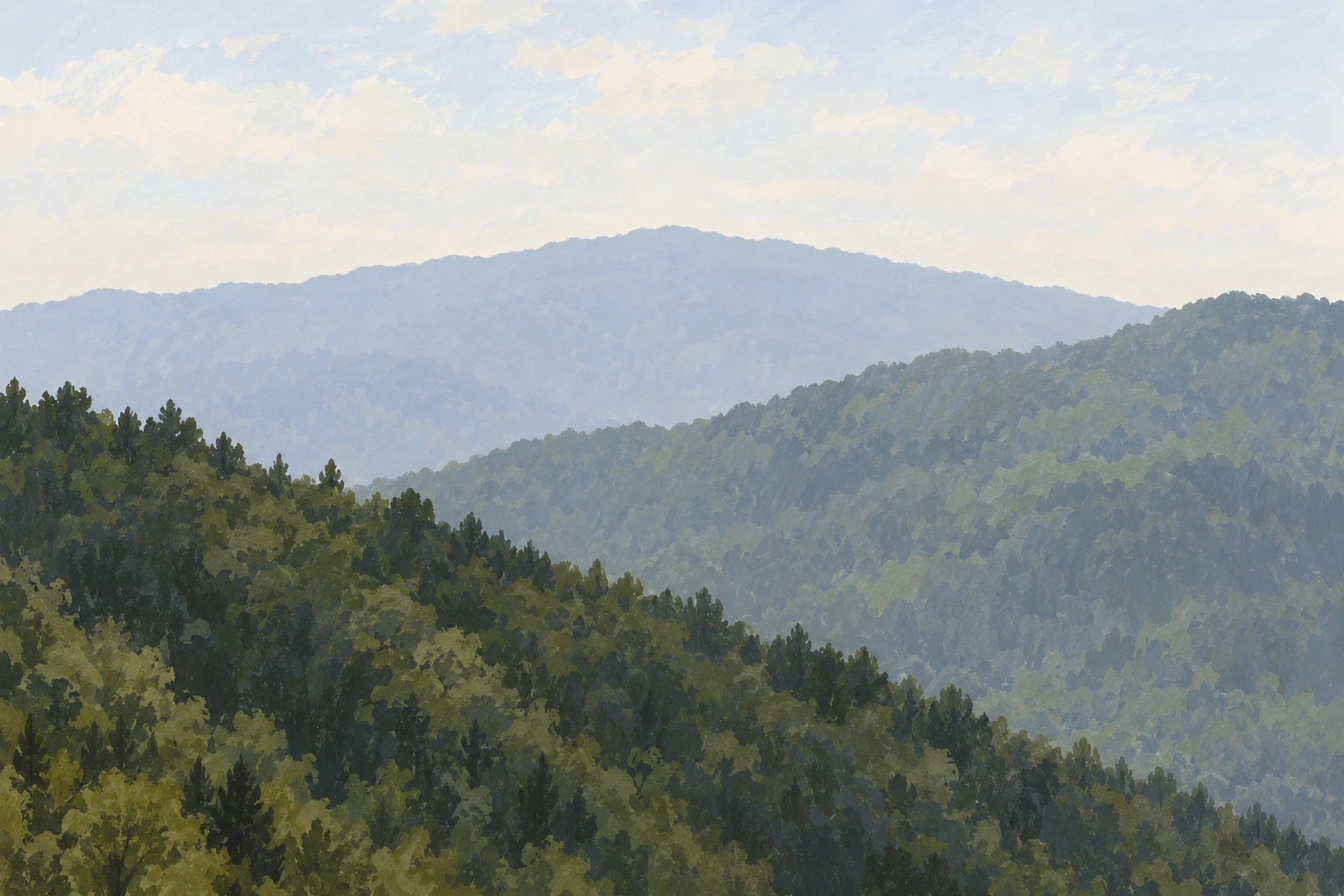
Three overlapping ridges demonstrate depth through progressively reduced contrast, cooler color, and softer edges.
Three Ridges · Atmospheric Perspective
- Shape & line
- Draw three broad, irregular ridge silhouettes with clear overlaps. Give the lower image-left foreground crest small clustered tree notches, simplify the middle crest into fewer rounded bumps, and make the upper-center distant crest nearly continuous with a softened edge.
- Color & light
- Paint the nearest ridge in deep muted olive with a broad range of light and dark, the middle ridge in lighter gray-green with reduced contrast, and the farthest in pale blue-gray close to the sky value. Let haze lift the shadow values with distance while keeping the sky the lightest large area.
- Texture & material
- Use matte gouache with grouped, broken brush marks for foreground foliage. Reduce those marks to broad patches on the middle ridge and a smooth wash-like opaque field on the farthest ridge; keep visible paper grain subtle enough that it does not restore distant detail.
- Composition
- Arrange the ridge overlaps as a rising diagonal from lower image-left toward upper image-right. Preserve a visible strip of the middle ridge between foreground and background, and reserve roughly the upper third for uninterrupted sky so the distance progression reads at thumbnail size.
Priority
Make the stepwise loss of contrast and detail across the three ridges the dominant visual lesson.
What to avoid & what to check
Avoid equally dark ridges, uniform sharp outlines, and detailed trees on the distant crest.
At thumbnail size, confirm that three separate ridges read from dark and detailed in front to pale and simplified behind.
Exact prompt for this example
SUBJECT
Exactly three wooded mountain ridges recede into a pale, hazy sky. The nearest ridge overlaps the middle ridge, and the middle ridge overlaps the farthest; each retains a distinct, gently uneven crest.

COMPOSITION
Use a wide landscape view with the nearest ridge entering from the lower image-left, the middle ridge rising across image-right, and the farthest ridge spanning the upper center. Keep all three crests readable and leave a generous area of quiet sky above them.

STYLE GUIDE
1. Shape & line
Draw three broad, irregular ridge silhouettes with clear overlaps. Give the lower image-left foreground crest small clustered tree notches, simplify the middle crest into fewer rounded bumps, and make the upper-center distant crest nearly continuous with a softened edge.

2. Color & light
Paint the nearest ridge in deep muted olive with a broad range of light and dark, the middle ridge in lighter gray-green with reduced contrast, and the farthest in pale blue-gray close to the sky value. Let haze lift the shadow values with distance while keeping the sky the lightest large area.

3. Texture & material
Use matte gouache with grouped, broken brush marks for foreground foliage. Reduce those marks to broad patches on the middle ridge and a smooth wash-like opaque field on the farthest ridge; keep visible paper grain subtle enough that it does not restore distant detail.

4. Composition
Arrange the ridge overlaps as a rising diagonal from lower image-left toward upper image-right. Preserve a visible strip of the middle ridge between foreground and background, and reserve roughly the upper third for uninterrupted sky so the distance progression reads at thumbnail size.

PRIORITY
Preserve the requested identity, count, action, composition and output settings. Apply the style rules within those constraints; a style reference must not replace the subject or layout. Within the style: Make the stepwise loss of contrast and detail across the three ridges the dominant visual lesson.

AVOID
Avoid equally dark ridges, uniform sharp outlines, and detailed trees on the distant crest.

OUTPUT
One landscape image in a 3:2 aspect ratio, rendered as a restrained opaque-gouache painting, with no text, labels, borders, or watermarks.

SELF-CHECK
At thumbnail size, confirm that three separate ridges read from dark and detailed in front to pale and simplified behind.
Model information comes from image provenance. The same prompt may produce a different result.