Text to imageArt stylesStyle guide
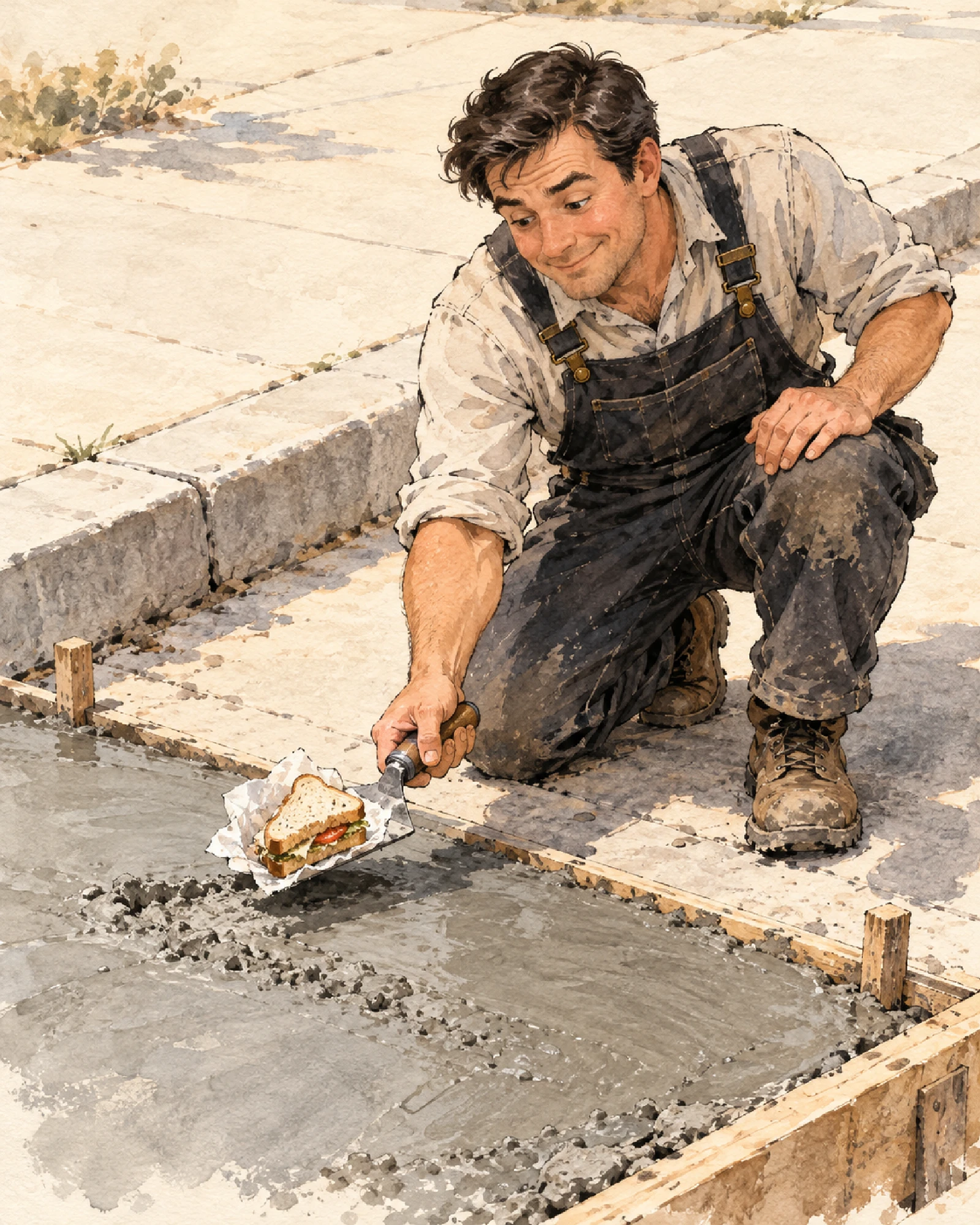
A Sandwich on the Trowel
A road worker lifts a dropped sandwich from wet concrete with a trowel. Overlapping workwear, arms and wrapping paper meet elastic ink lines and spreading washes, surrounded by generous open paper.
Remix this referenceA Sandwich on the Trowel
- Form language
- Reduce forms to interlocking broad masses with a few telling irregularities; let secondary details vary within the same economical abstraction.
- Contour
- Use elastic brush contours that swell under pressure, taper to fine tips and occasionally break or disappear; avoid enclosing every shape.
- Mark-making
- Alternate quick, spare ink strokes with broad wash sweeps; allow split-bristle skips and a few pooled endpoints, with natural changes in stroke direction.
- Surface rendering
- Build tone with translucent overlapping washes, soft blooms and occasional drying rims; preserve untouched paper through pale passages and uneven transitions.
Priority
Editorial ink wash must visibly retain brush pressure and the spreading behavior of diluted ink.
What to avoid & what to check
Exact prompt for this example
MODULE OWNERSHIP
subject: Subject count, type, stable proportions and landmarks, resting face geometry, hair shape, physical materials, garment construction and permanent marks. No emotion, movement, color assignment or rendering recipe.
expression: Facial soft-tissue displacement and pupil direction, muscle coordination, regional intensity, asymmetry and onset/peak/release. No head/body pose, stable appearance, skin color or rendering.
gesture: Head/neck/body/limb orientation, joint movement, support, contact and pose-caused occlusion using existing anatomy. No eye/pupil movement, emotion, identity, props inventory or camera.
props: Prop count, type, construction, physical material and scale relative to the subject. Holding/contact belongs to gesture, position to composition, color to palette.
scene: Environment elements, terrain, backdrop/floor presence and structural detail. No canvas positions, camera, lighting, assigned colors or render texture.
camera: Projection, focal-length impression, camera elevation/yaw/roll, viewing distance and crop. No actor pose, world placement, lighting or canvas aspect ratio.
composition: Normalized 0-100% canvas positions, scale in frame, depth/overlap, focal hierarchy and margins. No joint pose, camera projection, rendering, subject/prop inventory or emotion.
palette: Color anchors, hue/saturation/value ranges, colors assigned to parts and approximate color coverage. No illumination direction, shading algorithm, physical material or layout.
lighting: Light-source direction/softness/intensity, ambient illumination, physical shadow direction/length and highlight position. Absence of directional illumination is allowed. No shading technique, palette or material changes.
style: Reusable form abstraction, contour weight/taper/edge quality, medium and mark scale/density/direction, surface rendering and tonal transition technique. No fixed subject proportions, anatomy, identity, expression, pose, palette, light-source direction, camera or layout.
output: Image count, aspect ratio, size, file/alpha requirements and global lettering/logo/watermark restrictions. No background scenery, crop, style, identity or pose.

SUBJECT
inventory: One adult road worker, actor A, with an ordinary human build.
geometry: Broad oval face, rounded chin and sturdy hands; keep the figure recognizably adult without exaggerated proportions.
resting-face: Straight resting brows, gently hooded eyes and a broad mouth with a shallow upper-lip bow.
appearance: Short side-parted hair; woven bib overalls over a rolled-sleeve work shirt, with leather ankle boots.

PRIORITY


AVOID


CHECK


EXPRESSION — ACTOR A
brows: One brow rises slightly while the other remains nearly at rest.
lids: Lower lids tighten lightly without closing the eyes.
cheeks: A small cheek lift begins on the side of the rising mouth corner.
nose: Nostrils stay relaxed, with no nose wrinkle.
mouth: Closed lips form a small, uneven smile with only one corner lifting.
jaw: The jaw stays loose, with no visible clenching.
gaze: Pupils remain directed toward the sandwich on the trowel.
coordination: Focused eyes and the uneven smile suggest private amusement at the mishap.
timing: Catch the onset: the smile has just begun while the gaze is already settled.

PRIORITY


AVOID


CHECK


GESTURE
head: The neck bends gently forward and the chin lowers toward the working hand.
torso: The worker crouches with the torso folded forward and slightly turned toward the retrieval.
limbs: One arm extends low with the trowel; the other palm braces on a bent knee, with both boots planted.
contact: The trowel supports the sandwich from underneath, just clear of the concrete; the forearm overlaps the bib.

PRIORITY


AVOID


CHECK


PROPS
inventory: Two props: one fist-sized wrapped sandwich and one short hand trowel.
construction: The sandwich has soft bread, visible filling and an opened waxed-paper wrapper; the trowel has a steel blade and wooden grip.

PRIORITY


AVOID


CHECK


SCENE
inventory: A small outdoor pavement repair bay with fresh concrete, an existing curb and adjacent paving slabs.
structure: Low timber formwork contains the shallow concrete bed; a short disturbed streak records the retrieval.

PRIORITY


AVOID


CHECK


CAMERA
projection: Natural perspective with a normal-lens impression and moderate foreshortening.
viewpoint: An elevated three-quarter view looks gently downward, with no camera roll.
crop: A medium-wide view includes the entire worker and retrieval, clipping the nearest edge of the repair bay.

PRIORITY


AVOID


CHECK


COMPOSITION
placement: Group the worker in the lower-right half, with the sandwich just left of center and ample space above and left.
depth: Overlap the arm, bib and bent leg into one lively mass; let the trowel and wrapper separate clearly against the concrete.
spacing: Make the rescued lunch the first read and the face the second; the curb leads outward into a broad, quiet margin.

PRIORITY


AVOID


CHECK


PALETTE
colors: Use paper ivory, soot black, warm gray, muted ochre and a small tomato-red accent.
assignment: Assign black to hair and overalls, gray to concrete, ochre to skin and bread, and red to the exposed filling.
balance: Ivory and pale gray dominate; compact dark passages carry weight, while the filling supplies the smallest bright accent.

PRIORITY


AVOID


CHECK


LIGHTING
sources: Broad, soft daylight arrives from the upper left, supported by gentle ambient illumination.
shadows: Short, soft shadows fall toward the lower right, with deeper shade beneath the crouched body.
highlights: Restrained highlights touch the upper sleeve folds and the upward-facing lip of the trowel.

PRIORITY


AVOID


CHECK


STYLE GUIDE
form-language: Reduce forms to interlocking broad masses with a few telling irregularities; let secondary details vary within the same economical abstraction.
contour: Use elastic brush contours that swell under pressure, taper to fine tips and occasionally break or disappear; avoid enclosing every shape.
mark-making: Alternate quick, spare ink strokes with broad wash sweeps; allow split-bristle skips and a few pooled endpoints, with natural changes in stroke direction.
surface-rendering: Build tone with translucent overlapping washes, soft blooms and occasional drying rims; preserve untouched paper through pale passages and uneven transitions.

PRIORITY
Editorial ink wash must visibly retain brush pressure and the spreading behavior of diluted ink.

AVOID


CHECK


OUTPUT
format: One finished image, portrait 4:5, 1600 × 2000 pixels, opaque PNG.
restrictions: No lettering, logos, signatures or watermarks.

PRIORITY


AVOID


CHECK


FINAL INTEGRATION
expression + gesture: The facial reaction and retrieval should register as the same brief interruption in an ordinary workday.
composition + style: Use selective edge loss to connect the overlapping forms to the open paper while preserving the narrative's readability.
Model information comes from image provenance. The same prompt may produce a different result.