Text to imageComicsStyle guide
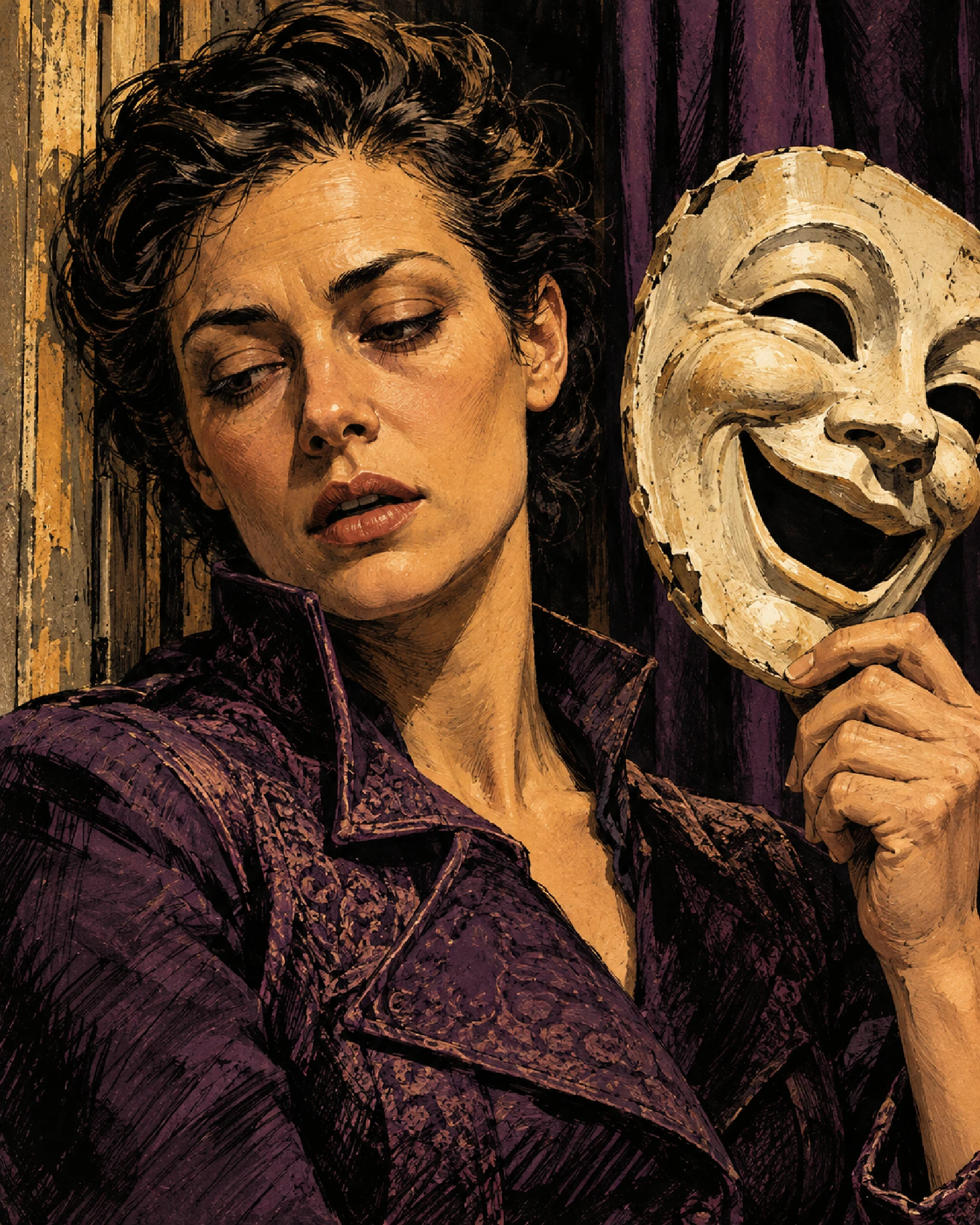
Actor Lifting a Laughing Mask
An intimate backstage portrait in bold, elastic American comic inks. An actor lifts a laughing mask aside, leaving its deeply carved smile beside her exhausted face across a narrow gap.
Remix this referenceActor Lifting a Laughing Mask
- Form language
- Build forms from interlocking wedges and broad curved planes; simplify secondary details and allow irregular shapes to vary coherently.
- Contour
- Use forceful brush contours with swelling widths, needle-fine tapers and occasional open edges.
- Mark-making
- Cluster quick, tapered hatch strokes into irregular fans; let dry-brush skips interrupt otherwise decisive ink marks.
- Surface rendering
- Set pooled ink masses against broad opaque paint passages; turn tone through broken hatching and ragged transitions that expose the paper.
Priority
Rendering medium: Bold American brush-and-ink comic illustration with opaque painted color.
What to avoid & what to check
Exact prompt for this example
MODULE OWNERSHIP
subject: Subject count, type, stable proportions and landmarks, resting face geometry, hair shape, physical materials, garment construction and permanent marks. No emotion, movement, color assignment or rendering recipe.
expression: Facial soft-tissue displacement and pupil direction, muscle coordination, regional intensity, asymmetry and onset/peak/release. No head/body pose, stable appearance, skin color or rendering.
gesture: Head/neck/body/limb orientation, joint movement, support, contact and pose-caused occlusion using existing anatomy. No eye/pupil movement, emotion, identity, props inventory or camera.
props: Prop count, type, construction, physical material and scale relative to the subject. Holding/contact belongs to gesture, position to composition, color to palette.
scene: Environment elements, terrain, backdrop/floor presence and structural detail. No canvas positions, camera, lighting, assigned colors or render texture.
camera: Projection, focal-length impression, camera elevation/yaw/roll, viewing distance and crop. No actor pose, world placement, lighting or canvas aspect ratio.
composition: Normalized 0-100% canvas positions, scale in frame, depth/overlap, focal hierarchy and margins. No joint pose, camera projection, rendering, subject/prop inventory or emotion.
palette: Color anchors, hue/saturation/value ranges, colors assigned to parts and approximate color coverage. No illumination direction, shading algorithm, physical material or layout.
lighting: Light-source direction/softness/intensity, ambient illumination, physical shadow direction/length and highlight position. Absence of directional illumination is allowed. No shading technique, palette or material changes.
style: Reusable form abstraction, contour weight/taper/edge quality, medium and mark scale/density/direction, surface rendering and tonal transition technique. No fixed subject proportions, anatomy, identity, expression, pose, palette, light-source direction, camera or layout.
output: Image count, aspect ratio, size, file/alpha requirements and global lettering/logo/watermark restrictions. No background scenery, crop, style, identity or pose.

SUBJECT
inventory: One original adult woman theater actor, designated A.
geometry: A has a long oval face, a sturdy neck, broad shoulders and substantial hands with square fingertips.
resting-face: Long upper eyelids, a broad nose bridge and a full lower lip establish her resting facial structure.
appearance: Short hair sweeps back in uneven waves; a woven stage jacket has a standing collar and overlapping front.

PRIORITY


AVOID


CHECK


EXPRESSION — ACTOR A
brows: Brows settle loosely, one resting slightly lower.
lids: Upper lids hang heavily, with unequal openness between the eyes.
cheeks: Cheeks relax without lifting toward the eyes.
nose: Nostrils remain relaxed, with no flare or bridge wrinkle.
mouth: Lips part narrowly, with one corner softer and lower.
jaw: The jaw releases into a small, unforced opening.
gaze: Pupils turn downward toward the gap beneath the mask.
coordination: Heavy lids and the loose mouth agree in quiet fatigue; retain their slight asymmetry.
timing: Hold fatigue at its quiet peak, before any recovery.

PRIORITY


AVOID


CHECK


GESTURE
head: A bows her head slightly and turns it a little toward the lifted mask.
torso: Her torso rests against the doorjamb, with one shoulder lower than the other.
limbs: The visible elbow opens outward as the wrist rotates the mask away from her face.
contact: Fingers curl around the mask rim; the back of her shoulder bears against the jamb.

PRIORITY


AVOID


CHECK


PROPS
inventory: One wearable theatrical comedy mask, approximately the size of A's face.
construction: Molded papier-mâché forms hollow eye openings, swollen cheeks and a deeply sculpted fixed grin; its rim is chipped.

PRIORITY


AVOID


CHECK


SCENE
inventory: A backstage doorway with a timber jamb and a heavy folded curtain; no floor is visible.
structure: The doorway opens into an unelaborated backstage recess; curtain folds provide the only repeated structural rhythm.

PRIORITY


AVOID


CHECK


CAMERA
projection: Natural perspective with the restrained depth of a short portrait lens.
viewpoint: Eye-level, close viewing distance, shallow three-quarter view and no camera roll.
crop: Crop tightly through the upper chest and hair crown; let part of the mask extend beyond the image edge.

PRIORITY


AVOID


CHECK


COMPOSITION
placement: A's face fills the left half; the mask occupies the upper right, with the hand below it.
depth: The mask overlaps the far shoulder but leaves the face unobstructed; doorway and curtain recede behind both.
spacing: Make the living face the first read and the carved grin the second; a narrow open wedge separates their contours.

PRIORITY


AVOID
Do not include panel divisions.

CHECK


PALETTE
colors: Use ink black, warm ochre, chalk ivory and muted aubergine as the compact color anchors.
assignment: Ochre colors the skin, ivory the mask, aubergine the jacket and curtain; hair and deepest accents use black.
balance: Large dark passages dominate; warm midvalues support the face, while ivory supplies the sharpest value contrast.

PRIORITY


AVOID


CHECK


LIGHTING
sources: A broad stage spill enters from upper left, strong against weak backstage ambient illumination.
shadows: Soft-edged shadows descend toward the lower right; the mask rim casts a short shadow on its inner surface.
highlights: Broad highlights catch the upper-left brow ridge, cheek and raised mask ridge.

PRIORITY


AVOID


CHECK


STYLE GUIDE
form-language: Build forms from interlocking wedges and broad curved planes; simplify secondary details and allow irregular shapes to vary coherently.
contour: Use forceful brush contours with swelling widths, needle-fine tapers and occasional open edges.
mark-making: Cluster quick, tapered hatch strokes into irregular fans; let dry-brush skips interrupt otherwise decisive ink marks.
surface-rendering: Set pooled ink masses against broad opaque paint passages; turn tone through broken hatching and ragged transitions that expose the paper.

PRIORITY
Rendering medium: Bold American brush-and-ink comic illustration with opaque painted color.

AVOID


CHECK


OUTPUT
format: One finished image, portrait 4:5 aspect ratio, 1600 × 2000 pixels, opaque PNG.
restrictions: No lettering, speech balloons, logos or watermarks.

PRIORITY


AVOID


CHECK


FINAL INTEGRATION
expression + props + composition: Let the facial performance and sculpted mask read together through their spatial relationship.
style + lighting: Translate the physical illumination through the ink vocabulary while retaining its broad directional clarity.
Model information comes from image provenance. The same prompt may produce a different result.