Text to imageLandscapeStyle guide
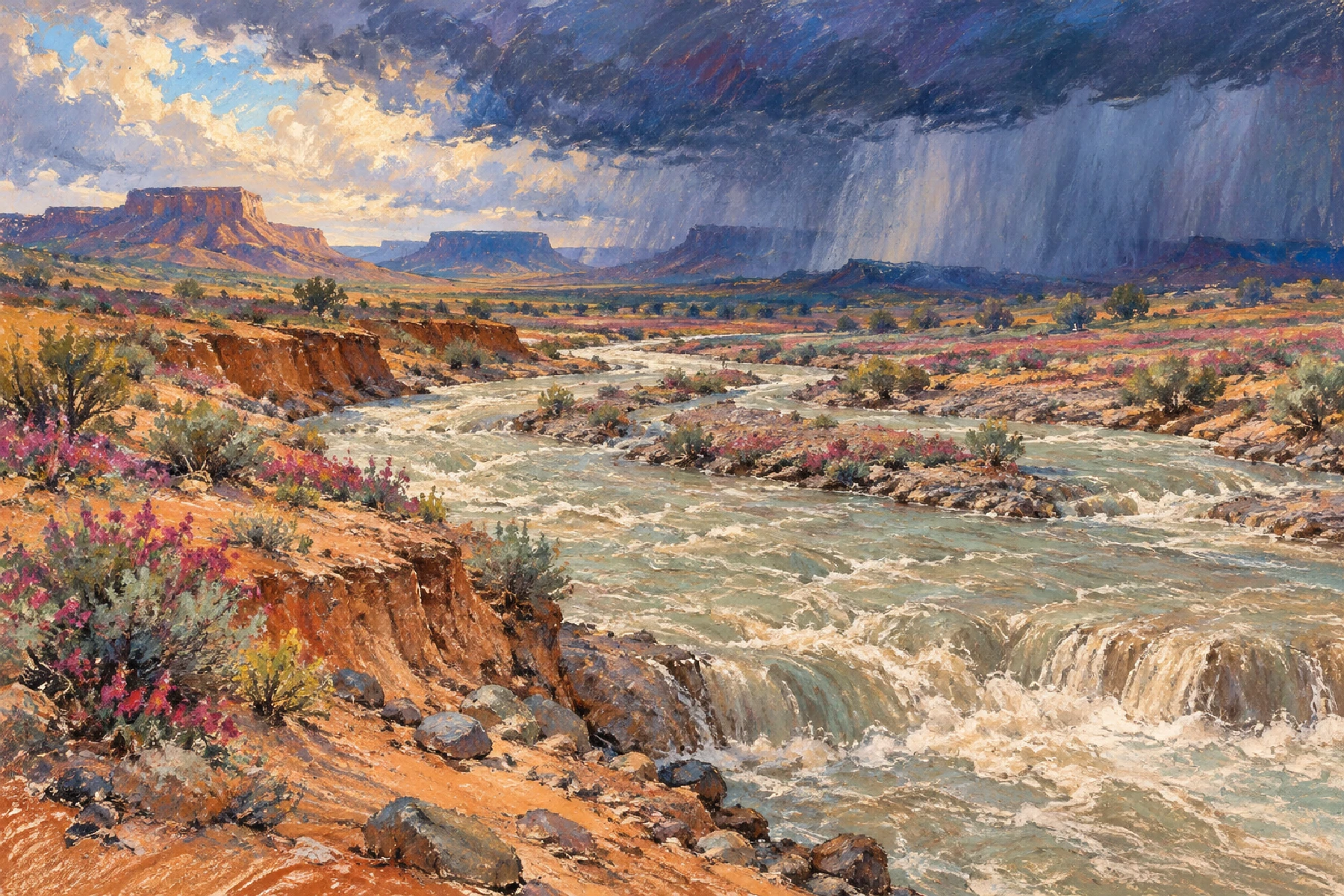
Flood Across the Flowering Desert
The first flood enters a dry channel through a flowering desert. Rubbed and scratched oil pastel entwines earth, water, and rainclouds in a dreamlike landscape.
Remix this referenceFlood Across the Flowering Desert
- Form language
- Simplify forms into interlocking, slightly swollen masses; let small details vary within a loose, dreamlike visual language.
- Contour
- Use broken, soft boundaries with occasional blunt pastel edges; let adjoining shapes merge briefly before separating.
- Mark-making
- Rub broad oil-pastel strokes sideways, then scratch irregular fine trails through them; retain lively skips and hand pressure.
- Surface rendering
- Build waxy, opaque deposits over rubbed translucent passages; scraped underlayers and uneven blending create tactile tonal shifts.
Priority
Make rubbed wax and scratched underlayers visibly define the oil-pastel treatment.
What to avoid & what to check
Exact prompt for this example
MODULE OWNERSHIP
subject: Subject count, type, stable proportions and landmarks, resting face geometry, hair shape, physical materials, garment construction and permanent marks. No emotion, movement, color assignment or rendering recipe.
expression: Facial soft-tissue displacement and pupil direction, muscle coordination, regional intensity, asymmetry and onset/peak/release. No head/body pose, stable appearance, skin color or rendering.
gesture: Head/neck/body/limb orientation, joint movement, support, contact and pose-caused occlusion using existing anatomy. No eye/pupil movement, emotion, identity, props inventory or camera.
props: Prop count, type, construction, physical material and scale relative to the subject. Holding/contact belongs to gesture, position to composition, color to palette.
scene: Environment elements, terrain, backdrop/floor presence and structural detail. No canvas positions, camera, lighting, assigned colors or render texture.
camera: Projection, focal-length impression, camera elevation/yaw/roll, viewing distance and crop. No actor pose, world placement, lighting or canvas aspect ratio.
composition: Normalized 0-100% canvas positions, scale in frame, depth/overlap, focal hierarchy and margins. No joint pose, camera projection, rendering, subject/prop inventory or emotion.
palette: Color anchors, hue/saturation/value ranges, colors assigned to parts and approximate color coverage. No illumination direction, shading algorithm, physical material or layout.
lighting: Light-source direction/softness/intensity, ambient illumination, physical shadow direction/length and highlight position. Absence of directional illumination is allowed. No shading technique, palette or material changes.
style: Reusable form abstraction, contour weight/taper/edge quality, medium and mark scale/density/direction, surface rendering and tonal transition technique. No fixed subject proportions, anatomy, identity, expression, pose, palette, light-source direction, camera or layout.
output: Image count, aspect ratio, size, file/alpha requirements and global lettering/logo/watermark restrictions. No background scenery, crop, style, identity or pose.

SUBJECT
inventory: The landscape is the primary subject; no figures, animals, or manufactured objects serve as primary subjects.
geometry: No separate subject geometry applies; terrain construction belongs to scene.
resting-face: No faces are present.
appearance: No separate character or product appearance applies.

PRIORITY


AVOID


CHECK


PROPS
inventory: No separate props.
construction: No prop construction applies.

PRIORITY


AVOID


CHECK


SCENE
inventory: A flowering desert basin contains a branching wash, eroded banks, low mesas, and an approaching rain curtain.
structure: A scalloped flood front enters the dry wash; shallow tributaries divide flowering gravel shelves beneath a storm sky with a broad cloud opening.

PRIORITY


AVOID


CHECK


CAMERA
projection: Use natural perspective with a moderately wide focal-length impression and gently expanding foreground depth.
viewpoint: Look diagonally across the wash from a low bank, slightly above the floodwater, with a level horizon.
crop: Frame a broad stretch of basin; nearby banks continue beyond the edges while the distant mesas remain visible.

PRIORITY


AVOID


CHECK


COMPOSITION
placement: The flood front anchors the lower right; its channel bends toward the upper left beneath a broad storm band.
depth: Flowering banks overlap the water at uneven intervals; distant mesas disappear partly behind the rain curtain.
spacing: Water leads attention and flower shelves follow; cluster flowers irregularly and keep an open interval between land and cloud.

PRIORITY


AVOID


CHECK


PALETTE
colors: Anchor the palette in dusty apricot, deep indigo, muted raspberry, and pale celadon, with restrained saturation.
assignment: Use apricot for earth, indigo for cloud and deeper water, raspberry for flowers, and celadon for shallow floodwater.
balance: Earth and storm hues dominate coverage; flower hues remain minor accents, and pale water contrasts with darker hues.

PRIORITY


AVOID


CHECK


LIGHTING
sources: Broad, soft light enters from the left; the rain curtain receives weaker ambient light.
shadows: Banks cast soft, short shadows toward the right; the storm casts a broad shadow over the distant basin.
highlights: Light catches the left-facing bank rims and scattered water crests without making every flower sparkle.

PRIORITY


AVOID


CHECK


STYLE GUIDE
form-language: Simplify forms into interlocking, slightly swollen masses; let small details vary within a loose, dreamlike visual language.
contour: Use broken, soft boundaries with occasional blunt pastel edges; let adjoining shapes merge briefly before separating.
mark-making: Rub broad oil-pastel strokes sideways, then scratch irregular fine trails through them; retain lively skips and hand pressure.
surface-rendering: Build waxy, opaque deposits over rubbed translucent passages; scraped underlayers and uneven blending create tactile tonal shifts.

PRIORITY
Make rubbed wax and scratched underlayers visibly define the oil-pastel treatment.

AVOID


CHECK


OUTPUT
format: Deliver one finished image, 3:2 aspect ratio, 1800 × 1200 pixels, opaque PNG.
restrictions: No lettering, logos, signatures, or watermarks.

PRIORITY


AVOID


CHECK


FINAL INTEGRATION
scene + composition + style: Environmental structure and overlap should stay legible through the medium's deliberate merging and abrasion.
palette + lighting + style: Let color relationships and broad illumination remain clear within the naturally variable pastel deposits.
Model information comes from image provenance. The same prompt may produce a different result.