Text to imageAnimationStyle guide
Giant Paper Boat in the Underpass
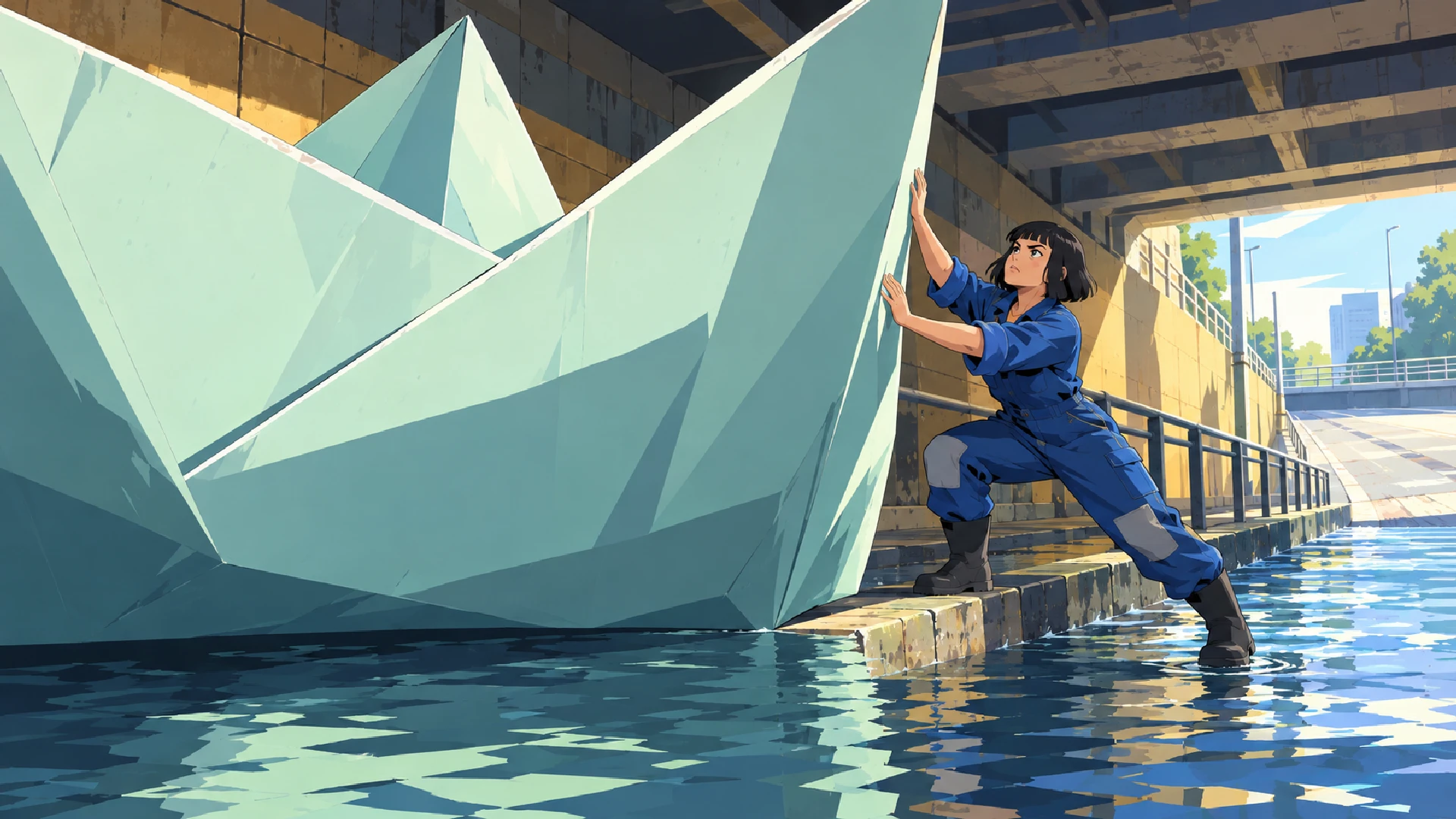
In a flooded underpass, a caretaker pushes open the folded sides of an enormous paper boat. Road railings and her small boots reveal its startling scale.
Remix this referenceGiant Paper Boat in the Underpass
- Form language
- Abstract surfaces into wedges, triangles and angular facets; simplify secondary shapes into broad, uneven polygons.
- Contour
- Use strong exterior line-weight contrast, tapered corners and short, sharp interior cuts; allow occasional purposeful breaks.
- Mark-making
- Use sparse, sharp strokes and small angular fragments for incidental detail; leave clean planes unmarked and vary marks naturally.
- Surface rendering
- Separate a small set of tones with hard graphic boundaries instead of gradients; use irregular planar breaks for surface variation.
Priority
Rendering medium: 2D angular Japanese anime graphic illustration; formal rendering reference: TRIGGER · 2010s · Promare (2019)
What to avoid & what to check
Exact prompt for this example
MODULE OWNERSHIP
subject: Subject count, type, stable proportions and landmarks, resting face geometry, hair shape, physical materials, garment construction and permanent marks. No emotion, movement, color assignment or rendering recipe.
expression: Facial soft-tissue displacement and pupil direction, muscle coordination, regional intensity, asymmetry and onset/peak/release. No head/body pose, stable appearance, skin color or rendering.
gesture: Head/neck/body/limb orientation, joint movement, support, contact and pose-caused occlusion using existing anatomy. No eye/pupil movement, emotion, identity, props inventory or camera.
props: Prop count, type, construction, physical material and scale relative to the subject. Holding/contact belongs to gesture, position to composition, color to palette.
scene: Environment elements, terrain, backdrop/floor presence and structural detail. No canvas positions, camera, lighting, assigned colors or render texture.
camera: Projection, focal-length impression, camera elevation/yaw/roll, viewing distance and crop. No actor pose, world placement, lighting or canvas aspect ratio.
composition: Normalized 0-100% canvas positions, scale in frame, depth/overlap, focal hierarchy and margins. No joint pose, camera projection, rendering, subject/prop inventory or emotion.
palette: Color anchors, hue/saturation/value ranges, colors assigned to parts and approximate color coverage. No illumination direction, shading algorithm, physical material or layout.
lighting: Light-source direction/softness/intensity, ambient illumination, physical shadow direction/length and highlight position. Absence of directional illumination is allowed. No shading technique, palette or material changes.
style: Reusable form abstraction, contour weight/taper/edge quality, medium and mark scale/density/direction, surface rendering and tonal transition technique. No fixed subject proportions, anatomy, identity, expression, pose, palette, light-source direction, camera or layout.
output: Image count, aspect ratio, size, file/alpha requirements and global lettering/logo/watermark restrictions. No background scenery, crop, style, identity or pose.

SUBJECT
inventory: One original adult human woman, a municipal caretaker.
geometry: A compact, sturdy build with broad palms, substantial forearms and a short, blunt bob.
resting-face: High cheekbones, a broad nose bridge, straight resting brows and a short, rounded jaw.
appearance: Canvas coveralls with side fastenings and knee patches; rubber ankle boots; no permanent markings.

PRIORITY


AVOID


CHECK


EXPRESSION — ACTOR A
brows: Inner brows begin drawing down and together.
lids: Upper lids narrow slightly while the lower lids brace.
cheeks: Cheeks tighten gently without lifting into a smile.
nose: Nostrils remain relaxed; the bridge stays unwrinkled.
mouth: Closed lips press together, slightly harder at one corner.
jaw: The jaw firms with no visible teeth or open-mouth strain.
gaze: Pupils turn upward toward the opening paper fold.
coordination: Brow compression leads; the quieter mouth keeps the effort controlled.
timing: Catch the onset: lips have sealed before the brows finish knitting.

PRIORITY


AVOID


CHECK


GESTURE
head: Turn the head toward the opening fold, chin lifted clear of the nearer shoulder.
torso: Lean into the task with a slight waist twist and shoulders spreading apart.
limbs: Push both arms apart; bend one knee over a raised step while the other leg provides support.
contact: Each palm presses a different folded side of the boat; both boots remain planted on solid footing.

PRIORITY


AVOID


CHECK


PROPS
inventory: One enormous paper boat, several times the caretaker's height.
construction: Folded heavy fiber paper forms a hollow hull, double sidewalls and tall triangular ends; no added fittings.

PRIORITY


AVOID


CHECK


SCENE
inventory: A shallowly flooded urban road underpass with a pedestrian ledge, guardrail and open exit.
structure: Concrete ceiling beams and ordinary road markings establish the familiar setting; water leaves the ledge exposed.

PRIORITY


AVOID


CHECK


CAMERA
projection: Wide-angle perspective with a roughly 28 mm impression and clear near-to-far expansion.
viewpoint: View from curb height at an oblique side angle, with a level horizon.
crop: A wide environmental view includes the caretaker's full body; the nearest boat tip extends beyond the frame.

PRIORITY


AVOID


CHECK


COMPOSITION
placement: The boat dominates the left two-thirds; the caretaker occupies the right third beneath its rising rim.
depth: A near paper wall overlaps the roadway; the caretaker separates from the distant upper-right exit and repeating rails.
spacing: The face and hands form the focal cluster; leave breathing room above them and a broad water interval below.

PRIORITY


AVOID


CHECK


PALETTE
colors: Use cobalt, pale mint, ochre and charcoal, with a small warm peach accent.
assignment: Mint paper, cobalt workwear and water, ochre concrete, charcoal hair and boots, peach skin.
balance: The pale boat occupies the largest color area; saturated cobalt punctuates a quieter ochre environment.

PRIORITY


AVOID


CHECK


LIGHTING
sources: Broad daylight enters from upper right through the open exit, with soft ambient fill beneath the ceiling.
shadows: The boat casts a broad shadow toward the lower left; shadows soften across the water.
highlights: Upper fold ridges and the exit-facing cheek catch light; water carries broken reflections beneath them.

PRIORITY


AVOID


CHECK


STYLE GUIDE
form-language: Abstract surfaces into wedges, triangles and angular facets; simplify secondary shapes into broad, uneven polygons.
contour: Use strong exterior line-weight contrast, tapered corners and short, sharp interior cuts; allow occasional purposeful breaks.
mark-making: Use sparse, sharp strokes and small angular fragments for incidental detail; leave clean planes unmarked and vary marks naturally.
surface-rendering: Separate a small set of tones with hard graphic boundaries instead of gradients; use irregular planar breaks for surface variation.

PRIORITY
Rendering medium: 2D angular Japanese anime graphic illustration; formal rendering reference: TRIGGER · 2010s · Promare (2019)

AVOID


CHECK


OUTPUT
format: One finished image, 16:9 landscape, 1920 × 1080 pixels, opaque PNG.
restrictions: No lettering, logos, signatures or watermarks.

PRIORITY


AVOID


CHECK


FINAL INTEGRATION
props + scene + composition: Familiar infrastructure makes the scale shift legible, while overlaps connect the oversized object to its setting.
expression + gesture: Facial tension and bodily effort describe the same beginning of sustained pressure.
Art direction
트리거 / TRIGGER · 2010s · 프로메어(2019) / Promare (2019) ↗- Abstract form surfaces into wedges, triangles and angular facets
- Strong exterior weight contrast with short sharp interior cuts
- Small angular facets and sharp marks, with no marks in clean planes
- A small set of sharply separated tonal planes in place of gradients
Model information comes from image provenance. The same prompt may produce a different result.