Text to imageCafe & brandStyle guide
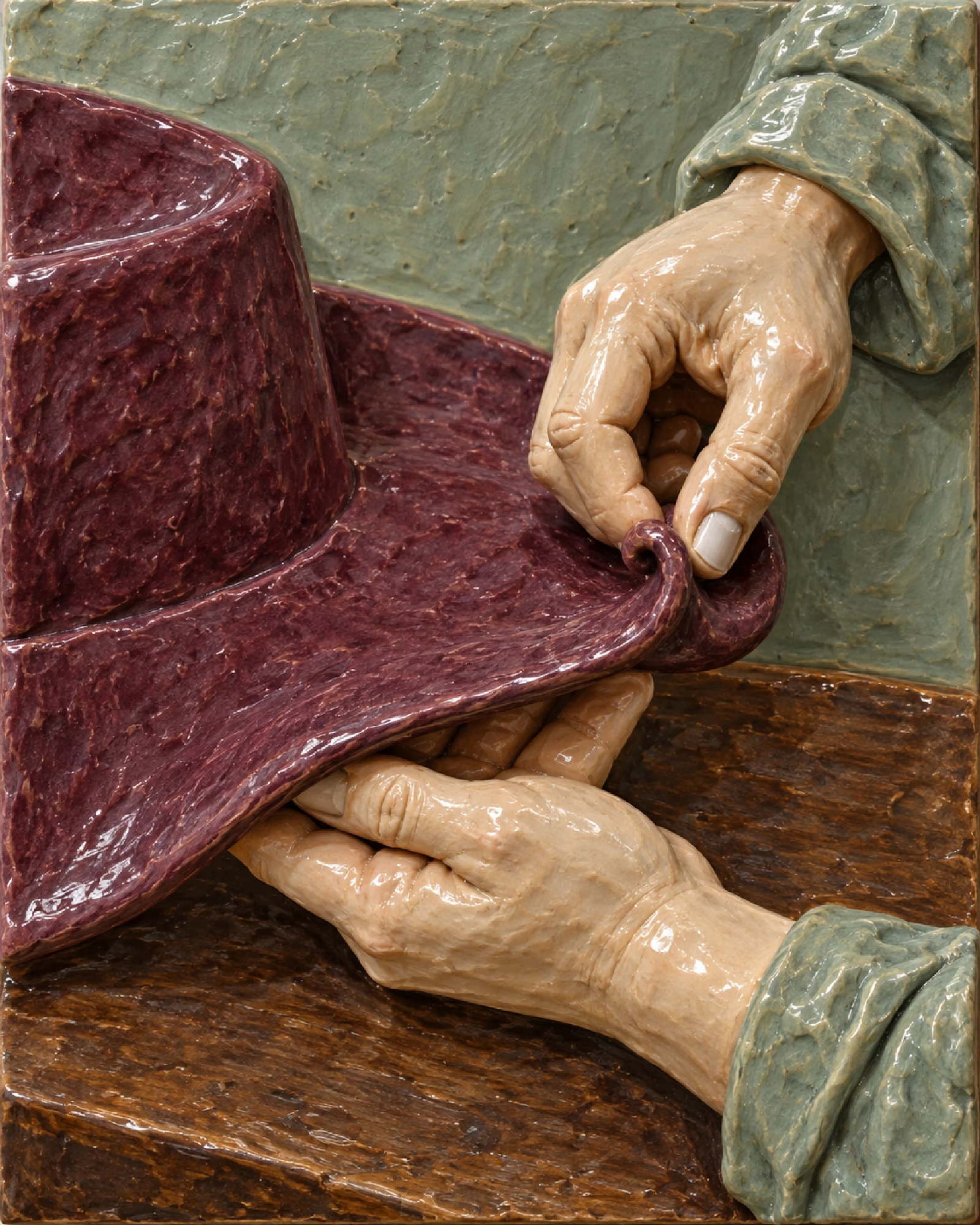
Hands Shaping a Hat Brim
An intimate millinery image catches fingertips rolling a felt hat brim. Pressed clay traces and pooled glaze turn the making process into a tactile ceramic relief.
Remix this referenceHands Shaping a Hat Brim
- Form language
- Translate forms into shallow modeled ceramic masses; simplify minor detail into broad convex and concave surfaces.
- Contour
- Use softly rounded raised edges and occasional pressed grooves, with edges defined by relief rather than drawn outlines.
- Mark-making
- Alternate broad thumb-smoothed passages with a few blunt tool impressions; retain natural hand-worked irregularities.
- Surface rendering
- Render glaze as pooled translucent depth in recesses and thinner satin passages over ridges, with gently uneven transitions.
Priority
Rounded modeled edges and pooled glaze must make the image read as hand-shaped ceramic relief.
What to avoid & what to check
Exact prompt for this example
MODULE OWNERSHIP
subject: Subject count, type, stable proportions and landmarks, resting face geometry, hair shape, physical materials, garment construction and permanent marks. No emotion, movement, color assignment or rendering recipe.
expression: Facial soft-tissue displacement and pupil direction, muscle coordination, regional intensity, asymmetry and onset/peak/release. No head/body pose, stable appearance, skin color or rendering.
gesture: Head/neck/body/limb orientation, joint movement, support, contact and pose-caused occlusion using existing anatomy. No eye/pupil movement, emotion, identity, props inventory or camera.
props: Prop count, type, construction, physical material and scale relative to the subject. Holding/contact belongs to gesture, position to composition, color to palette.
scene: Environment elements, terrain, backdrop/floor presence and structural detail. No canvas positions, camera, lighting, assigned colors or render texture.
camera: Projection, focal-length impression, camera elevation/yaw/roll, viewing distance and crop. No actor pose, world placement, lighting or canvas aspect ratio.
composition: Normalized 0-100% canvas positions, scale in frame, depth/overlap, focal hierarchy and margins. No joint pose, camera projection, rendering, subject/prop inventory or emotion.
palette: Color anchors, hue/saturation/value ranges, colors assigned to parts and approximate color coverage. No illumination direction, shading algorithm, physical material or layout.
lighting: Light-source direction/softness/intensity, ambient illumination, physical shadow direction/length and highlight position. Absence of directional illumination is allowed. No shading technique, palette or material changes.
style: Reusable form abstraction, contour weight/taper/edge quality, medium and mark scale/density/direction, surface rendering and tonal transition technique. No fixed subject proportions, anatomy, identity, expression, pose, palette, light-source direction, camera or layout.
output: Image count, aspect ratio, size, file/alpha requirements and global lettering/logo/watermark restrictions. No background scenery, crop, style, identity or pose.

SUBJECT
inventory: One adult milliner, A.
geometry: Broad palms, slender fingers and short rounded nails provide a recognizable hand structure.
resting-face: No resting facial geometry is prescribed for this hand detail.
appearance: Bare skin with subtle knuckle creases; plain woven work sleeves end in softly folded cuffs.

PRIORITY


AVOID


CHECK


EXPRESSION — ACTOR A
brows: No brow displacement is prescribed.
lids: No eyelid displacement is prescribed.
cheeks: No cheek displacement is prescribed.
nose: No nasal soft-tissue movement is prescribed.
mouth: No lip displacement is prescribed.
jaw: No jaw displacement is prescribed.
gaze: No pupil direction is prescribed.
coordination: No facial muscle coordination is prescribed.
timing: No facial onset, peak or release is prescribed.

PRIORITY


AVOID


CHECK


GESTURE
head: No head or neck orientation is prescribed.
torso: No torso pose is prescribed.
limbs: A's left hand cups upward beneath the brim while the right fingers curl toward its edge.
contact: The left palm supports the felt; the right thumb and index finger pinch a small roll into the brim.

PRIORITY


AVOID


CHECK


PROPS
inventory: One unfinished adult felt hat, large enough to span both hands.
construction: A seamless felt body has a low oval crown and a broad flexible brim, without a band or ornament.

PRIORITY


AVOID


CHECK


SCENE
inventory: A millinery work surface and an uninterrupted wall; no additional workshop equipment.
structure: The tabletop meets the wall at a simple junction, suggesting a quiet working alcove.

PRIORITY


AVOID


CHECK


CAMERA
projection: A mild telephoto impression keeps the intimate detail compact with little perspective distortion.
viewpoint: View from slightly above and obliquely across the work surface, with no camera roll.
crop: Exclude the head, neck and torso; crop both forearms and part of the crown, retaining fingertips and the rolled brim.

PRIORITY


AVOID


CHECK


COMPOSITION
placement: The brim sweeps diagonally across the frame; the pinched roll sits just right of center as the focal detail.
depth: The supporting hand lies behind the brim; the working fingers overlap its edge against the recessed backdrop.
spacing: The hat fills most of the image, balanced by a quiet upper-left opening and generous space around the pinch.

PRIORITY


AVOID


CHECK


PALETTE
colors: Mulberry, warm ivory, muted celadon and a restrained deep brown.
assignment: Mulberry colors the hat, ivory the hands, celadon the sleeves and wall, and brown the work surface.
balance: The rich hat color dominates, with pale hands and subdued surrounding colors providing breathing room.

PRIORITY


AVOID


CHECK


LIGHTING
sources: A broad soft source from the upper right, with gentle ambient fill.
shadows: Short shadows fall toward the lower left, deepening beneath the curled brim and touching fingers.
highlights: Small highlights gather on upper-right ridges and rounded fingertip surfaces.

PRIORITY


AVOID


CHECK


STYLE GUIDE
form-language: Translate forms into shallow modeled ceramic masses; simplify minor detail into broad convex and concave surfaces.
contour: Use softly rounded raised edges and occasional pressed grooves, with edges defined by relief rather than drawn outlines.
mark-making: Alternate broad thumb-smoothed passages with a few blunt tool impressions; retain natural hand-worked irregularities.
surface-rendering: Render glaze as pooled translucent depth in recesses and thinner satin passages over ridges, with gently uneven transitions.

PRIORITY
Rounded modeled edges and pooled glaze must make the image read as hand-shaped ceramic relief.

AVOID


CHECK


OUTPUT
format: One image, 4:5 portrait, 1600 × 2000 pixels, opaque PNG.
restrictions: No lettering, logos or watermarks.

PRIORITY


AVOID


CHECK


FINAL INTEGRATION
gesture + props + composition: Visible hand contact makes the craft understandable within the close arrangement.
style + lighting: Illumination reveals relief depth and glaze behavior without overwhelming the modeled edges.
Model information comes from image provenance. The same prompt may produce a different result.