Text to imageComicsStyle guide
A Giant Paper Crane from the Copier
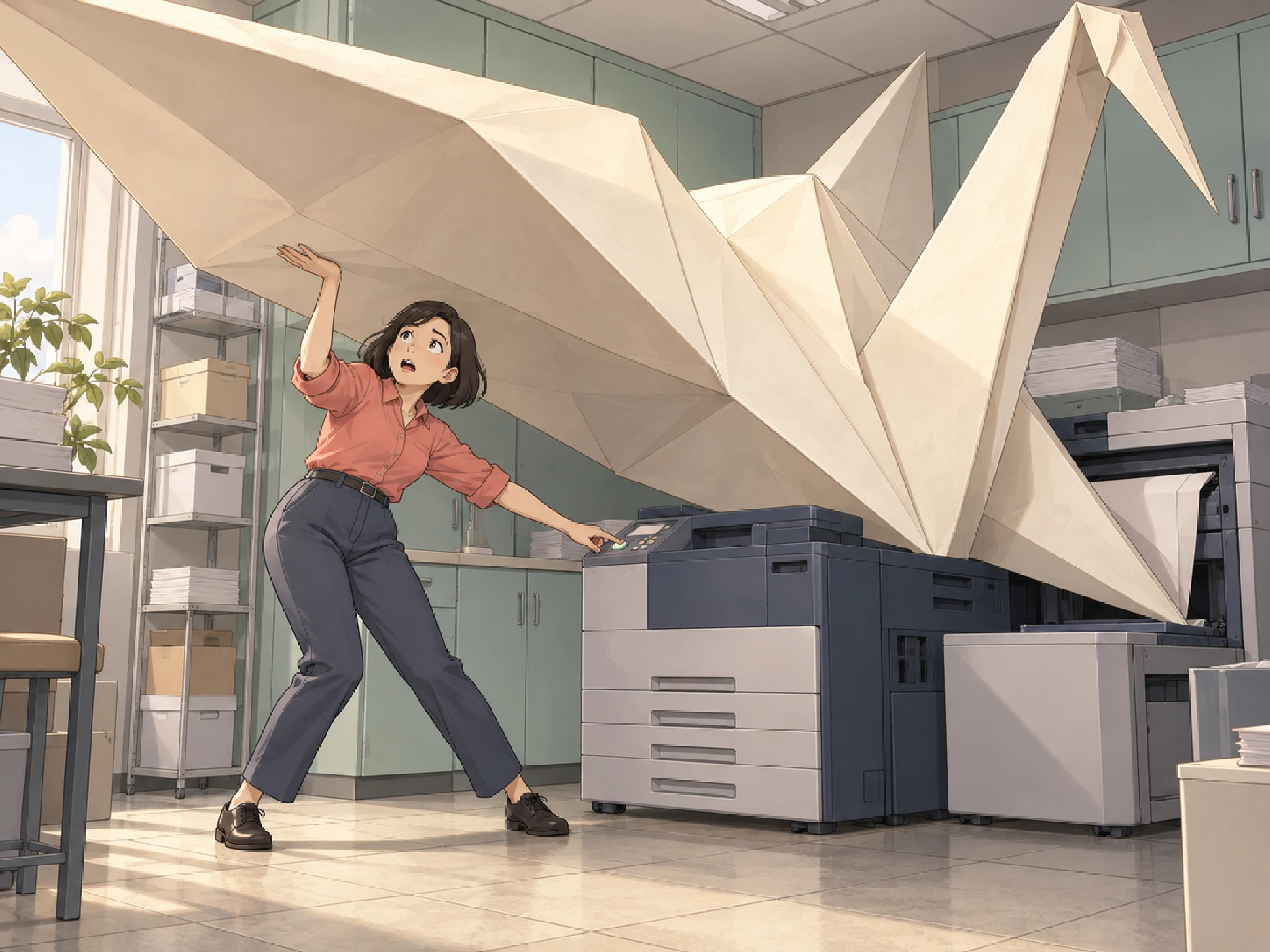
An office worker supports the wing of a room-sized paper crane while reaching for the copier’s stop button. Supple webtoon lines and softly continuous color turn an absurd interruption into one expressive comic illustration.
Remix this referenceA Giant Paper Crane from the Copier
- Form language
- Simplify forms into supple curves and decisive folded planes; let incidental shapes vary within the same economical drawing language.
- Contour
- Use fine tinted contours with slight pressure changes, tapered endings and occasional openings where adjacent tones carry the edge.
- Mark-making
- Keep interior strokes sparse and fluid, using brief curved accents and a few loose corrective lines instead of dense hatching.
- Surface rendering
- Blend continuous color through broad soft transitions, retaining firmer fold boundaries and slight brush variation within open tonal passages.
Priority
Rendering medium: Soft continuous-color digital webtoon comic illustration.
What to avoid & what to check
Exact prompt for this example
MODULE OWNERSHIP
subject: Subject count, type, stable proportions and landmarks, resting face geometry, hair shape, physical materials, garment construction and permanent marks. No emotion, movement, color assignment or rendering recipe.
expression: Facial soft-tissue displacement and pupil direction, muscle coordination, regional intensity, asymmetry and onset/peak/release. No head/body pose, stable appearance, skin color or rendering.
gesture: Head/neck/body/limb orientation, joint movement, support, contact and pose-caused occlusion using existing anatomy. No eye/pupil movement, emotion, identity, props inventory or camera.
props: Prop count, type, construction, physical material and scale relative to the subject. Holding/contact belongs to gesture, position to composition, color to palette.
scene: Environment elements, terrain, backdrop/floor presence and structural detail. No canvas positions, camera, lighting, assigned colors or render texture.
camera: Projection, focal-length impression, camera elevation/yaw/roll, viewing distance and crop. No actor pose, world placement, lighting or canvas aspect ratio.
composition: Normalized 0-100% canvas positions, scale in frame, depth/overlap, focal hierarchy and margins. No joint pose, camera projection, rendering, subject/prop inventory or emotion.
palette: Color anchors, hue/saturation/value ranges, colors assigned to parts and approximate color coverage. No illumination direction, shading algorithm, physical material or layout.
lighting: Light-source direction/softness/intensity, ambient illumination, physical shadow direction/length and highlight position. Absence of directional illumination is allowed. No shading technique, palette or material changes.
style: Reusable form abstraction, contour weight/taper/edge quality, medium and mark scale/density/direction, surface rendering and tonal transition technique. No fixed subject proportions, anatomy, identity, expression, pose, palette, light-source direction, camera or layout.
output: Image count, aspect ratio, size, file/alpha requirements and global lettering/logo/watermark restrictions. No background scenery, crop, style, identity or pose.

SUBJECT
inventory: One adult office worker, actor A.
geometry: An ordinary adult build with broad shoulders, a long oval face and a rounded chin.
resting-face: Straight brows, shallow upper-lid folds, a broad nose tip and a wide mouth define the resting face.
appearance: A blunt chin-length bob, a woven shirt with rolled cuffs, straight trousers and plain lace-up shoes.

PRIORITY


AVOID


CHECK


EXPRESSION — ACTOR A
brows: Both brows rise, with the left brow slightly higher.
lids: Upper lids lift clearly; lower lids retain a little tension.
cheeks: Cheeks remain mostly relaxed, with a slight lift beside the mouth.
nose: Nostrils stay relaxed without a nose wrinkle.
mouth: Lips part into a small uneven opening, one corner pulled sideways.
jaw: The jaw drops only a little, keeping the reaction momentarily restrained.
gaze: Pupils turn upward toward the enormous paper wing.
coordination: The widened upper face leads; the mouth registers a slower, crooked response.
timing: Hold the apex just after the unexpected size becomes apparent.

PRIORITY


AVOID


CHECK


GESTURE
head: A draws her neck back and tips her head away from the low paper wing.
torso: Her torso bends sideways beneath the wing, with weight supported by staggered feet.
limbs: Her left arm reaches upward with an open palm; her right arm extends toward the copier controls.
contact: Her left palm supports a wing fold while her right index finger depresses a broad control button.

PRIORITY


AVOID


CHECK


PROPS
inventory: One origami paper crane, with a wingspan several times the worker’s height.
construction: A single folded paper sheet forms a hollow angular body, broad wings, a pointed tail and a long folded neck.

PRIORITY


AVOID


CHECK


SCENE
inventory: A compact office copy room with a floor-standing copier, storage cupboards and a tiled floor.
structure: A low suspended ceiling and shallow cupboards make the room familiar; the copier has an open output slot.

PRIORITY


AVOID


CHECK


CAMERA
projection: Moderate wide-angle perspective with readable depth and restrained edge distortion.
viewpoint: View from just below standing eye level, obliquely across the room, with no camera roll.
crop: Show the worker from head to shoes and the full copier; let the crane extend beyond the frame.

PRIORITY


AVOID


CHECK


COMPOSITION
placement: A occupies the left third, the copier the lower right, and the crane sweeps across the upper field.
depth: The crane’s narrow tail disappears into the output slot; its near wing overlaps cupboards and part of A’s shoulder.
spacing: Read A’s face and supporting hand first, then the enormous crane; preserve a clear pocket around her face.

PRIORITY


AVOID


CHECK


PALETTE
colors: Warm ivory, muted mint, dusty coral and deep blue-gray form a restrained, moderately saturated palette.
assignment: Use ivory for the crane, mint for cupboards, coral for the shirt, blue-gray for copier and trousers, and warm tan skin.
balance: Pale room tones dominate; the coral shirt provides the main saturated accent and darks remain selective.

PRIORITY


AVOID


CHECK


LIGHTING
sources: Broad soft daylight enters from the left, supplemented by gentle room ambience.
shadows: The wing casts a broad soft shadow across the copier; floor shadows extend a short distance rightward.
highlights: Broad highlights follow the left-facing paper planes and the worker’s left cheek.

PRIORITY


AVOID


CHECK


STYLE GUIDE
form-language: Simplify forms into supple curves and decisive folded planes; let incidental shapes vary within the same economical drawing language.
contour: Use fine tinted contours with slight pressure changes, tapered endings and occasional openings where adjacent tones carry the edge.
mark-making: Keep interior strokes sparse and fluid, using brief curved accents and a few loose corrective lines instead of dense hatching.
surface-rendering: Blend continuous color through broad soft transitions, retaining firmer fold boundaries and slight brush variation within open tonal passages.

PRIORITY
Rendering medium: Soft continuous-color digital webtoon comic illustration.

AVOID


CHECK


OUTPUT
format: One finished image, landscape 4:3, 2048 × 1536 pixels, opaque PNG.
restrictions: No dialogue, lettering, logos or watermarks.

PRIORITY


AVOID


CHECK


FINAL INTEGRATION
gesture + props + composition: Keep the support contact legible so the scale surprise and interrupted task read together.
Model information comes from image provenance. The same prompt may produce a different result.