Text to imageLandscapeStyle guide
Low-Tide Estuary · Branching-Channel Lead
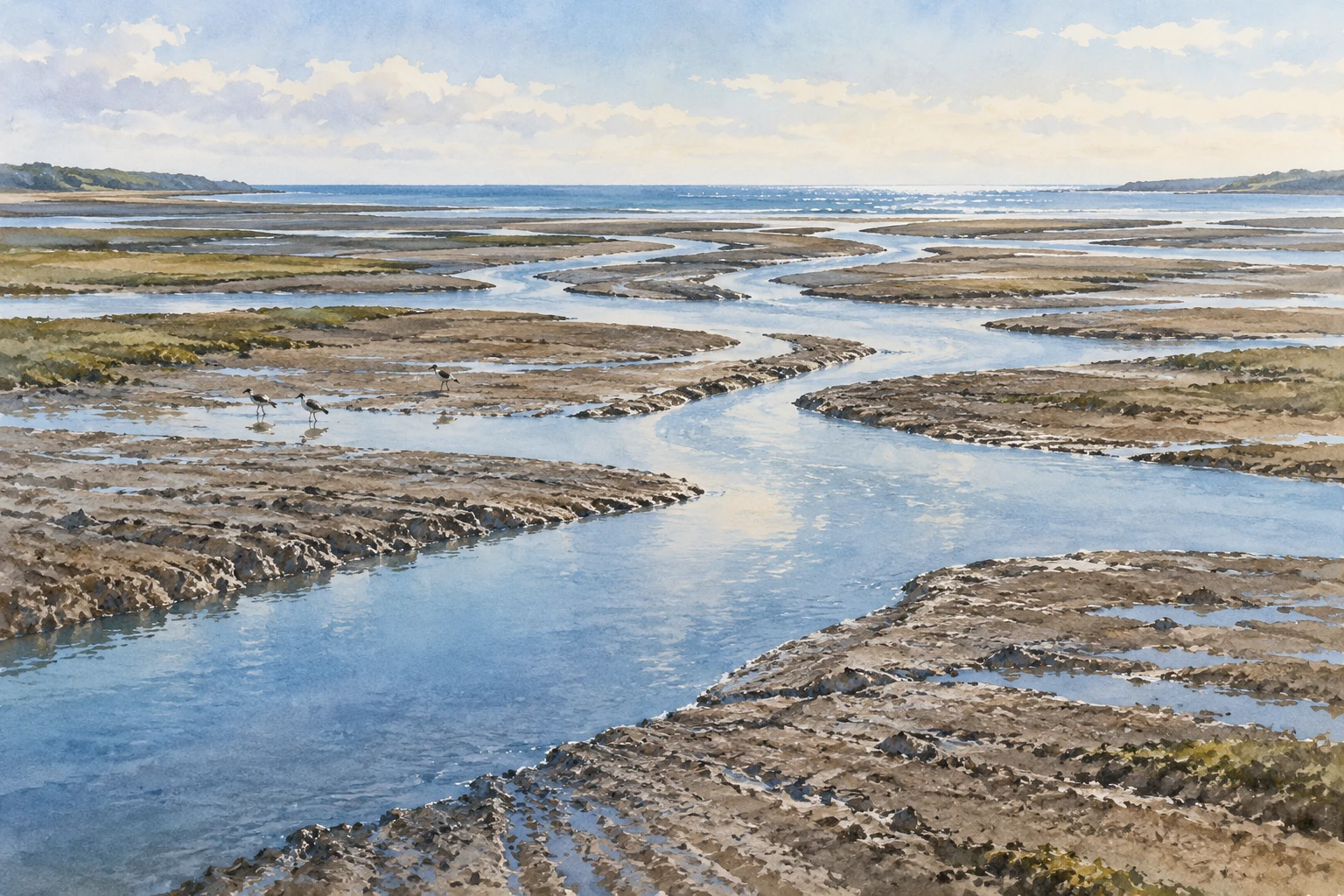
Branching water channels guide the eye and establish scale across a broad landscape.
Remix this referenceLow-Tide Estuary · Branching-Channel Lead
- Shape & line
- Branch a broad near channel into progressively narrower distant channels with irregular bank ridges.
- Color & light
- Use restrained natural watercolor colors with clear value separation between water and exposed mud.
- Texture & material
- Keep nearest dry-brush bank edges crisp and distant wet edges soft, alternating open washes with sediment texture.
- Composition
- Lead the eye through narrowing channels toward the sea, keeping birds small and the channel network dominant.
Priority
Preserve the distinctive construction and medium first, readable spatial hierarchy second, subtle surface details third.
What to avoid & what to check
Avoid extra subjects, inconsistent repeated geometry, hidden key details, crowded overlaps, unwanted text and watermarks.
Check each style rule against the finished image: visible shape construction, color and light, material treatment, and composition. Preserve the exact subject count and scene requirements.
Exact prompt for this example
SUBJECT
Depict an original low-tide estuary from a modest elevated viewpoint. A wide foreground channel splits into several progressively narrower branches that lead the eye toward a distant strip of sea. Exposed mudbanks carry small, irregular ridges whose spacing tightens with distance; a few shorebirds near the middle ground establish scale without becoming the subject. Let the banks alternate between open shapes and fine sediment texture, and keep the horizon low enough to emphasize the channel network. Render as a restrained watercolor landscape with crisp dry-brush edges on the nearest banks and softer wet edges farther away. No buildings, lettering, logos, or watermarks.

COMPOSITION
Elevated low-tide estuary view with wide foreground channel branching toward distant sea, irregular mudbank ridges and a few small middle-ground shorebirds. No buildings.

STYLE GUIDE
1. Shape & line
Branch a broad near channel into progressively narrower distant channels with irregular bank ridges.

2. Color & light
Use restrained natural watercolor colors with clear value separation between water and exposed mud.

3. Texture & material
Keep nearest dry-brush bank edges crisp and distant wet edges soft, alternating open washes with sediment texture.

4. Composition
Lead the eye through narrowing channels toward the sea, keeping birds small and the channel network dominant.

PRIORITY
Preserve the requested identity, count, action, composition and output settings. Apply the style rules within those constraints; a style reference must not replace the subject or layout. Within the style: Preserve the distinctive construction and medium first, readable spatial hierarchy second, subtle surface details third.

AVOID
Avoid extra subjects, inconsistent repeated geometry, hidden key details, crowded overlaps, unwanted text and watermarks.

OUTPUT
One finished landscape image, aspect ratio 3:2. No lettering, captions, dimensions, unrelated logos, watermark, border or interface.

SELF-CHECK
Check each style rule against the finished image: visible shape construction, color and light, material treatment, and composition. Preserve the exact subject count and scene requirements.
Model information comes from image provenance. The same prompt may produce a different result.