Text to imageIllustrationStyle guide
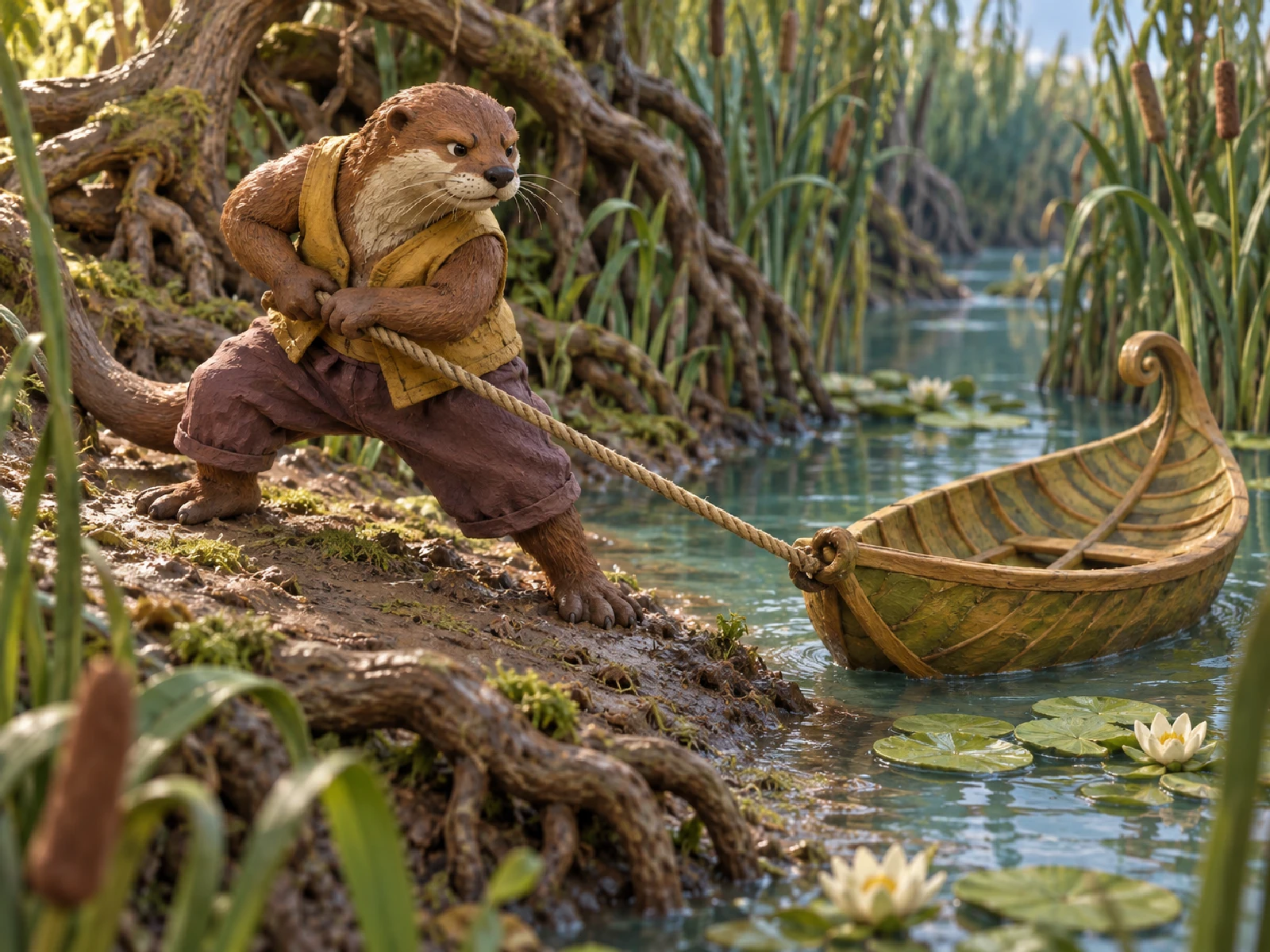
Otter Hauling a Leaf Skiff
An otter ferryman hauls a leaf-shaped skiff through a waterway enclosed by reeds and roots. Pressed clay marks and rounded handmade edges give the forceful pulling gesture warmth and tactile presence.
Remix this referenceOtter Hauling a Leaf Skiff
- Form language
- Translate forms into hand-built clay masses with pinched extensions and gently uneven planes; retain useful irregularity within a coherent sculptural language.
- Contour
- Use rounded sculptural edges rather than drawn outlines; small pinching variations keep silhouettes handmade without making them ragged.
- Mark-making
- Broad thumb presses and occasional short tool incisions articulate clay surfaces; their spacing and direction vary naturally with each worked area.
- Surface rendering
- Render a tactile matte clay miniature with softly rolled tonal transitions, shallow tool relief and slight rubbed sheen on selected raised edges.
Priority
Make hand-shaped clay visible at both silhouette and surface.
What to avoid & what to check
Avoid polished plastic smoothness or uniform stamped texture.
The setting and character share a convincing handmade sculptural treatment.
Exact prompt for this example
MODULE OWNERSHIP
subject: Subject count, type, stable proportions and landmarks, resting face geometry, hair shape, physical materials, garment construction and permanent marks. No emotion, movement, color assignment or rendering recipe.
expression: Facial soft-tissue displacement and pupil direction, muscle coordination, regional intensity, asymmetry and onset/peak/release. No head/body pose, stable appearance, skin color or rendering.
gesture: Head/neck/body/limb orientation, joint movement, support, contact and pose-caused occlusion using existing anatomy. No eye/pupil movement, emotion, identity, props inventory or camera.
props: Prop count, type, construction, physical material and scale relative to the subject. Holding/contact belongs to gesture, position to composition, color to palette.
scene: Environment elements, terrain, backdrop/floor presence and structural detail. No canvas positions, camera, lighting, assigned colors or render texture.
camera: Projection, focal-length impression, camera elevation/yaw/roll, viewing distance and crop. No actor pose, world placement, lighting or canvas aspect ratio.
composition: Normalized 0-100% canvas positions, scale in frame, depth/overlap, focal hierarchy and margins. No joint pose, camera projection, rendering, subject/prop inventory or emotion.
palette: Color anchors, hue/saturation/value ranges, colors assigned to parts and approximate color coverage. No illumination direction, shading algorithm, physical material or layout.
lighting: Light-source direction/softness/intensity, ambient illumination, physical shadow direction/length and highlight position. Absence of directional illumination is allowed. No shading technique, palette or material changes.
style: Reusable form abstraction, contour weight/taper/edge quality, medium and mark scale/density/direction, surface rendering and tonal transition technique. No fixed subject proportions, anatomy, identity, expression, pose, palette, light-source direction, camera or layout.
output: Image count, aspect ratio, size, file/alpha requirements and global lettering/logo/watermark restrictions. No background scenery, crop, style, identity or pose.

SUBJECT
inventory: One original anthropomorphic adult river otter, actor A; no other characters.
geometry: A long-bodied otter with a broad muzzle, small round ears, sturdy short limbs and a thick tapering tail.
resting-face: Oval eyes sit above rounded cheek pads; a small wedge nose and short mouth line define the muzzle at rest.
appearance: Short dense fur, a sleeveless canvas vest and loose cropped trousers; no badges or permanent markings.

PRIORITY
Keep the otter identity clear through muzzle, ears and tail.

AVOID
Avoid turning the ferryman into a generic bear-shaped mascot.

CHECK
The character remains recognizably an otter beneath its work clothes.

EXPRESSION — ACTOR A
brows: The brow area draws slightly inward above the nose.
lids: Upper lids narrow modestly; lower lids remain firm rather than squeezed shut.
cheeks: Cheek pads compress subtly beside the mouth.
nose: The nose stays unwrinkled with no conspicuous nostril flare.
mouth: Closed lips press together, with one corner slightly tighter.
jaw: The jaw holds closed without an exaggerated clench.
gaze: Pupils glance toward the rope beside the hands.
coordination: Focused lids and restrained lip pressure carry the effort without a grimace.
timing: Capture sustained effort at its peak, before the facial tension releases.

PRIORITY
Make concentration readable through coordinated small displacements.

AVOID
Avoid rage-like teeth exposure or extreme squinting.

CHECK
The face conveys steady effort with restrained asymmetry.

GESTURE
head: The head follows the direction of travel with the chin slightly lowered and the neck continuous with the forward lean.
torso: The torso leans into the haul while the shoulders draw back against the rope's resistance.
limbs: A leading foot plants firmly, the rear heel lifts, and bent arms draw both hands toward the near hip.
contact: Both hands grip the taut rope; the planted foot presses into the bank, and overlapping hands may hide small finger details.

PRIORITY
Make the whole body participate in the pull.

AVOID
Avoid a floating stance or slack hand contact.

CHECK
Support and rope contact make the hauling action immediately legible.

PROPS
inventory: One leaf-shaped skiff and one hauling rope; the skiff is long enough to carry the otter.
construction: The wooden skiff has a hollow hull, raised leaf-vein ribs and a curled prow; the braided fiber rope attaches to a bow loop.

PRIORITY
Combine a usable boat shape with a clear leaf silhouette.

AVOID
Avoid extra cargo or nautical accessories.

CHECK
The skiff reads as a small working vessel rather than a loose leaf.

SCENE
inventory: A narrow marsh waterway with a muddy towpath, reed thickets, exposed willow roots and a few water lilies.
structure: The towpath follows an irregular bank beneath arching roots; reed channels continue deeper into the marsh.

PRIORITY
Make the waterway feel inhabited and enclosed by growing forms.

AVOID
Avoid a bare display platform beneath the miniature.

CHECK
Bank, roots and reed channels form one continuous marsh setting.

CAMERA
projection: Natural perspective with a normal-lens miniature-photography impression and moderate depth of field.
viewpoint: Look from slightly above the otter's waist, obliquely across the bank, with no camera roll.
crop: Include the full otter and skiff in an environmental view; crop some nearby roots and reeds at the edges.

PRIORITY
Keep both the pulling action and miniature depth readable.

AVOID
Avoid extreme macro blur across the hands or rope.

CHECK
The view reveals enough contact detail to understand the action.

COMPOSITION
placement: Place the otter left of center and the skiff in the lower right; the rope forms the connecting diagonal.
depth: Foreground roots and reeds frame the near layer; the otter leads the hierarchy, followed by the skiff and receding channel.
spacing: Keep an open pocket around the face and hands while allowing dense overlaps around the outer edges.

PRIORITY
Let the hauling connection organize the layered setting.

AVOID
Avoid foliage tangencies that break the rope's visual continuity.

CHECK
The eye finds the otter, follows the rope and reaches the skiff.

PALETTE
colors: Chestnut brown, mustard ochre, moss green and muted turquoise, supported by deep plum accents.
assignment: Use chestnut for fur and roots, mustard for the vest and skiff, moss for plants, turquoise for water and plum for trousers.
balance: Green and turquoise occupy broad areas; warm browns and ochres occupy smaller areas, with plum as a limited accent.

PRIORITY


AVOID
Avoid equally saturated colors on every miniature element.

CHECK


LIGHTING
sources: A large soft source enters from the upper left, with gentle ambient fill reaching into the root canopy.
shadows: Soft shadows fall rightward; compact contact shadows ground the feet, roots and skiff at the water.
highlights: Broad highlights rest on upper shoulders, rounded root crests and the skiff rim; water catches a few low glints.

PRIORITY
Reveal relief without flattening the layered enclosure.

AVOID
Avoid hard studio glare on every surface.

CHECK
Soft illumination still gives clear contact and volume.

STYLE GUIDE
form-language: Translate forms into hand-built clay masses with pinched extensions and gently uneven planes; retain useful irregularity within a coherent sculptural language.
contour: Use rounded sculptural edges rather than drawn outlines; small pinching variations keep silhouettes handmade without making them ragged.
mark-making: Broad thumb presses and occasional short tool incisions articulate clay surfaces; their spacing and direction vary naturally with each worked area.
surface-rendering: Render a tactile matte clay miniature with softly rolled tonal transitions, shallow tool relief and slight rubbed sheen on selected raised edges.

PRIORITY
Make hand-shaped clay visible at both silhouette and surface.

AVOID
Avoid polished plastic smoothness or uniform stamped texture.

CHECK
The setting and character share a convincing handmade sculptural treatment.

OUTPUT
format: One finished image, 4:3 aspect ratio, 1600 × 1200 pixels, opaque PNG.
restrictions: No lettering, logos, watermarks or presentation borders.

PRIORITY
Deliver one complete illustrative scene.

AVOID
Avoid turnaround sheets or construction annotations.

CHECK
The single export meets the requested dimensions and contains no added graphics.

FINAL INTEGRATION
expression + gesture + props: Facial effort, body support and functional prop construction cooperate to make the action convincing.
scene + composition + lighting + style: Environmental layers stay readable as illumination reveals the handmade relief without overwhelming the focal hierarchy.
palette + composition: Warm browns and ochres reinforce the otter and skiff's focal roles; the color relationships support the hierarchy without fragmenting the setting.
Model information comes from image provenance. The same prompt may produce a different result.