Text to imageArt stylesStyle guide
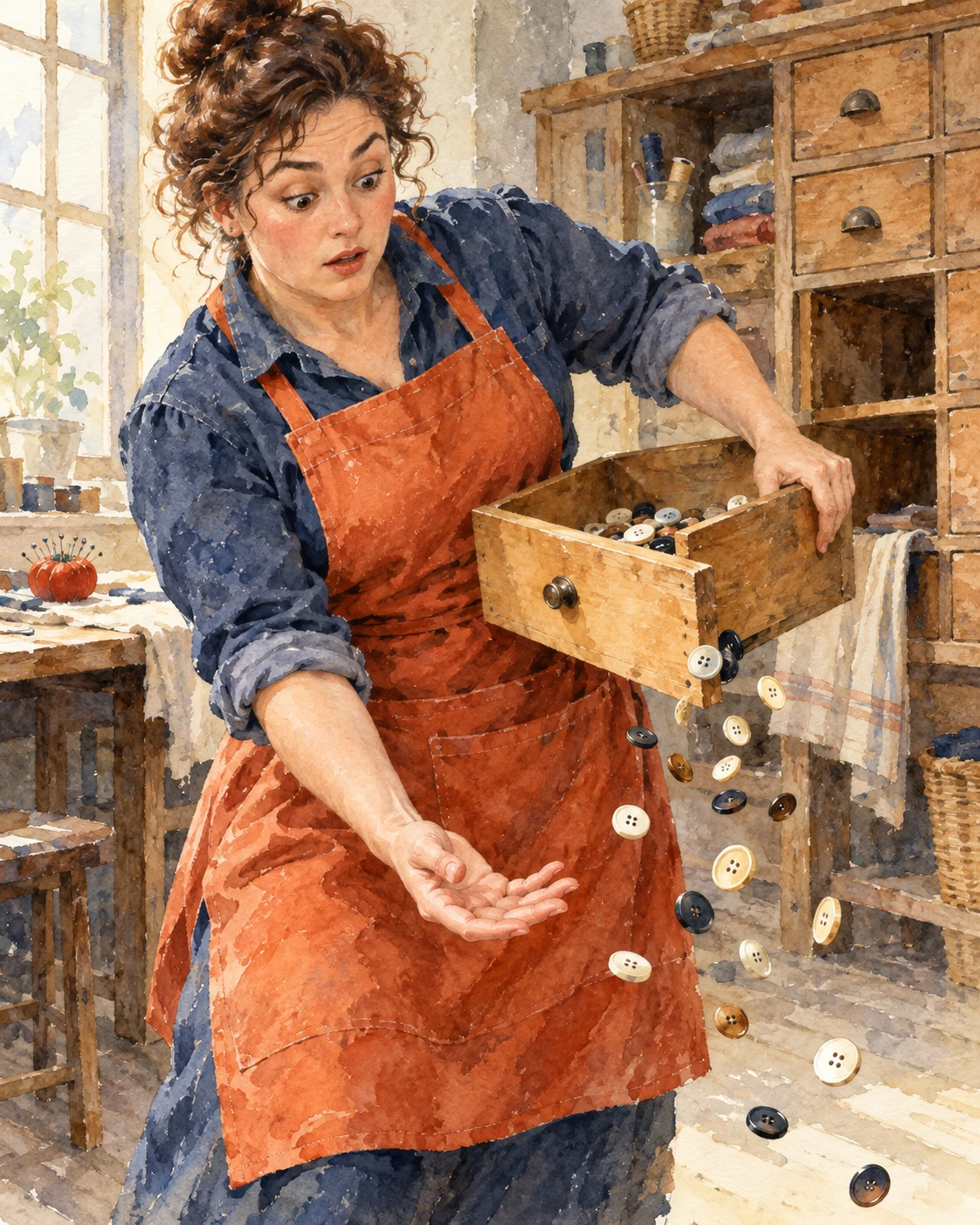
Woman Catching Spilled Buttons
A woman reaches beneath buttons spilling from a tilted drawer. Overlapping forms, watercolor blooms and broken edges bring a small workshop mishap to life.
Remix this referenceWoman Catching Spilled Buttons
- Form language
- Simplify forms into broad, interlocking wash masses, reserving small descriptive shapes for essential recognizability.
- Contour
- Use broken painted edges that alternate between crisp touches, dry skips and soft losses; avoid a continuous enclosing outline.
- Mark-making
- Lay generous wet strokes beside quick dry-brush flicks, allowing irregular blooms and occasional pooled pigment to remain visible.
- Surface rendering
- Build translucent layers with soft backruns and selective opaque accents; let paper show through and local handling vary naturally.
Priority
Expressive watercolor blooms and broken edges define the rendering.
What to avoid & what to check
Exact prompt for this example
MODULE OWNERSHIP
subject: Subject count, type, stable proportions and landmarks, resting face geometry, hair shape, physical materials, garment construction and permanent marks. No emotion, movement, color assignment or rendering recipe.
expression: Facial soft-tissue displacement and pupil direction, muscle coordination, regional intensity, asymmetry and onset/peak/release. No head/body pose, stable appearance, skin color or rendering.
gesture: Head/neck/body/limb orientation, joint movement, support, contact and pose-caused occlusion using existing anatomy. No eye/pupil movement, emotion, identity, props inventory or camera.
props: Prop count, type, construction, physical material and scale relative to the subject. Holding/contact belongs to gesture, position to composition, color to palette.
scene: Environment elements, terrain, backdrop/floor presence and structural detail. No canvas positions, camera, lighting, assigned colors or render texture.
camera: Projection, focal-length impression, camera elevation/yaw/roll, viewing distance and crop. No actor pose, world placement, lighting or canvas aspect ratio.
composition: Normalized 0-100% canvas positions, scale in frame, depth/overlap, focal hierarchy and margins. No joint pose, camera projection, rendering, subject/prop inventory or emotion.
palette: Color anchors, hue/saturation/value ranges, colors assigned to parts and approximate color coverage. No illumination direction, shading algorithm, physical material or layout.
lighting: Light-source direction/softness/intensity, ambient illumination, physical shadow direction/length and highlight position. Absence of directional illumination is allowed. No shading technique, palette or material changes.
style: Reusable form abstraction, contour weight/taper/edge quality, medium and mark scale/density/direction, surface rendering and tonal transition technique. No fixed subject proportions, anatomy, identity, expression, pose, palette, light-source direction, camera or layout.
output: Image count, aspect ratio, size, file/alpha requirements and global lettering/logo/watermark restrictions. No background scenery, crop, style, identity or pose.

SUBJECT
inventory: One adult woman, actor A, wearing a work shirt and a pocketed apron.
geometry: An ordinary adult build with broad shoulders, a sturdy waist and substantial hands.
resting-face: Broad cheeks, oval eyes, a short straight nose and level resting lips establish her face.
appearance: Curly hair forms a loose bun; the cotton shirt has rolled cuffs, and the canvas apron has one broad pocket.

PRIORITY


AVOID


CHECK


EXPRESSION — ACTOR A
brows: Both brows lift, with her left brow rising slightly sooner.
lids: Upper lids open abruptly; lower lids retain a little tension.
cheeks: Cheeks stay mostly relaxed, without a smile lift.
nose: Nostrils widen subtly without wrinkling the nose.
mouth: Lips part into a small uneven opening, with corners held loose.
jaw: The jaw releases just enough to separate the lips.
gaze: Both pupils track the nearest falling button below her face.
coordination: The eyes react more strongly than the mouth, keeping surprise brief and practical.
timing: Catch the onset: brows and lids have reacted before the mouth fully opens.

PRIORITY


AVOID


CHECK


GESTURE
head: Her neck inclines and her chin dips toward the spill.
torso: Her torso twists sideways over a planted stance, interrupting an ordinary step.
limbs: One elbow tucks inward to steady the drawer; the opposite arm sweeps down with an open, cupped palm.
contact: One hand grips the drawer rim against her hip; the free palm reaches beneath buttons still in the air.

PRIORITY


AVOID


CHECK


PROPS
inventory: One shallow drawer and a loose handful of fingertip-sized coat buttons.
construction: The drawer is plain wood with a small pull; buttons mix shell and resin with simple pierced centers.

PRIORITY


AVOID


CHECK


SCENE
inventory: A small sewing workroom contains a storage cabinet, a broad worktable and a bare floor.
structure: An empty drawer slot interrupts the cabinet; the worktable has a thick top and an open space beneath.

PRIORITY


AVOID


CHECK


CAMERA
projection: Natural perspective with a moderately wide lens impression.
viewpoint: View from standing eye level at a three-quarter angle, close enough to read her face.
crop: Frame her from above the bun to mid-thigh, including the whole drawer and reaching hand.

PRIORITY


AVOID


CHECK


COMPOSITION
placement: Her face occupies the upper-left third; the drawer crosses the middle and the buttons descend toward the lower right.
depth: The drawer overlaps her apron; scattered buttons bridge the foreground and the quieter cabinet behind.
spacing: Lead from face to drawer to open palm; leave breathing room around the falling buttons and a margin below the hand.

PRIORITY


AVOID


CHECK


PALETTE
colors: Persimmon, muted indigo, warm ochre and paper ivory, with restrained natural skin tones.
assignment: Give the apron persimmon, the shirt indigo, the wood ochre and most buttons ivory.
balance: Warm pale areas dominate; indigo supplies the deepest values and the apron provides the strongest saturation.

PRIORITY


AVOID


CHECK


LIGHTING
sources: Broad soft daylight enters from high left, with gentle ambient fill throughout the room.
shadows: Soft shadows fall down and right, gathering beneath the drawer and her forearm.
highlights: Small highlights catch the upper-left edges of shell buttons and the drawer rim.

PRIORITY


AVOID


CHECK


STYLE GUIDE
form-language: Simplify forms into broad, interlocking wash masses, reserving small descriptive shapes for essential recognizability.
contour: Use broken painted edges that alternate between crisp touches, dry skips and soft losses; avoid a continuous enclosing outline.
mark-making: Lay generous wet strokes beside quick dry-brush flicks, allowing irregular blooms and occasional pooled pigment to remain visible.
surface-rendering: Build translucent layers with soft backruns and selective opaque accents; let paper show through and local handling vary naturally.

PRIORITY
Expressive watercolor blooms and broken edges define the rendering.

AVOID


CHECK


OUTPUT
format: One finished image.
restrictions: Deliver one opaque PNG, 1600 × 2000 pixels, in a 4:5 aspect ratio; no lettering, logos or watermarks.

PRIORITY


AVOID


CHECK


FINAL INTEGRATION
expression + gesture: Facial reaction and bodily response should feel like the same interrupted instant.
Model information comes from image provenance. The same prompt may produce a different result.