Text to imageCafe & brandStyle guide
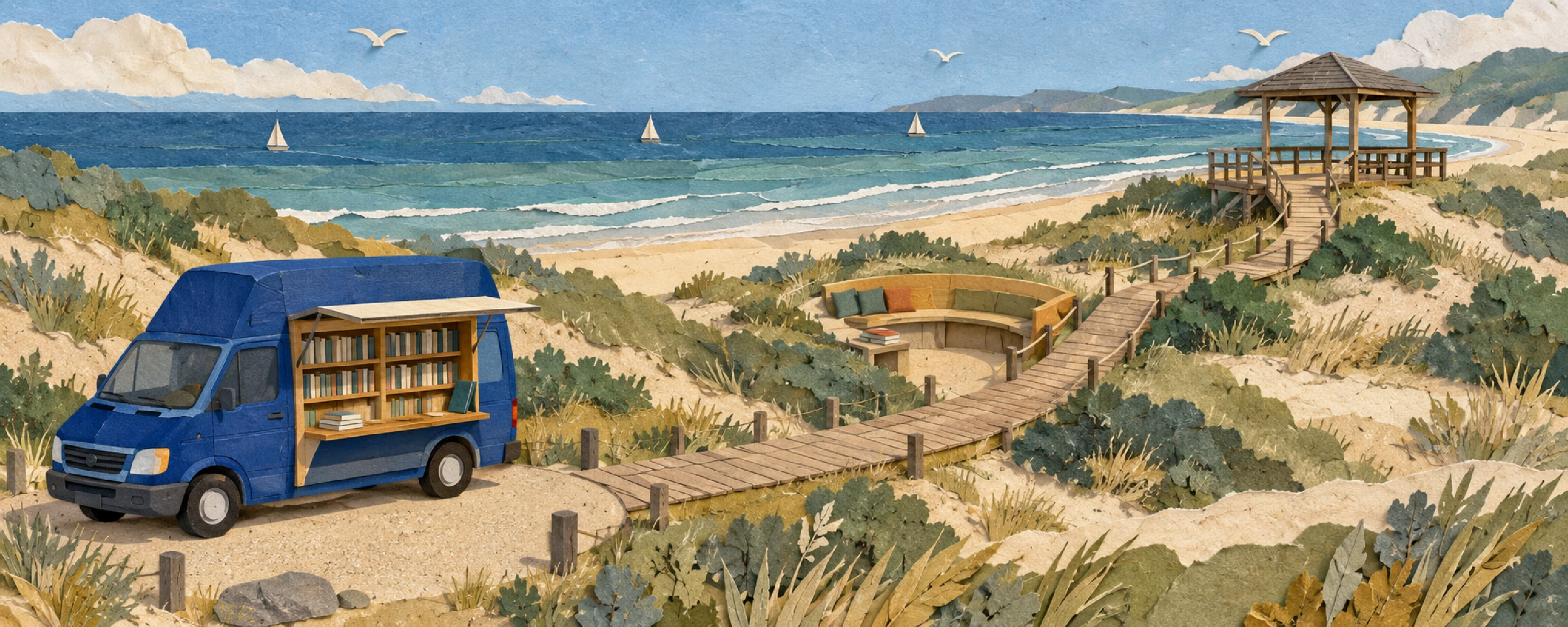
Library Van at the Dune Boardwalk
A path leads from an open library van through a dune reading hollow to a seaside lookout. Tactile overlapping paper turns a coastal library service into a panoramic visual journey.
Remix this referenceLibrary Van at the Dune Boardwalk
- Form language
- Build recognizable forms from broad cut silhouettes and nested planes; let secondary shapes vary with a consistent handmade simplicity.
- Contour
- Use scissor-cut edges with slight wobbles and occasional torn interruptions; let overlapping edges replace drawn outlines.
- Mark-making
- Add sparse rubbed-pigment strokes and a few blunt pencil notations within cut pieces; vary marks naturally instead of patterning every plane.
- Surface rendering
- Layer visibly thick matte papers with lifted corners and exposed fibers; create tonal transitions through overlapping translucent scraps.
Priority
Make tactile cut-paper overlaps the defining visual treatment.
What to avoid & what to check
Exact prompt for this example
MODULE OWNERSHIP
subject: Subject count, type, stable proportions and landmarks, resting face geometry, hair shape, physical materials, garment construction and permanent marks. No emotion, movement, color assignment or rendering recipe.
expression: Facial soft-tissue displacement and pupil direction, muscle coordination, regional intensity, asymmetry and onset/peak/release. No head/body pose, stable appearance, skin color or rendering.
gesture: Head/neck/body/limb orientation, joint movement, support, contact and pose-caused occlusion using existing anatomy. No eye/pupil movement, emotion, identity, props inventory or camera.
props: Prop count, type, construction, physical material and scale relative to the subject. Holding/contact belongs to gesture, position to composition, color to palette.
scene: Environment elements, terrain, backdrop/floor presence and structural detail. No canvas positions, camera, lighting, assigned colors or render texture.
camera: Projection, focal-length impression, camera elevation/yaw/roll, viewing distance and crop. No actor pose, world placement, lighting or canvas aspect ratio.
composition: Normalized 0-100% canvas positions, scale in frame, depth/overlap, focal hierarchy and margins. No joint pose, camera projection, rendering, subject/prop inventory or emotion.
palette: Color anchors, hue/saturation/value ranges, colors assigned to parts and approximate color coverage. No illumination direction, shading algorithm, physical material or layout.
lighting: Light-source direction/softness/intensity, ambient illumination, physical shadow direction/length and highlight position. Absence of directional illumination is allowed. No shading technique, palette or material changes.
style: Reusable form abstraction, contour weight/taper/edge quality, medium and mark scale/density/direction, surface rendering and tonal transition technique. No fixed subject proportions, anatomy, identity, expression, pose, palette, light-source direction, camera or layout.
output: Image count, aspect ratio, size, file/alpha requirements and global lettering/logo/watermark restrictions. No background scenery, crop, style, identity or pose.

SUBJECT
inventory: One original compact library van; no people or animals.
geometry: A short-wheelbase van has a tall roof, rounded front corners and a broad side service opening with built-in shelves.
resting-face: No face or anthropomorphic facial features.
appearance: Folded sheet metal forms the body, rubber forms the tires and timber forms the inset shelving and service counter.

PRIORITY


AVOID


CHECK


PROPS
inventory: One modest collection of slim lending books, each small enough to fit comfortably within a van shelf.
construction: Books consist of bound paper blocks and simple card covers; allow naturally varied thicknesses.

PRIORITY


AVOID


CHECK


SCENE
inventory: Coastal dunes contain an arrival court, a timber boardwalk, a sheltered reading hollow, a lookout pavilion and an open sea.
structure: A continuous boardwalk links the court, a recessed nook with built-in benches and an open-sided pavilion above the beach.

PRIORITY


AVOID


CHECK


CAMERA
projection: Use gently compressed perspective with a mild long-lens impression, keeping the environmental route legible.
viewpoint: View obliquely downward from above the dune ridge, with a level horizon and no camera roll.
crop: Use a panoramic environmental view that includes the full van, the connected route and the distant sea horizon.

PRIORITY


AVOID


CHECK


COMPOSITION
placement: Anchor the van in the lower-left court; carry the boardwalk through the central hollow toward the upper-right pavilion.
depth: The van and visible shelf books lead the eye, followed by the reading hollow and lookout; overlapping dune bands establish depth.
spacing: Leave broad sea and sky intervals around the tighter land route; keep the van and pavilion clear of the outer edges.

PRIORITY


AVOID


CHECK


PALETTE
colors: Use deep ultramarine, oat cream, sea-glass green and warm ochre, with a small vermilion accent.
assignment: Give the van ultramarine, dunes cream, sea green and timber ochre; distribute vermilion among a few book covers.
balance: Pale cream and softened green occupy the broad fields; reserve the deepest blue for the van and quieter distant accents.

PRIORITY


AVOID


CHECK


LIGHTING
sources: Broad daylight comes from the upper left, with soft ambient fill reaching recessed areas.
shadows: Shallow cast shadows fall to the lower right; overlaps produce narrow contact shadows without heavy contrast.
highlights: Keep highlights broad and subdued on upward-facing planes; omit sharp reflective flashes.

PRIORITY


AVOID


CHECK


STYLE GUIDE
form-language: Build recognizable forms from broad cut silhouettes and nested planes; let secondary shapes vary with a consistent handmade simplicity.
contour: Use scissor-cut edges with slight wobbles and occasional torn interruptions; let overlapping edges replace drawn outlines.
mark-making: Add sparse rubbed-pigment strokes and a few blunt pencil notations within cut pieces; vary marks naturally instead of patterning every plane.
surface-rendering: Layer visibly thick matte papers with lifted corners and exposed fibers; create tonal transitions through overlapping translucent scraps.

PRIORITY
Make tactile cut-paper overlaps the defining visual treatment.

AVOID


CHECK


OUTPUT
format: One finished image, panoramic 5:2, 3000 × 1200 pixels, opaque PNG.
restrictions: No lettering, logos, signatures or watermarks.

PRIORITY


AVOID


CHECK
Model information comes from image provenance. The same prompt may produce a different result.