Text to imageProductStyle guide
Crank Music Box and Paper Score
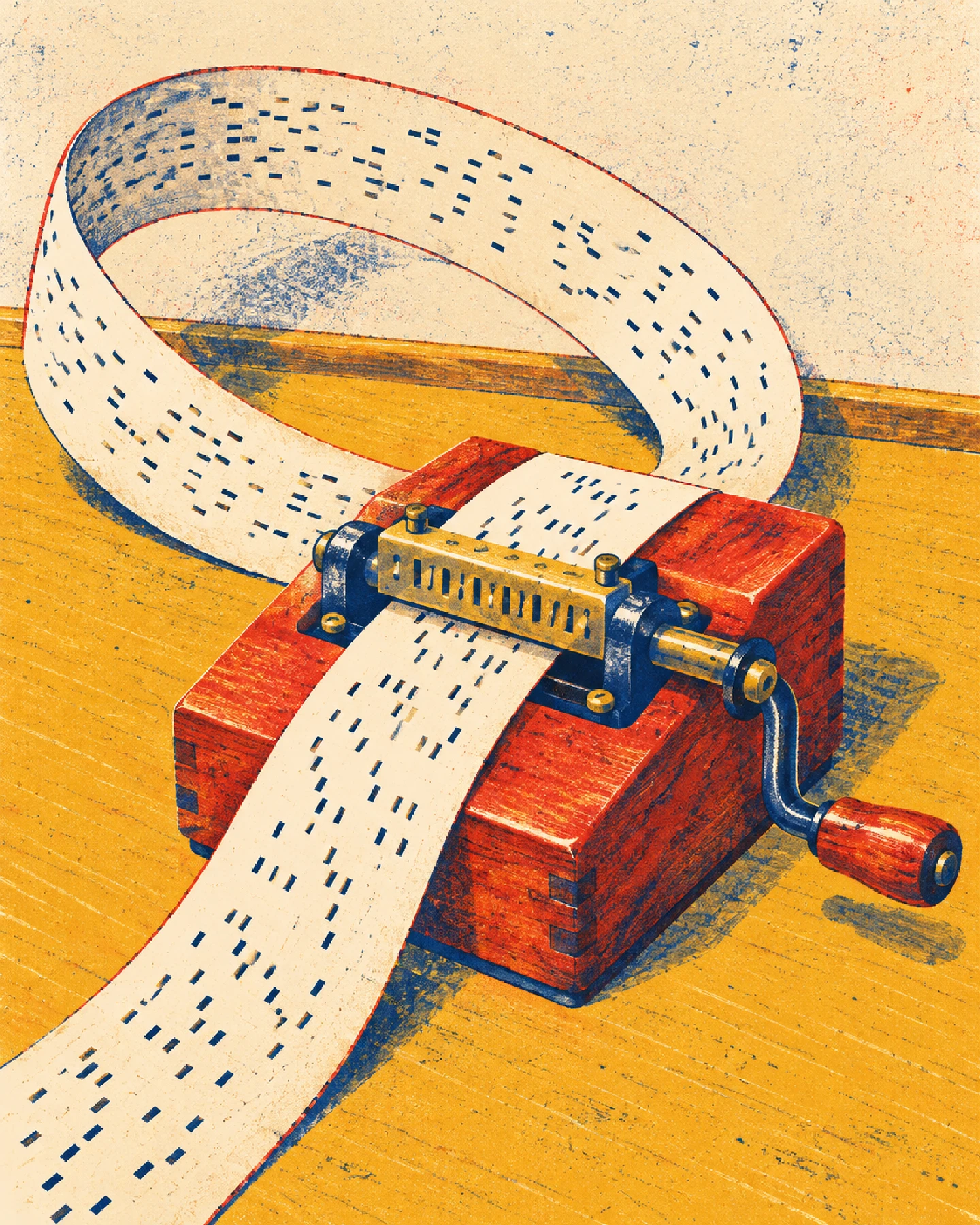
A punched paper score forms a large loop around a small crank music box. Overlapping forms and playful registration offsets give this riso product illustration a tumbling rhythm.
Remix this referenceCrank Music Box and Paper Score
- Form language
- Compress volumes into chunky interlocking planes and broad elastic curves, allowing slight handmade irregularity.
- Contour
- Use blunt, slightly wavering edges with occasional offset contour slivers; keep small structural junctions legible.
- Mark-making
- Let loose stencil grain gather unevenly across broad marks, with a few lively roller streaks and naturally varied speckling.
- Surface rendering
- Build tones through translucent overprints and uneven ink deposit; use playful registration shifts and exposed paper breaks.
Priority
Make the riso print visibly tactile through grain, overprinting and playful registration offsets.
What to avoid & what to check
Exact prompt for this example
MODULE OWNERSHIP
subject: Subject count, type, stable proportions and landmarks, resting face geometry, hair shape, physical materials, garment construction and permanent marks. No emotion, movement, color assignment or rendering recipe.
expression: Facial soft-tissue displacement and pupil direction, muscle coordination, regional intensity, asymmetry and onset/peak/release. No head/body pose, stable appearance, skin color or rendering.
gesture: Head/neck/body/limb orientation, joint movement, support, contact and pose-caused occlusion using existing anatomy. No eye/pupil movement, emotion, identity, props inventory or camera.
props: Prop count, type, construction, physical material and scale relative to the subject. Holding/contact belongs to gesture, position to composition, color to palette.
scene: Environment elements, terrain, backdrop/floor presence and structural detail. No canvas positions, camera, lighting, assigned colors or render texture.
camera: Projection, focal-length impression, camera elevation/yaw/roll, viewing distance and crop. No actor pose, world placement, lighting or canvas aspect ratio.
composition: Normalized 0-100% canvas positions, scale in frame, depth/overlap, focal hierarchy and margins. No joint pose, camera projection, rendering, subject/prop inventory or emotion.
palette: Color anchors, hue/saturation/value ranges, colors assigned to parts and approximate color coverage. No illumination direction, shading algorithm, physical material or layout.
lighting: Light-source direction/softness/intensity, ambient illumination, physical shadow direction/length and highlight position. Absence of directional illumination is allowed. No shading technique, palette or material changes.
style: Reusable form abstraction, contour weight/taper/edge quality, medium and mark scale/density/direction, surface rendering and tonal transition technique. No fixed subject proportions, anatomy, identity, expression, pose, palette, light-source direction, camera or layout.
output: Image count, aspect ratio, size, file/alpha requirements and global lettering/logo/watermark restrictions. No background scenery, crop, style, identity or pose.

SUBJECT
inventory: One palm-sized, paper-fed mechanical music box with an integral side crank.
geometry: A low wedge-shaped body supports a raised feed bridge; a bent crank ends in a rounded grip.
resting-face: No face or facial anatomy applies.
appearance: A hardwood shell encloses the mechanism; the feed bridge and crank are brass, with a wooden grip.

PRIORITY


AVOID


CHECK


PROPS
inventory: One continuous punched paper score, approximately as wide as the music box's feed opening.
construction: Flexible, uncoated paper encodes the score solely through small rectangular perforations in irregular musical clusters.

PRIORITY


AVOID


CHECK


SCENE
inventory: A continuous tabletop and a plain backdrop form a modest demonstration setting.
structure: The tabletop has a shallow raised back lip; no enclosing room architecture is visible.

PRIORITY


AVOID


CHECK


CAMERA
projection: Use a natural perspective with a normal-lens impression and mild depth convergence.
viewpoint: Look down from a close three-quarter view on the crank side, with no camera roll.
crop: Show the complete music box and large paper loop; only the trailing paper exits through the lower frame edge.

PRIORITY


AVOID


CHECK


COMPOSITION
placement: Place the music box below and right of center; the large paper loop rises across the upper-left area.
depth: The loop passes behind the box while its returning tail overlaps the near corner; the product remains the first focal point.
spacing: Leave open space inside the loop and keep the crank silhouette clear.

PRIORITY


AVOID


CHECK


PALETTE
colors: Use vermilion, ultramarine and mustard against warm cream, with rich chromatic darks.
assignment: Assign vermilion to the shell, ultramarine to the metal parts and shadows, cream to the score, and mustard to the tabletop.
balance: Keep cream broadly present, vermilion concentrated, and the mustard field pale enough for the paper edges to read.

PRIORITY


AVOID


CHECK


LIGHTING
sources: A broad soft source shines from the upper left, supported by gentle ambient fill.
shadows: Short, soft shadows fall toward the lower right; overlapping paper creates small contact shadows.
highlights: Broad highlights rest on upper-left body edges, with a small bright glint along the crank bend.

PRIORITY


AVOID


CHECK


STYLE GUIDE
form-language: Compress volumes into chunky interlocking planes and broad elastic curves, allowing slight handmade irregularity.
contour: Use blunt, slightly wavering edges with occasional offset contour slivers; keep small structural junctions legible.
mark-making: Let loose stencil grain gather unevenly across broad marks, with a few lively roller streaks and naturally varied speckling.
surface-rendering: Build tones through translucent overprints and uneven ink deposit; use playful registration shifts and exposed paper breaks.

PRIORITY
Make the riso print visibly tactile through grain, overprinting and playful registration offsets.

AVOID


CHECK


OUTPUT
format: Deliver one finished image at 4:5, 1440 × 1800 pixels, as an opaque PNG.
restrictions: No lettering, logos, signatures or watermarks.

PRIORITY


AVOID


CHECK


FINAL INTEGRATION
subject + props + composition: Coordinate the score's route with the feed opening so the overlapping arrangement remains mechanically understandable.
style + palette: Let ink interactions enrich the limited palette while keeping adjacent parts distinguishable.
Model information comes from image provenance. The same prompt may produce a different result.