Text to imageLandscapeStyle guide
Waterfall Across the Pass
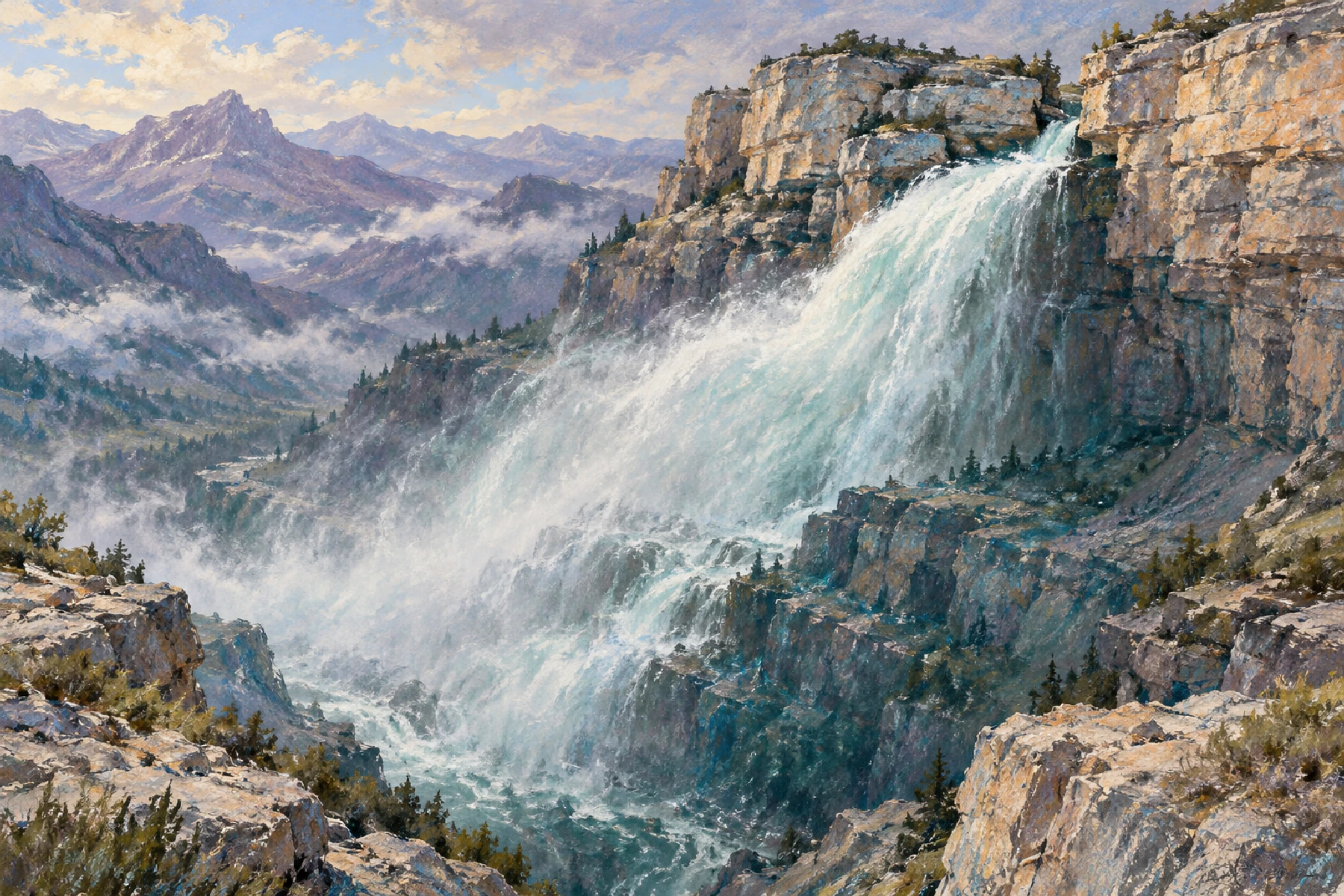
A waterfall's spray stretches across a limestone pass above layered mountain valleys. Rubbed and scratched oil pastel dissolves the boundary between water and rock.
Remix this referenceWaterfall Across the Pass
- Form language
- Compress complex forms into interlocking wedges and long, dissolving ribbons; retain irregular silhouettes rather than geometric precision.
- Contour
- Build edges from broken pastel deposits, alternating blunt interruptions with rubbed losses; use scratched accents sparingly.
- Mark-making
- Drag oil-pastel sticks on their sides, rub passages with a cloth and scratch through selected layers; allow uneven pressure and wandering marks.
- Surface rendering
- Keep waxy ridges beside smoky rubbed transitions; let underlayers show through scumbled passages so the surface feels worked and dreamlike.
Priority
Preserve the contrast between rubbed oil-pastel haze and decisive scratched marks.
What to avoid & what to check
Exact prompt for this example
MODULE OWNERSHIP
subject: Subject count, type, stable proportions and landmarks, resting face geometry, hair shape, physical materials, garment construction and permanent marks. No emotion, movement, color assignment or rendering recipe.
expression: Facial soft-tissue displacement and pupil direction, muscle coordination, regional intensity, asymmetry and onset/peak/release. No head/body pose, stable appearance, skin color or rendering.
gesture: Head/neck/body/limb orientation, joint movement, support, contact and pose-caused occlusion using existing anatomy. No eye/pupil movement, emotion, identity, props inventory or camera.
props: Prop count, type, construction, physical material and scale relative to the subject. Holding/contact belongs to gesture, position to composition, color to palette.
scene: Environment elements, terrain, backdrop/floor presence and structural detail. No canvas positions, camera, lighting, assigned colors or render texture.
camera: Projection, focal-length impression, camera elevation/yaw/roll, viewing distance and crop. No actor pose, world placement, lighting or canvas aspect ratio.
composition: Normalized 0-100% canvas positions, scale in frame, depth/overlap, focal hierarchy and margins. No joint pose, camera projection, rendering, subject/prop inventory or emotion.
palette: Color anchors, hue/saturation/value ranges, colors assigned to parts and approximate color coverage. No illumination direction, shading algorithm, physical material or layout.
lighting: Light-source direction/softness/intensity, ambient illumination, physical shadow direction/length and highlight position. Absence of directional illumination is allowed. No shading technique, palette or material changes.
style: Reusable form abstraction, contour weight/taper/edge quality, medium and mark scale/density/direction, surface rendering and tonal transition technique. No fixed subject proportions, anatomy, identity, expression, pose, palette, light-source direction, camera or layout.
output: Image count, aspect ratio, size, file/alpha requirements and global lettering/logo/watermark restrictions. No background scenery, crop, style, identity or pose.

SUBJECT
inventory: One monumental limestone cleft and its waterfall form the landscape subject; no people or animals.
geometry: A narrow outlet interrupts broad, stepped rock shoulders; the waterfall has a slender throat and a wide veil.
resting-face: No face or facial landmarks apply.
appearance: The subject consists of water and bedded limestone with irregular fractures; individual cracks may vary naturally.

PRIORITY


AVOID


CHECK


PROPS
inventory: No separate props.
construction: No prop construction applies.

PRIORITY


AVOID


CHECK


SCENE
inventory: An alpine ravine contains broken ledges, low scrub, distant mountain folds and loose banks of valley mist.
structure: Wind carries the falling water sideways through the open pass; beneath it, the ravine descends through successive shelves.

PRIORITY


AVOID


CHECK


CAMERA
projection: Use a moderately wide perspective with convincing recession and little distortion at the frame edges.
viewpoint: Look obliquely across the ravine from an opposing slope, slightly below the waterfall outlet, with a level horizon.
crop: Frame a broad landscape view with nearby rock entering the edges and the distant valley still visible beneath the spray.

PRIORITY


AVOID


CHECK


COMPOSITION
placement: Place the outlet in the upper-right third; let the water veil sweep across the middle toward the lower-left opening.
depth: A cropped foreground ledge overlaps the lower ravine; separate the cleft, spray and distant ridges into readable layers.
spacing: Make the sweeping veil the first read and the deep valley the second; leave generous breathing room beyond its loose end.

PRIORITY


AVOID


CHECK


PALETTE
colors: Use smoky violet, chalk apricot, deep petrol and pale celadon, with restrained saturation and a broad value range.
assignment: Assign apricot to exposed limestone, violet to distant mountains, petrol to the ravine and celadon to water and mist.
balance: Let muted rock and mountain hues dominate; reserve the palest values for the water veil and a few exposed stone edges.

PRIORITY


AVOID


CHECK


LIGHTING
sources: Broad, soft daylight enters from the upper left through thin cloud, with gentle ambient light throughout the valley.
shadows: Rock shoulders cast broad shadows down and right; deep recesses remain subdued without sharply cut shadow edges.
highlights: Light catches the upper-left rims of rock and the exposed surface of the spray, without a hard glare.

PRIORITY


AVOID


CHECK


STYLE GUIDE
form-language: Compress complex forms into interlocking wedges and long, dissolving ribbons; retain irregular silhouettes rather than geometric precision.
contour: Build edges from broken pastel deposits, alternating blunt interruptions with rubbed losses; use scratched accents sparingly.
mark-making: Drag oil-pastel sticks on their sides, rub passages with a cloth and scratch through selected layers; allow uneven pressure and wandering marks.
surface-rendering: Keep waxy ridges beside smoky rubbed transitions; let underlayers show through scumbled passages so the surface feels worked and dreamlike.

PRIORITY
Preserve the contrast between rubbed oil-pastel haze and decisive scratched marks.

AVOID


CHECK


OUTPUT
format: One finished image, 3:2 aspect ratio, 1800 × 1200 pixels, opaque PNG; no lettering, logos or watermarks.
restrictions: Deliver one finished image at 3:2, 1800 × 1200 pixels, as an opaque PNG, without lettering, logos or watermarks.

PRIORITY


AVOID


CHECK


FINAL INTEGRATION
scene + composition + style: Let the setting supply the sweeping event, composition carry its visual path and pastel handling soften the transitions between layers.
Model information comes from image provenance. The same prompt may produce a different result.