Text to imageCharacterStyle guide
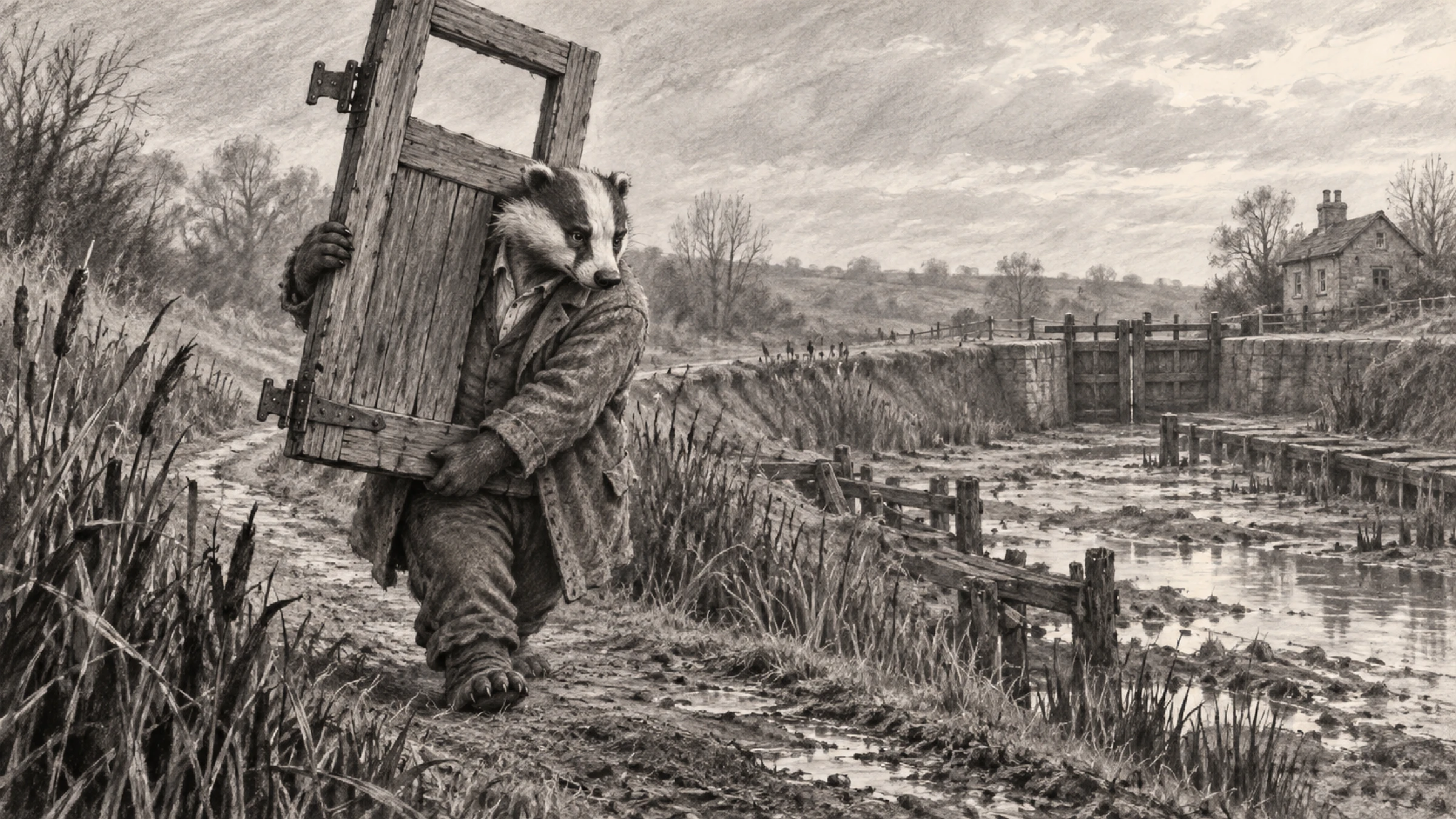
Badger Carrying a Door through the Reeds
A badger shoulders a reclaimed door along an abandoned channel, with smudged charcoal and erased light carrying the journey toward a distant lockhouse.
Remix this referenceBadger Carrying a Door through the Reeds
- Form language
- Build observed volumes from irregular joined masses, retaining small asymmetries and allowing incidental details to vary.
- Contour
- Let edges alternate between blunt charcoal accents and contours lost in rubbing; avoid tracing every boundary equally.
- Mark-making
- Use broad side-of-stick sweeps, loose diagonal hatching and occasional blunt touches, with naturally uneven pressure.
- Surface rendering
- Rub charcoal into continuous smoky tones, then lift light with an eraser; preserve partial ghosts of revised strokes.
Priority
Make observational charcoal, visible smudges and erased light the defining treatment.
What to avoid & what to check
Exact prompt for this example
MODULE OWNERSHIP
subject: Subject count, type, stable proportions and landmarks, resting face geometry, hair shape, physical materials, garment construction and permanent marks. No emotion, movement, color assignment or rendering recipe.
expression: Facial soft-tissue displacement and pupil direction, muscle coordination, regional intensity, asymmetry and onset/peak/release. No head/body pose, stable appearance, skin color or rendering.
gesture: Head/neck/body/limb orientation, joint movement, support, contact and pose-caused occlusion using existing anatomy. No eye/pupil movement, emotion, identity, props inventory or camera.
props: Prop count, type, construction, physical material and scale relative to the subject. Holding/contact belongs to gesture, position to composition, color to palette.
scene: Environment elements, terrain, backdrop/floor presence and structural detail. No canvas positions, camera, lighting, assigned colors or render texture.
camera: Projection, focal-length impression, camera elevation/yaw/roll, viewing distance and crop. No actor pose, world placement, lighting or canvas aspect ratio.
composition: Normalized 0-100% canvas positions, scale in frame, depth/overlap, focal hierarchy and margins. No joint pose, camera projection, rendering, subject/prop inventory or emotion.
palette: Color anchors, hue/saturation/value ranges, colors assigned to parts and approximate color coverage. No illumination direction, shading algorithm, physical material or layout.
lighting: Light-source direction/softness/intensity, ambient illumination, physical shadow direction/length and highlight position. Absence of directional illumination is allowed. No shading technique, palette or material changes.
style: Reusable form abstraction, contour weight/taper/edge quality, medium and mark scale/density/direction, surface rendering and tonal transition technique. No fixed subject proportions, anatomy, identity, expression, pose, palette, light-source direction, camera or layout.
output: Image count, aspect ratio, size, file/alpha requirements and global lettering/logo/watermark restrictions. No background scenery, crop, style, identity or pose.

SUBJECT
inventory: One original adult anthropomorphic badger, actor A.
geometry: A compact, heavy trunk, short sturdy legs, broad paws, small rounded ears and a blunt projecting muzzle.
resting-face: Deep-set eyes, low brow ridges, a broad nose pad and a short closed mouth establish the resting face.
appearance: Coarse fur with permanent paired facial bands; a woven coat with broad lapels and a loose open front.

PRIORITY


AVOID


CHECK


EXPRESSION — ACTOR A
brows: The inner brow lines draw slightly down and together.
lids: Upper lids lower modestly; lower lids tighten without squeezing shut.
cheeks: Cheeks firm subtly around the muzzle without lifting into a smile.
nose: The nose stays unwrinkled, with only a slight widening of the nostrils.
mouth: The mouth presses closed, with one corner held a little more firmly.
jaw: The jaw remains closed with mild tension, without an exaggerated clench.
gaze: Pupils aim forward and slightly downward toward the next stretch of the path.
coordination: Brow compression and mouth pressure share the effort; the eyes remain clearly open.
timing: Hold the modest apex of concentration.

PRIORITY


AVOID


CHECK


GESTURE
head: A keeps the neck extended and chin slightly lowered, turning the head clear of the load.
torso: The torso leans forward with the left shoulder raised under the load.
limbs: One foot bears weight as the other advances; the left forearm supports low while the right hand steadies high.
contact: The door rests against the left shoulder; the left paw cradles its bottom rail and the right grips a side stile.

PRIORITY


AVOID


CHECK


PROPS
inventory: One reclaimed wooden door, somewhat taller than A.
construction: A stout rail-and-stile frame encloses lower boards and an empty rectangular upper opening; iron hinges remain attached.

PRIORITY


AVOID


CHECK


SCENE
inventory: An abandoned drainage channel with silt shelves, reed clumps, broken timber walkways and a low lockhouse.
structure: A narrow towpath follows the channel's bends; shallow pools interrupt the silt and missing planks expose the banks.

PRIORITY


AVOID


CHECK


CAMERA
projection: Use natural perspective with a moderately wide lens impression and gentle distance recession.
viewpoint: Observe from just above A's waist height, obliquely across the channel, with a level horizon.
crop: Include the complete figure and door within a panoramic view extending well beyond their immediate surroundings.

PRIORITY


AVOID


CHECK


COMPOSITION
placement: Place A around 30% of canvas width, a little over half the frame height; the lockhouse sits near the far right.
depth: The face and load lead; overlapping reeds introduce the foreground, and the receding path carries attention toward the distant lockhouse.
spacing: Leave ample open channel ahead of A and a clear gap around the upper door opening; keep both feet inside the margin.

PRIORITY


AVOID


CHECK


PALETTE
colors: A near-monochrome range of warm paper ivory, ash gray, charcoal gray and soot black.
assignment: Keep the face pale with dark bands, the coat middle gray, the door weathered gray and deep reeds near-black.
balance: Broad pale and middle values dominate, with the darkest accents concentrated in the nearer forms.

PRIORITY


AVOID


CHECK


LIGHTING
sources: Soft daylight from the upper right combines with generous sky ambient light.
shadows: Faint ground shadows extend leftward; the door casts a soft local shadow across the supporting shoulder.
highlights: Light gathers on the upper muzzle, exposed door edges and shallow water surfaces.

PRIORITY


AVOID


CHECK


STYLE GUIDE
form-language: Build observed volumes from irregular joined masses, retaining small asymmetries and allowing incidental details to vary.
contour: Let edges alternate between blunt charcoal accents and contours lost in rubbing; avoid tracing every boundary equally.
mark-making: Use broad side-of-stick sweeps, loose diagonal hatching and occasional blunt touches, with naturally uneven pressure.
surface-rendering: Rub charcoal into continuous smoky tones, then lift light with an eraser; preserve partial ghosts of revised strokes.

PRIORITY
Make observational charcoal, visible smudges and erased light the defining treatment.

AVOID


CHECK


OUTPUT
format: One finished image, 16:9 aspect ratio, 2400 × 1350 pixels, opaque PNG.
restrictions: No lettering, logos, signatures or watermarks.

PRIORITY


AVOID


CHECK


FINAL INTEGRATION
expression + gesture: A's modest facial concentration apex accompanies the sustained carrying action.
Model information comes from image provenance. The same prompt may produce a different result.