Text to imageIllustrationStyle guide
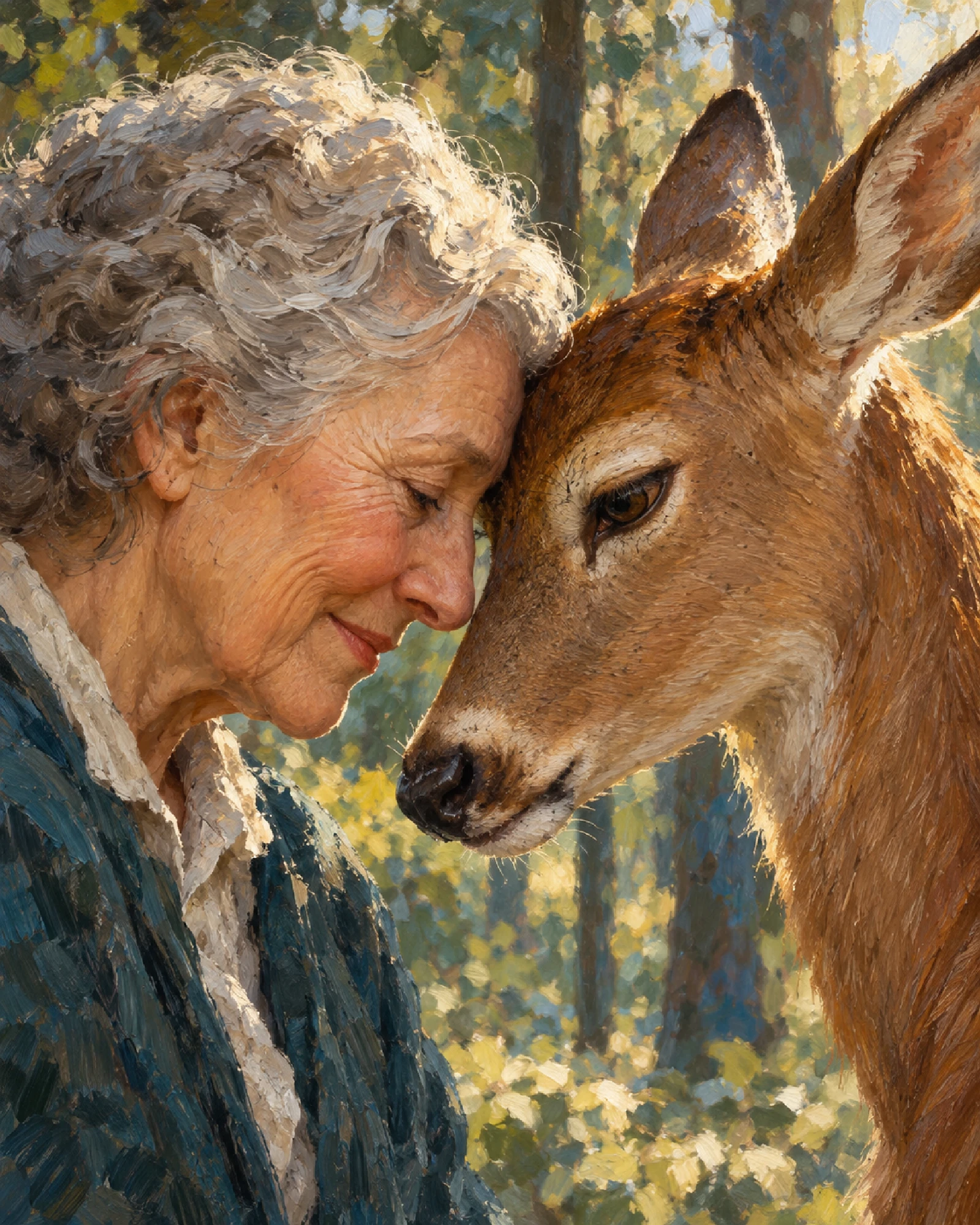
Woman and Deer, Forehead to Forehead
At a woodland edge, an elderly woman and a doe touch foreheads. Closely cropped profiles and luminous, continuous painted tones make their quiet encounter feel immediate.
Remix this referenceWoman and Deer, Forehead to Forehead
- Form language
- Build recognizable volumes from interlocking broad painted masses, simplifying minor detail while allowing irregular organic transitions.
- Contour
- Use mostly lost-and-found painted edges, sharpening a few short boundaries and dissolving others into adjacent tones without uniform outlines.
- Mark-making
- Let broad, overlapping brush sweeps remain visible beneath occasional fine curved strokes; vary pressure and direction naturally.
- Surface rendering
- Create luminous continuous tones through translucent paint veils over opaque body color, with gently merged transitions and selective broken brush edges.
Priority
Preserve luminous continuous-tone painting with visible, naturally varied brushwork.
What to avoid & what to check
Exact prompt for this example
MODULE OWNERSHIP
subject: Subject count, type, stable proportions and landmarks, resting face geometry, hair shape, physical materials, garment construction and permanent marks. No emotion, movement, color assignment or rendering recipe.
expression: Facial soft-tissue displacement and pupil direction, muscle coordination, regional intensity, asymmetry and onset/peak/release. No head/body pose, stable appearance, skin color or rendering.
gesture: Head/neck/body/limb orientation, joint movement, support, contact and pose-caused occlusion using existing anatomy. No eye/pupil movement, emotion, identity, props inventory or camera.
props: Prop count, type, construction, physical material and scale relative to the subject. Holding/contact belongs to gesture, position to composition, color to palette.
scene: Environment elements, terrain, backdrop/floor presence and structural detail. No canvas positions, camera, lighting, assigned colors or render texture.
camera: Projection, focal-length impression, camera elevation/yaw/roll, viewing distance and crop. No actor pose, world placement, lighting or canvas aspect ratio.
composition: Normalized 0-100% canvas positions, scale in frame, depth/overlap, focal hierarchy and margins. No joint pose, camera projection, rendering, subject/prop inventory or emotion.
palette: Color anchors, hue/saturation/value ranges, colors assigned to parts and approximate color coverage. No illumination direction, shading algorithm, physical material or layout.
lighting: Light-source direction/softness/intensity, ambient illumination, physical shadow direction/length and highlight position. Absence of directional illumination is allowed. No shading technique, palette or material changes.
style: Reusable form abstraction, contour weight/taper/edge quality, medium and mark scale/density/direction, surface rendering and tonal transition technique. No fixed subject proportions, anatomy, identity, expression, pose, palette, light-source direction, camera or layout.
output: Image count, aspect ratio, size, file/alpha requirements and global lettering/logo/watermark restrictions. No background scenery, crop, style, identity or pose.

SUBJECT
inventory: A is one elderly woman; B is one adult doe with ordinary deer anatomy.
geometry: A has a long cheek plane and prominent nose bridge; B has a tapered muzzle, long ears and a slender neck.
resting-face: A has hooded eyes, a narrow mouth and settled cheek folds; B has lateral eyes and a softly divided muzzle.
appearance: A has short loose curls and a plain linen collar; B has short facial fur and longer fur along the neck, with no antlers.

PRIORITY


AVOID


CHECK


EXPRESSION — ACTOR A
brows: The visible brow relaxes without lifting or knitting.
lids: The visible eyelids settle almost closed without squeezing.
cheeks: A slight cheek lift supports the small smile.
nose: The nose stays relaxed, with no nostril flare.
mouth: The visible mouth corner rises gently; the lips remain together.
jaw: The jaw releases tension without opening the mouth.
gaze: The barely visible pupil rests downward toward B.
coordination: Soft lids and the restrained mouth corner carry the same quiet affection.
timing: Hold the settled apex of a small affectionate smile.

PRIORITY


AVOID


CHECK


EXPRESSION — ACTOR B
brows: No distinct brow action is prescribed.
lids: The visible eyelid lowers slightly without closing.
cheeks: The muzzle-side cheek remains uncontracted.
nose: The nostrils remain relaxed and unflared.
mouth: The mouth stays gently closed without a human smile.
jaw: The jaw remains loose and closed.
gaze: The visible pupil rests toward A's nearby face.
coordination: A softened eyelid accompanies an otherwise resting muzzle.
timing: Hold a quiet resting apex without an impending reaction.

PRIORITY


AVOID


CHECK


GESTURE
head: A inclines her head toward B; B lifts its muzzle until their foreheads meet just above the eyes.
torso: A's visible shoulder turns toward B; B's neck extends upward from its body.
limbs: No limb movement is prescribed; B's visible ears open loosely to the sides.
contact: Their foreheads make light, direct contact without pressing either face out of shape.

PRIORITY


AVOID


CHECK


PROPS
inventory: No separate props.
construction: No prop construction applies.

PRIORITY


AVOID


CHECK


SCENE
inventory: A woodland edge with sparse leaves and distant tree trunks; no visible floor.
structure: Open gaps between trunks suggest a clearing beyond the immediate encounter.

PRIORITY


AVOID


CHECK


CAMERA
projection: Natural perspective with a short-telephoto impression and minimal facial distortion.
viewpoint: Eye-level, nearly side-on to the meeting profiles, with no camera roll.
crop: An intimate close-up cuts through A's rear curls and shoulder and B's lower neck; exclude hands, legs and B's body, preserving forehead contact.

PRIORITY


AVOID


CHECK


COMPOSITION
placement: A occupies the left half and B the right; the forehead contact sits just above center, around 55% across.
depth: Keep both profiles on the same focal plane; background fragments recede behind their shared silhouette.
spacing: The contact is the first focal point; leave a narrow wedge of open space between the lower faces and unequal outer margins.

PRIORITY


AVOID


CHECK


PALETTE
colors: Use pearl gold, muted rose, chestnut and deep blue-green with restrained saturation.
assignment: A's skin carries rose and gold, her hair pearl gray, her collar blue-green; B carries chestnut, and the woodland carries blue-green.
balance: Warm middle values dominate the faces; cooler darks support them, with pale accents used sparingly.

PRIORITY


AVOID


CHECK


LIGHTING
sources: Broad daylight enters from the upper right, with soft ambient fill from the clearing.
shadows: Soft shadows fall down and left; a delicate contact shadow separates the touching foreheads.
highlights: Broad highlights touch the upper forehead planes and ear rims; the eyes retain small moist reflections.

PRIORITY


AVOID


CHECK


STYLE GUIDE
form-language: Build recognizable volumes from interlocking broad painted masses, simplifying minor detail while allowing irregular organic transitions.
contour: Use mostly lost-and-found painted edges, sharpening a few short boundaries and dissolving others into adjacent tones without uniform outlines.
mark-making: Let broad, overlapping brush sweeps remain visible beneath occasional fine curved strokes; vary pressure and direction naturally.
surface-rendering: Create luminous continuous tones through translucent paint veils over opaque body color, with gently merged transitions and selective broken brush edges.

PRIORITY
Preserve luminous continuous-tone painting with visible, naturally varied brushwork.

AVOID


CHECK


OUTPUT
format: One finished image, 4:5 aspect ratio, 1600 × 2000 pixels, opaque PNG.
restrictions: No lettering, logos, signatures or watermarks.

PRIORITY


AVOID


CHECK


FINAL INTEGRATION
expression + gesture + composition: The restrained facial performance and direct contact work together through the shared focal relationship.
lighting + style: The painterly transitions preserve the broad illumination while allowing visible brush variation.
Model information comes from image provenance. The same prompt may produce a different result.