Text to imageIllustrationStyle guide
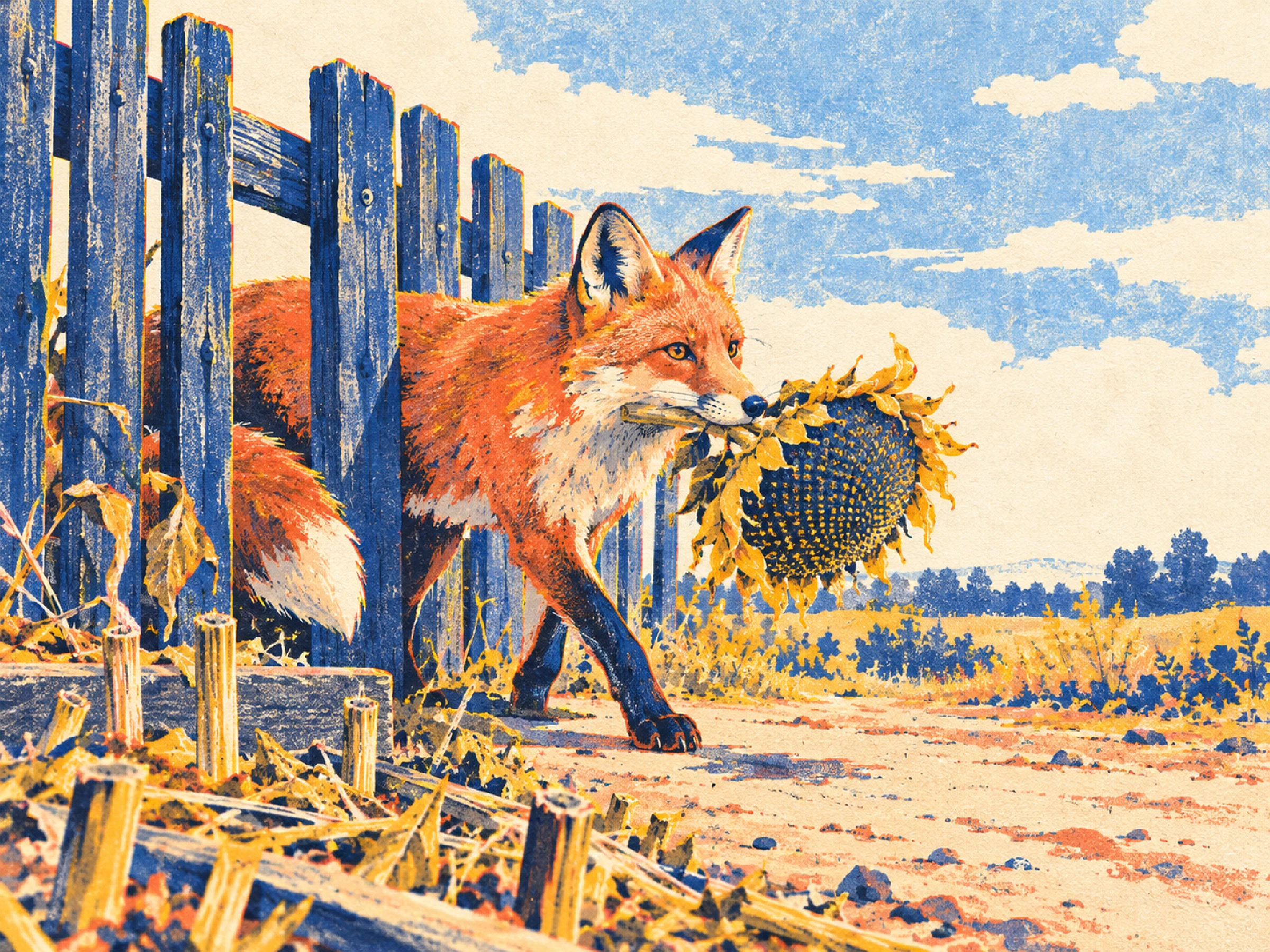
Fox Carrying a Sunflower Through a Fence
A fox carries a broad sunflower head through an allotment fence. Spacious sky, grainy ink, and playful registration offsets give this small post-harvest encounter a vivid printed presence.
Remix this referenceFox Carrying a Sunflower Through a Fence
- Form language
- Build forms from buoyant, slightly uneven cut shapes; simplify internal detail into decisive notches and clustered motifs.
- Contour
- Printed shape edges carry most boundaries; occasional blunt, broken strokes add definition without enclosing every form.
- Mark-making
- Use grainy risograph ink and loose seed-like flecks; playful registration offsets leave small wandering fringes.
- Surface rendering
- Layer translucent ink into darker overprints; let mottled deposits and exposed paper vary naturally within the cut-shape language.
Priority
Make grain, translucent overprinting, and playful registration offsets visibly define the risograph treatment.
What to avoid & what to check
Exact prompt for this example
MODULE OWNERSHIP
subject: Subject count, type, stable proportions and landmarks, resting face geometry, hair shape, physical materials, garment construction and permanent marks. No emotion, movement, color assignment or rendering recipe.
expression: Facial soft-tissue displacement and pupil direction, muscle coordination, regional intensity, asymmetry and onset/peak/release. No head/body pose, stable appearance, skin color or rendering.
gesture: Head/neck/body/limb orientation, joint movement, support, contact and pose-caused occlusion using existing anatomy. No eye/pupil movement, emotion, identity, props inventory or camera.
props: Prop count, type, construction, physical material and scale relative to the subject. Holding/contact belongs to gesture, position to composition, color to palette.
scene: Environment elements, terrain, backdrop/floor presence and structural detail. No canvas positions, camera, lighting, assigned colors or render texture.
camera: Projection, focal-length impression, camera elevation/yaw/roll, viewing distance and crop. No actor pose, world placement, lighting or canvas aspect ratio.
composition: Normalized 0-100% canvas positions, scale in frame, depth/overlap, focal hierarchy and margins. No joint pose, camera projection, rendering, subject/prop inventory or emotion.
palette: Color anchors, hue/saturation/value ranges, colors assigned to parts and approximate color coverage. No illumination direction, shading algorithm, physical material or layout.
lighting: Light-source direction/softness/intensity, ambient illumination, physical shadow direction/length and highlight position. Absence of directional illumination is allowed. No shading technique, palette or material changes.
style: Reusable form abstraction, contour weight/taper/edge quality, medium and mark scale/density/direction, surface rendering and tonal transition technique. No fixed subject proportions, anatomy, identity, expression, pose, palette, light-source direction, camera or layout.
output: Image count, aspect ratio, size, file/alpha requirements and global lettering/logo/watermark restrictions. No background scenery, crop, style, identity or pose.

SUBJECT
inventory: One adult red fox, actor A; no other animals or people.
geometry: A long, narrow body, slender legs, triangular ears, pointed muzzle, and full brush tail establish a recognizable fox.
resting-face: Small almond-shaped eyes, a tapered nose, and a narrow mouth seam define the resting facial structure.
appearance: Dense natural fur with a fuller neck ruff and tail; typical fox patches, without clothing or added permanent marks.

PRIORITY


AVOID


CHECK


EXPRESSION — ACTOR A
brows: The visible brow region rests without lifting or drawing inward.
lids: The visible eyelids stay softly open, without a squint or startled widening.
cheeks: Cheeks remain relaxed, with a slight inward pull beside the mouth corners.
nose: The nose bridge stays smooth and the nostrils remain unflared.
mouth: Mouth corners stay level; the lips draw slightly inward without exposing teeth.
jaw: Jaw muscles show light sustained tension without a hard clench.
gaze: The visible pupil points toward the fence opening.
coordination: Keep upper-face relaxation coordinated with the small tension around the muzzle.
timing: Hold the apex of a quiet neutral beat, with lower-face tension already settled.

PRIORITY


AVOID


CHECK


GESTURE
head: A turns its muzzle slightly back toward the fence, angling the carried sunflower edge-on through the opening.
torso: The shoulders have cleared the opening while the torso curves gently through it.
limbs: One forepaw reaches onto the path, the other supports the chest; the tail trails in a loose low curve.
contact: The jaws grip the stem; a fence slat partly hides the hindquarters while leaving the carrying contact visible.

PRIORITY


AVOID


CHECK


PROPS
inventory: One harvested sunflower head, its broad seed disk slightly wider than the fox's head.
construction: A shallow disk of packed seeds with ragged dried bracts, a few remaining petals, and a short fibrous stem.

PRIORITY


AVOID


CHECK


SCENE
inventory: A harvested allotment edge with a timber fence, an earth path, scattered cut stalks, and open sky.
structure: Uneven vertical slats leave one broad gap; a low bed border separates the stubble from the uninterrupted path.

PRIORITY


AVOID


CHECK


CAMERA
projection: A gently compressed perspective with little wide-angle distortion.
viewpoint: View from just above the fox's shoulder height, obliquely across the fence; keep the camera level.
crop: A medium-wide view includes the entire fox and sunflower; the fence continues beyond the left edge.

PRIORITY


AVOID


CHECK


COMPOSITION
placement: Cluster the fence opening and fox in the lower-left half; let the sunflower project toward the open right side.
depth: The sunflower beside the muzzle is the first read, followed by the body and overlapping fence slats.
spacing: Leave broad, irregular sky above and to the right; sparse ground accents keep the exit route spacious.

PRIORITY


AVOID


CHECK


PALETTE
colors: Warm ivory, burnt coral, saffron yellow, and deep cobalt form a restricted, expressive palette.
assignment: Coral carries the fox, saffron the sunflower rim and stubble, cobalt the seed disk and fence; ivory serves sky and fur patches.
balance: Ivory dominates; coral forms the main warm mass, while yellow and cobalt supply smaller, concentrated accents.

PRIORITY


AVOID


CHECK


LIGHTING
sources: Broad, soft daylight arrives from the upper right with gentle ambient fill.
shadows: Short, soft-edged shadows fall leftward beneath the fox and along the fence base.
highlights: Restrained light catches the upper ear rims, shoulder ridge, and exposed sunflower edge.

PRIORITY


AVOID


CHECK


STYLE GUIDE
form-language: Build forms from buoyant, slightly uneven cut shapes; simplify internal detail into decisive notches and clustered motifs.
contour: Printed shape edges carry most boundaries; occasional blunt, broken strokes add definition without enclosing every form.
mark-making: Use grainy risograph ink and loose seed-like flecks; playful registration offsets leave small wandering fringes.
surface-rendering: Layer translucent ink into darker overprints; let mottled deposits and exposed paper vary naturally within the cut-shape language.

PRIORITY
Make grain, translucent overprinting, and playful registration offsets visibly define the risograph treatment.

AVOID


CHECK


OUTPUT
format: One finished illustration, landscape 4:3, 2400 × 1800 pixels, opaque PNG.
restrictions: No lettering, logos, signatures, or watermarks.

PRIORITY


AVOID


CHECK


FINAL INTEGRATION
expression + gesture: Let the restrained facial acting support the carrying action without competing with it.
gesture + composition: Keep the carrying contact legible within the overlapping arrangement so the small action reads immediately.
palette + style: Let the limited inks produce secondary colors through overprinting while preserving the assigned color roles.
Model information comes from image provenance. The same prompt may produce a different result.