Text to imageArt stylesStyle guide
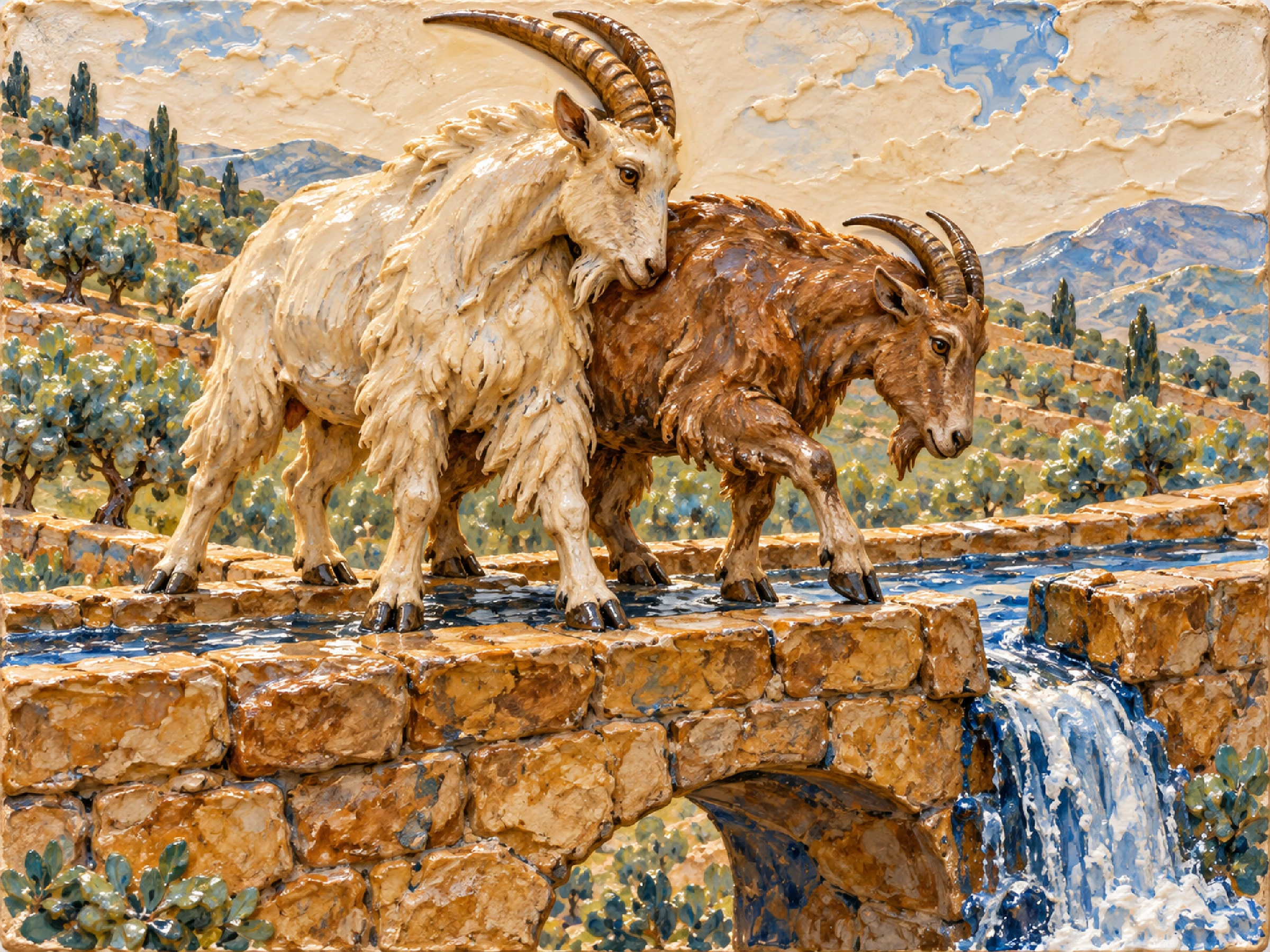
Two Goats Passing on an Aqueduct
Two goats squeeze shoulder to shoulder along a narrow aqueduct wall above spilling water, rendered in rounded clay relief with deeply pooled glaze.
Remix this referenceTwo Goats Passing on an Aqueduct
- Form language
- Build ceramic relief from rounded, pressed masses and shallow recessed fields; simplify small forms into broad modeled ridges.
- Contour
- Let raised clay edges define irregularly swelling, softened contours; reserve thin incisions for a few internal separations.
- Mark-making
- Leave selective thumb sweeps and blunt tool grooves following each mass; allow natural variation in marks and unworked intervals.
- Surface rendering
- Pool translucent glaze in hollows and thin it over crests; retain uneven fired transitions and occasional exposed clay edges.
Priority
Make modeled ceramic relief and visibly pooled glaze the defining treatment throughout.
What to avoid & what to check
Exact prompt for this example
MODULE OWNERSHIP
subject: Subject count, type, stable proportions and landmarks, resting face geometry, hair shape, physical materials, garment construction and permanent marks. No emotion, movement, color assignment or rendering recipe.
expression: Facial soft-tissue displacement and pupil direction, muscle coordination, regional intensity, asymmetry and onset/peak/release. No head/body pose, stable appearance, skin color or rendering.
gesture: Head/neck/body/limb orientation, joint movement, support, contact and pose-caused occlusion using existing anatomy. No eye/pupil movement, emotion, identity, props inventory or camera.
props: Prop count, type, construction, physical material and scale relative to the subject. Holding/contact belongs to gesture, position to composition, color to palette.
scene: Environment elements, terrain, backdrop/floor presence and structural detail. No canvas positions, camera, lighting, assigned colors or render texture.
camera: Projection, focal-length impression, camera elevation/yaw/roll, viewing distance and crop. No actor pose, world placement, lighting or canvas aspect ratio.
composition: Normalized 0-100% canvas positions, scale in frame, depth/overlap, focal hierarchy and margins. No joint pose, camera projection, rendering, subject/prop inventory or emotion.
palette: Color anchors, hue/saturation/value ranges, colors assigned to parts and approximate color coverage. No illumination direction, shading algorithm, physical material or layout.
lighting: Light-source direction/softness/intensity, ambient illumination, physical shadow direction/length and highlight position. Absence of directional illumination is allowed. No shading technique, palette or material changes.
style: Reusable form abstraction, contour weight/taper/edge quality, medium and mark scale/density/direction, surface rendering and tonal transition technique. No fixed subject proportions, anatomy, identity, expression, pose, palette, light-source direction, camera or layout.
output: Image count, aspect ratio, size, file/alpha requirements and global lettering/logo/watermark restrictions. No background scenery, crop, style, identity or pose.

SUBJECT
inventory: Two adult mountain goats: A has long swept-back horns; B has shorter curved horns.
geometry: Both have sturdy barrel-shaped bodies, narrow cloven hooves, short tails and small chin beards.
resting-face: Long wedge-shaped muzzles, side-set eyes and short pointed ears establish their resting faces.
appearance: Coarse coats gather into a few shaggy tufts; neither goat wears clothing or accessories.

PRIORITY


AVOID


CHECK


EXPRESSION — ACTOR A
brows: Keep the tissue above the eyes relaxed, without a raised ridge or inward bunching.
lids: Let the visible lids rest at a natural opening, without widening or squeezing.
cheeks: Keep the cheeks loose, without lifting or gathering beside the muzzle.
nose: Keep the nostrils at rest, without flaring or wrinkling the bridge.
mouth: Close the lips softly with level corners and no pursing.
jaw: Keep the jaw settled without clenching or dropping.
gaze: Direct the visible pupil toward B's shoulder.
coordination: Keep upper and lower facial regions equally quiet, without a pronounced asymmetric pull.
timing: Hold a subdued neutral apex with no developing facial reaction.

PRIORITY


AVOID


CHECK


EXPRESSION — ACTOR B
brows: Leave the tissue above the eyes smooth and uncontracted.
lids: Keep the visible lids naturally open, without a startled lift or tight squint.
cheeks: Let the cheeks remain relaxed, with no upward push against the lower lids.
nose: Leave the nostrils unflared and the muzzle tissue unwrinkled.
mouth: Keep the lips lightly together, without pulling back the corners.
jaw: Rest the jaw in a soft closure without visible tension.
gaze: Direct the visible pupil toward the open footing beyond A.
coordination: Maintain a quiet resting face; pupil direction provides the only distinct facial emphasis.
timing: Hold the neutral apex steadily, without a rising or releasing reaction.

PRIORITY


AVOID


CHECK


GESTURE
head: A draws its neck aside; B lowers its head to pass beneath A's horn sweep.
torso: A braces across the narrow footing while B twists its shoulders through the remaining gap.
limbs: A plants its visible legs firmly; B lifts one forehoof in a tentative forward step.
contact: Their shoulders brush; planted hooves bear on the wall cap, with B's far legs partly hidden by A.

PRIORITY


AVOID


CHECK


PROPS
inventory: No separate props.
construction: No prop construction applies.

PRIORITY


AVOID


CHECK


SCENE
inventory: An old hillside irrigation aqueduct, spilling water, terraced orchard slopes and open sky.
structure: A narrow masonry wall borders the channel; a broken outlet releases water over its arched support.

PRIORITY


AVOID


CHECK


CAMERA
projection: Use a gently compressed perspective with little wide-angle distortion.
viewpoint: Look slightly down from a three-quarter side view, close enough to read the crossing clearly.
crop: Keep both goats complete; crop the aqueduct's continuing ends and the lower falling water.

PRIORITY


AVOID


CHECK


COMPOSITION
placement: The two goats dominate the upper middle; the spill answers them below and to the right.
depth: A overlaps B, the wall overlaps the orchard, and falling water crosses the recessed arch opening.
spacing: Keep the crossing tightly interlocked, with generous sky around the horns and a clear opening beneath the arch.

PRIORITY


AVOID


CHECK


PALETTE
colors: Use chalk cream, warm umber, amber ochre, deep cobalt and muted celadon.
assignment: A is cream, B umber, masonry amber ochre, water cobalt, orchard celadon, and sky pale cream.
balance: Warm pale areas predominate; cobalt supplies a concentrated dark accent and celadon stays subdued.

PRIORITY


AVOID


CHECK


LIGHTING
sources: Broad soft light grazes from the upper left, supported by gentle ambient illumination.
shadows: Short soft shadows fall toward the lower right from projecting forms; recesses remain softly shadowed.
highlights: Broad highlights gather on upper-left-facing bulges, with stronger glints along the water.

PRIORITY


AVOID


CHECK


STYLE GUIDE
form-language: Build ceramic relief from rounded, pressed masses and shallow recessed fields; simplify small forms into broad modeled ridges.
contour: Let raised clay edges define irregularly swelling, softened contours; reserve thin incisions for a few internal separations.
mark-making: Leave selective thumb sweeps and blunt tool grooves following each mass; allow natural variation in marks and unworked intervals.
surface-rendering: Pool translucent glaze in hollows and thin it over crests; retain uneven fired transitions and occasional exposed clay edges.

PRIORITY
Make modeled ceramic relief and visibly pooled glaze the defining treatment throughout.

AVOID


CHECK


OUTPUT
format: One finished image, landscape 4:3, 2400 × 1800 pixels, opaque PNG.
restrictions: No lettering, logos or watermarks.

PRIORITY


AVOID


CHECK


FINAL INTEGRATION
gesture + composition: Let overlap strengthen the crowded encounter while keeping the passing action readable.
style + lighting: Let illumination reveal the modeled surface while glaze transitions remain distinct from cast shadows.
Model information comes from image provenance. The same prompt may produce a different result.