Text to imageArt stylesStyle guide
Stitching a Split Gourd
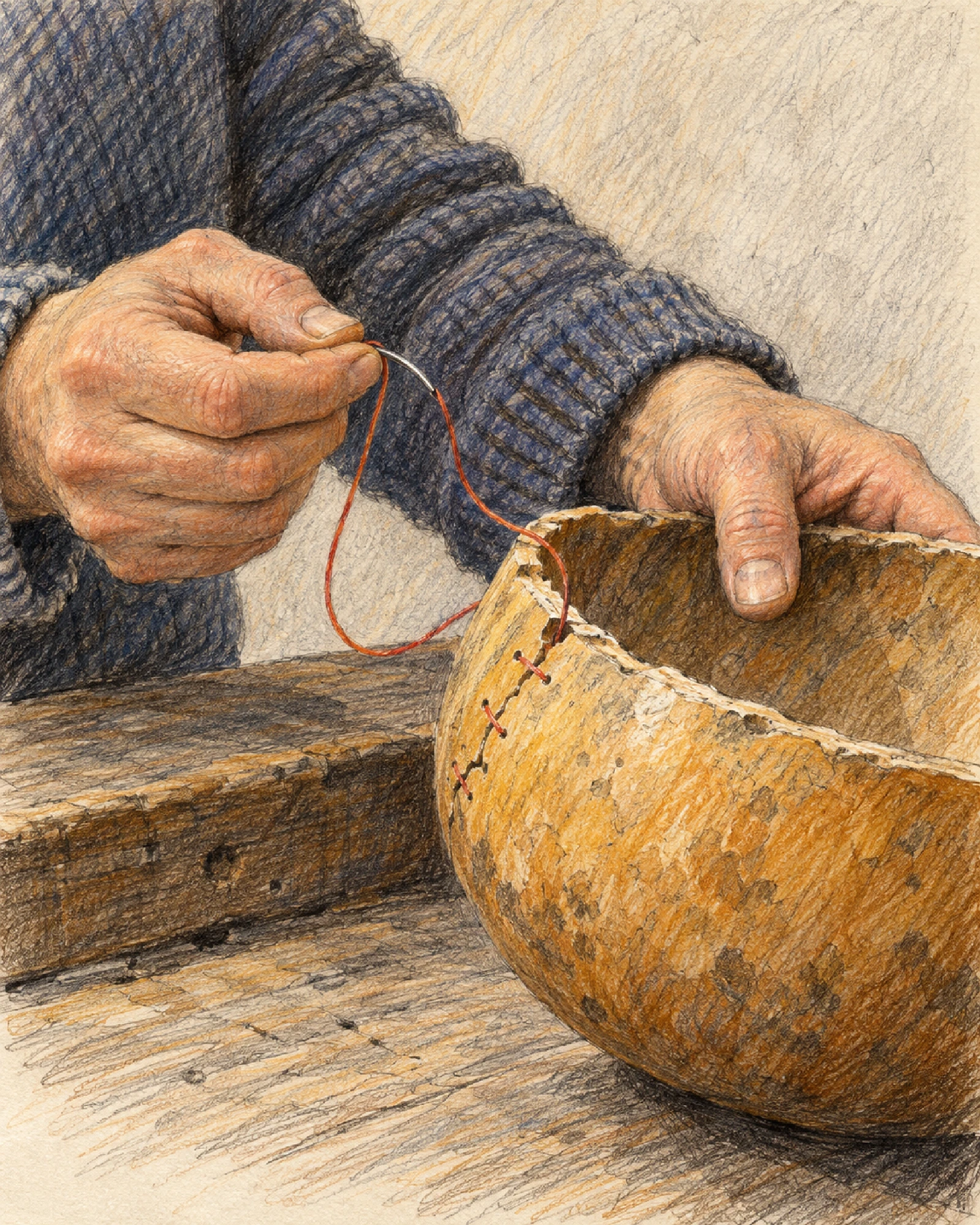
An intimate view of hands drawing thread through a split gourd bowl. Rough graphite and open colored-pencil layers distinguish brittle shell from soft sleeves.
Remix this referenceStitching a Split Gourd
- Form language
- Build volumes from searching arcs and broad faceted masses; allow small irregularities and natural variation in secondary forms.
- Contour
- Use broken graphite contours with pressure-swollen turns, light restatements and occasional unfinished edges.
- Mark-making
- Cross loose colored-pencil strokes over directional graphite hatching; vary stroke length and leave natural paper gaps.
- Surface rendering
- Accumulate translucent pencil layers into rubbed midtones, retaining granular paper tooth and a few sharply pressed dark accents.
Priority
Keep rough graphite and colored-pencil handling visibly legible as a finished sketchbook drawing.
What to avoid & what to check
Exact prompt for this example
MODULE OWNERSHIP
subject: Subject count, type, stable proportions and landmarks, resting face geometry, hair shape, physical materials, garment construction and permanent marks. No emotion, movement, color assignment or rendering recipe.
expression: Facial soft-tissue displacement and pupil direction, muscle coordination, regional intensity, asymmetry and onset/peak/release. No head/body pose, stable appearance, skin color or rendering.
gesture: Head/neck/body/limb orientation, joint movement, support, contact and pose-caused occlusion using existing anatomy. No eye/pupil movement, emotion, identity, props inventory or camera.
props: Prop count, type, construction, physical material and scale relative to the subject. Holding/contact belongs to gesture, position to composition, color to palette.
scene: Environment elements, terrain, backdrop/floor presence and structural detail. No canvas positions, camera, lighting, assigned colors or render texture.
camera: Projection, focal-length impression, camera elevation/yaw/roll, viewing distance and crop. No actor pose, world placement, lighting or canvas aspect ratio.
composition: Normalized 0-100% canvas positions, scale in frame, depth/overlap, focal hierarchy and margins. No joint pose, camera projection, rendering, subject/prop inventory or emotion.
palette: Color anchors, hue/saturation/value ranges, colors assigned to parts and approximate color coverage. No illumination direction, shading algorithm, physical material or layout.
lighting: Light-source direction/softness/intensity, ambient illumination, physical shadow direction/length and highlight position. Absence of directional illumination is allowed. No shading technique, palette or material changes.
style: Reusable form abstraction, contour weight/taper/edge quality, medium and mark scale/density/direction, surface rendering and tonal transition technique. No fixed subject proportions, anatomy, identity, expression, pose, palette, light-source direction, camera or layout.
output: Image count, aspect ratio, size, file/alpha requirements and global lettering/logo/watermark restrictions. No background scenery, crop, style, identity or pose.

SUBJECT
inventory: A is one adult craftsperson.
geometry: Broad palms, substantial fingertips and short nails define ordinary working hands.
resting-face: Resting facial geometry is unspecified.
appearance: Bare hands and a wool sweater with thick ribbed cuffs; no jewelry or permanent marks are specified.

PRIORITY


AVOID


CHECK


EXPRESSION — ACTOR A
brows: No brow action is prescribed.
lids: No lid action is prescribed.
cheeks: No cheek displacement is prescribed.
nose: No nasal action is prescribed.
mouth: No mouth action is prescribed.
jaw: No jaw action is prescribed.
gaze: Pupil direction is unspecified.
coordination: No facial muscle coordination is prescribed.
timing: The neutral apex has no prescribed facial performance.

PRIORITY


AVOID


CHECK


GESTURE
head: No head or neck pose control applies.
torso: Torso posture remains unprescribed.
limbs: Forearms converge; the right wrist turns outward as thumb and forefinger draw the needle away.
contact: The left hand cups the bowl rim against the bench; the right hand pulls the thread into a loose arc.

PRIORITY


AVOID


CHECK


PROPS
inventory: One split gourd bowl, one curved metal sewing needle and one continuous length of linen thread.
construction: The dried gourd is wider than a palm, with a rough rim and pierced crack; the needle is finger-length.

PRIORITY


AVOID


CHECK


SCENE
inventory: A small repair workroom with a timber bench and a plain plaster wall.
structure: The bench has a worn lip and shallow dents; the wall is uninterrupted, with no floor included.

PRIORITY


AVOID


CHECK


CAMERA
projection: Natural perspective with a normal-lens impression and restrained foreshortening.
viewpoint: Look closely down from slightly above bench height, obliquely across the working hands.
crop: Exclude the face; crop through forearms and the bowl's lower edge, retaining both hands, needle and working crack.

PRIORITY


AVOID


CHECK


COMPOSITION
placement: Place the stitching gap just right of center, with the bowl filling the lower-right area.
depth: The nearer cuff overlaps the bowl; the thread arc separates from the distant wall.
spacing: Focus on the needle-to-crack interval, leaving upper-left breathing room and an uneven outer silhouette.

PRIORITY


AVOID


CHECK


PALETTE
colors: Graphite gray, honey ochre, muted indigo, subdued peach and a vermilion accent on warm ivory.
assignment: Ochre for the gourd, indigo for cuffs, vermilion for thread and subdued peach for hands.
balance: Ivory and graphite dominate; restrained colored passages and a slender vermilion accent provide contrast.

PRIORITY


AVOID


CHECK


LIGHTING
sources: Broad, soft daylight enters from the upper left with gentle ambient fill.
shadows: Short shadows fall lower right, deepening beneath fingertips and inside the bowl.
highlights: Small highlights follow the upper-left rim and the needle's exposed curve.

PRIORITY


AVOID


CHECK


STYLE GUIDE
form-language: Build volumes from searching arcs and broad faceted masses; allow small irregularities and natural variation in secondary forms.
contour: Use broken graphite contours with pressure-swollen turns, light restatements and occasional unfinished edges.
mark-making: Cross loose colored-pencil strokes over directional graphite hatching; vary stroke length and leave natural paper gaps.
surface-rendering: Accumulate translucent pencil layers into rubbed midtones, retaining granular paper tooth and a few sharply pressed dark accents.

PRIORITY
Keep rough graphite and colored-pencil handling visibly legible as a finished sketchbook drawing.

AVOID


CHECK


OUTPUT
format: One image, portrait 4:5, 1600 × 2000 pixels, opaque PNG.
restrictions: No lettering, logos, signatures or watermarks.

PRIORITY


AVOID


CHECK


FINAL INTEGRATION
gesture + composition + style: Let the observed action and drawing rhythm reinforce each other without over-resolving incidental detail.
Model information comes from image provenance. The same prompt may produce a different result.