Text to imageArt stylesStyle guide
Water Through a Broken Dam
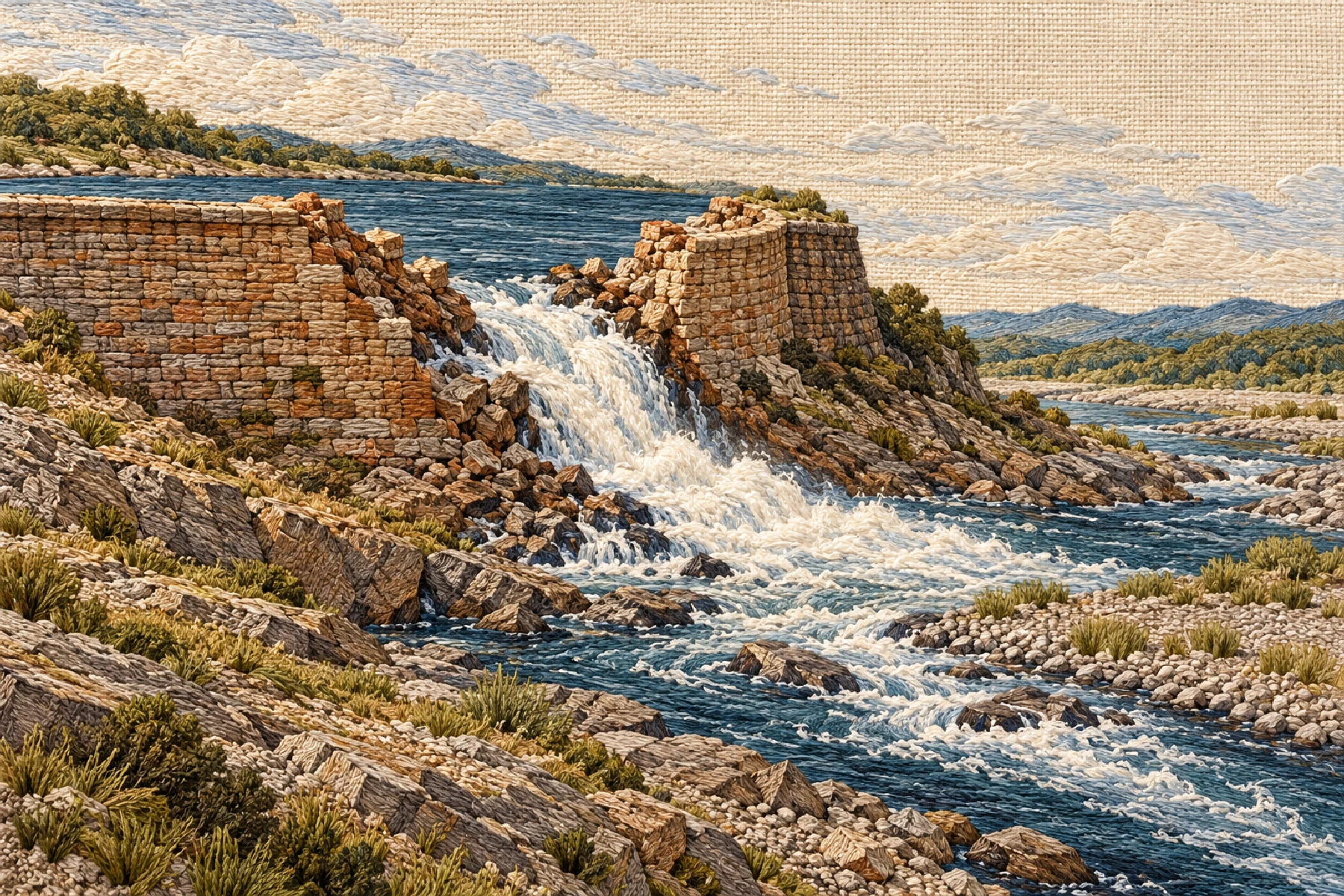
An embroidered illustration of water pouring through a breached stone dam, with raised threads and long stitches contrasting an asymmetric torrent with spacious sky.
Remix this referenceWater Through a Broken Dam
- Form language
- Reduce complex forms to interlocking irregular bands and stepped masses; retain small handmade deviations rather than mechanical repetition.
- Contour
- Build selected edges from couched cords with softly scalloped boundaries; let thinner stitched edges taper and occasionally break.
- Mark-making
- Use visibly separate long satin stitches for broad passages and shorter overlapping stitches at transitions; vary stitch length and spacing naturally.
- Surface rendering
- Create tactile thread relief over woven cloth, blending tones through interleaved strands and leaving quieter passages sparsely worked.
Priority
The finished image must visibly read as raised embroidery with distinct strands and exposed woven ground.
What to avoid & what to check
Exact prompt for this example
MODULE OWNERSHIP
subject: Subject count, type, stable proportions and landmarks, resting face geometry, hair shape, physical materials, garment construction and permanent marks. No emotion, movement, color assignment or rendering recipe.
expression: Facial soft-tissue displacement and pupil direction, muscle coordination, regional intensity, asymmetry and onset/peak/release. No head/body pose, stable appearance, skin color or rendering.
gesture: Head/neck/body/limb orientation, joint movement, support, contact and pose-caused occlusion using existing anatomy. No eye/pupil movement, emotion, identity, props inventory or camera.
props: Prop count, type, construction, physical material and scale relative to the subject. Holding/contact belongs to gesture, position to composition, color to palette.
scene: Environment elements, terrain, backdrop/floor presence and structural detail. No canvas positions, camera, lighting, assigned colors or render texture.
camera: Projection, focal-length impression, camera elevation/yaw/roll, viewing distance and crop. No actor pose, world placement, lighting or canvas aspect ratio.
composition: Normalized 0-100% canvas positions, scale in frame, depth/overlap, focal hierarchy and margins. No joint pose, camera projection, rendering, subject/prop inventory or emotion.
palette: Color anchors, hue/saturation/value ranges, colors assigned to parts and approximate color coverage. No illumination direction, shading algorithm, physical material or layout.
lighting: Light-source direction/softness/intensity, ambient illumination, physical shadow direction/length and highlight position. Absence of directional illumination is allowed. No shading technique, palette or material changes.
style: Reusable form abstraction, contour weight/taper/edge quality, medium and mark scale/density/direction, surface rendering and tonal transition technique. No fixed subject proportions, anatomy, identity, expression, pose, palette, light-source direction, camera or layout.
output: Image count, aspect ratio, size, file/alpha requirements and global lettering/logo/watermark restrictions. No background scenery, crop, style, identity or pose.

SUBJECT
inventory: One breached stone dam is the principal built subject; no people or animals.
geometry: A broad curved retaining wall has an irregular open breach between two surviving shoulders.
resting-face: No facial geometry applies.
appearance: The dam consists of weathered stone blocks with broken coping and an exposed rubble core at the breach.

PRIORITY


AVOID


CHECK


PROPS
inventory: No separate props.
construction: No prop construction applies.

PRIORITY


AVOID


CHECK


SCENE
inventory: A reservoir feeds a falling torrent and a winding river between gravel banks beneath an open sky.
structure: Water passes through the breach into a shallow rocky gorge; scattered bank grasses provide sparse detail.

PRIORITY


AVOID


CHECK


CAMERA
projection: Use gently compressed orthographic projection with enough depth to distinguish reservoir and downstream gorge.
viewpoint: Look obliquely down from the downstream side, with a level horizon and no camera roll.
crop: A wide environmental view includes the complete breach and lets the downstream river continue beyond the frame.

PRIORITY


AVOID


CHECK


COMPOSITION
placement: Set the dam across the upper left; the breach leads into a descending river sweep toward the lower right.
depth: The falling water is the first focal point, followed by the broken wall and the quieter reservoir behind it.
spacing: Leave a broad uninterrupted sky opening at upper right; preserve breathing room around the broken silhouette.

PRIORITY


AVOID


CHECK


PALETTE
colors: Use flax cream, deep petrol blue, chalk white, muted terracotta and a small amount of dull olive.
assignment: Assign cream to sky, petrol to deep water, white to the torrent, terracotta to masonry and olive to grasses.
balance: Let cream occupy the largest area; concentrate the strongest light–dark contrast in the water.

PRIORITY


AVOID


CHECK


LIGHTING
sources: Broad soft light arrives obliquely from the upper left, supported by gentle ambient illumination.
shadows: Keep relief shadows short and soft toward the lower right; the breach retains a deeper recess shadow.
highlights: Subtle highlights catch upper-left-facing ridges without producing a polished glare.

PRIORITY


AVOID


CHECK


STYLE GUIDE
form-language: Reduce complex forms to interlocking irregular bands and stepped masses; retain small handmade deviations rather than mechanical repetition.
contour: Build selected edges from couched cords with softly scalloped boundaries; let thinner stitched edges taper and occasionally break.
mark-making: Use visibly separate long satin stitches for broad passages and shorter overlapping stitches at transitions; vary stitch length and spacing naturally.
surface-rendering: Create tactile thread relief over woven cloth, blending tones through interleaved strands and leaving quieter passages sparsely worked.

PRIORITY
The finished image must visibly read as raised embroidery with distinct strands and exposed woven ground.

AVOID


CHECK


OUTPUT
format: One landscape image, 3:2 aspect ratio, 1800 × 1200 pixels, opaque PNG.
restrictions: No lettering, logos, signatures or watermarks.

PRIORITY


AVOID


CHECK
Model information comes from image provenance. The same prompt may produce a different result.