Text to imageCafe & brandStyle guide
Rain Boots Making Way for a Frog
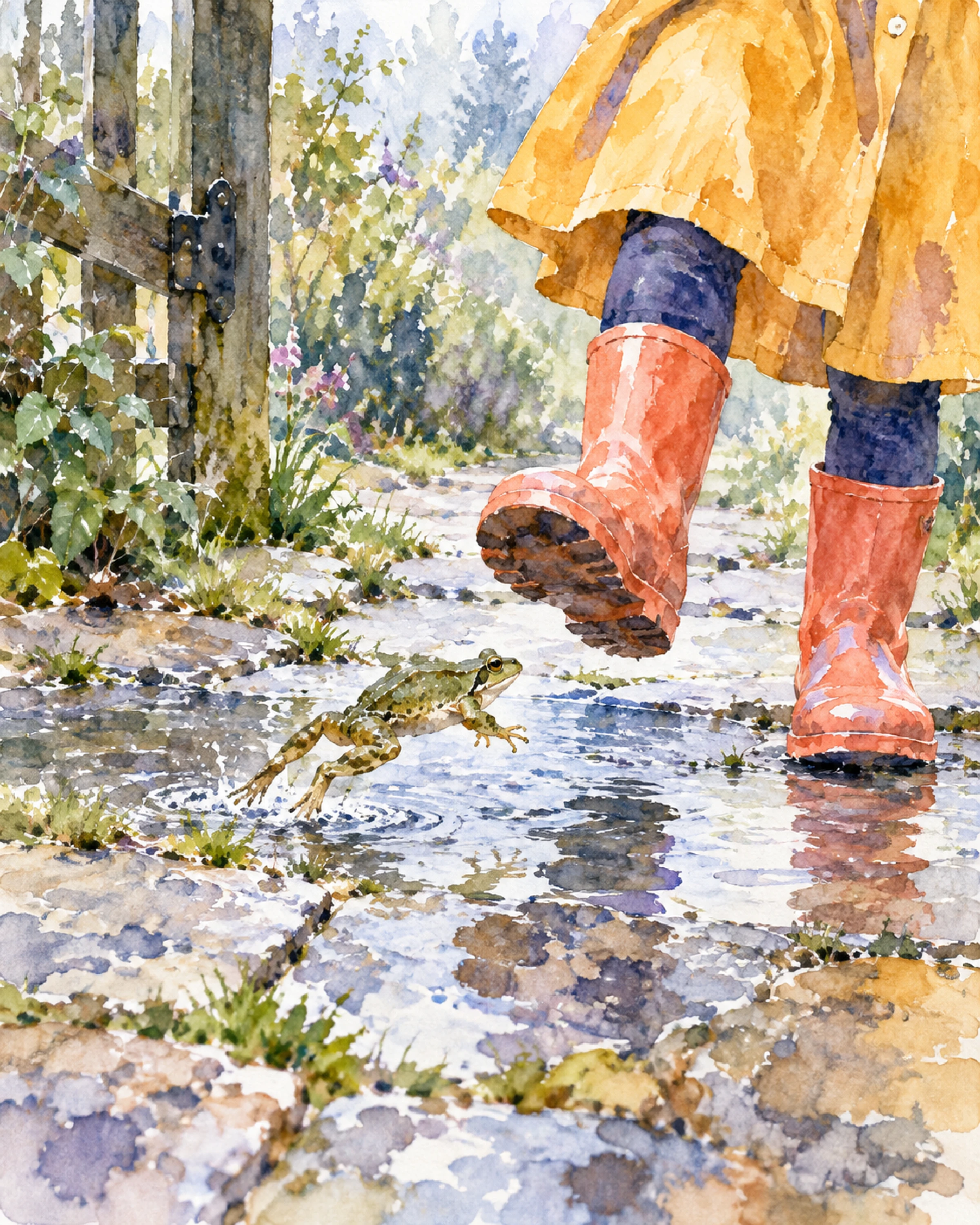
A child lifts one rain boot to let a frog cross a puddle. Blooming watercolor and spacious rainwater create a gentle adventure for an original rainwear brand.
Remix this referenceRain Boots Making Way for a Frog
- Form language
- Build recognizable forms from broad, slightly uneven wash shapes; minor details may vary within this economical language.
- Contour
- Use mostly unoutlined silhouettes, alternating pooled edges with broken, disappearing boundaries and occasional tapered brush accents.
- Mark-making
- Let wet strokes bloom into one another; add a few directional drybrush skips with naturally varying pressure and width.
- Surface rendering
- Transparent layers retain luminous paper; soft tonal bleeding meets occasional sediment rims and selectively lifted passages.
Priority
Expressive watercolor blooms and broken edges must remain visibly active.
What to avoid & what to check
Exact prompt for this example
MODULE OWNERSHIP
subject: Subject count, type, stable proportions and landmarks, resting face geometry, hair shape, physical materials, garment construction and permanent marks. No emotion, movement, color assignment or rendering recipe.
expression: Facial soft-tissue displacement and pupil direction, muscle coordination, regional intensity, asymmetry and onset/peak/release. No head/body pose, stable appearance, skin color or rendering.
gesture: Head/neck/body/limb orientation, joint movement, support, contact and pose-caused occlusion using existing anatomy. No eye/pupil movement, emotion, identity, props inventory or camera.
props: Prop count, type, construction, physical material and scale relative to the subject. Holding/contact belongs to gesture, position to composition, color to palette.
scene: Environment elements, terrain, backdrop/floor presence and structural detail. No canvas positions, camera, lighting, assigned colors or render texture.
camera: Projection, focal-length impression, camera elevation/yaw/roll, viewing distance and crop. No actor pose, world placement, lighting or canvas aspect ratio.
composition: Normalized 0-100% canvas positions, scale in frame, depth/overlap, focal hierarchy and margins. No joint pose, camera projection, rendering, subject/prop inventory or emotion.
palette: Color anchors, hue/saturation/value ranges, colors assigned to parts and approximate color coverage. No illumination direction, shading algorithm, physical material or layout.
lighting: Light-source direction/softness/intensity, ambient illumination, physical shadow direction/length and highlight position. Absence of directional illumination is allowed. No shading technique, palette or material changes.
style: Reusable form abstraction, contour weight/taper/edge quality, medium and mark scale/density/direction, surface rendering and tonal transition technique. No fixed subject proportions, anatomy, identity, expression, pose, palette, light-source direction, camera or layout.
output: Image count, aspect ratio, size, file/alpha requirements and global lettering/logo/watermark restrictions. No background scenery, crop, style, identity or pose.

SUBJECT
inventory: One school-age child, A, and one small garden frog, B.
geometry: A has familiar child proportions; B has a broad head, compact trunk and recognizable frog feet.
resting-face: A's resting facial geometry is unspecified; B has prominent eyes and a broad, naturally closed mouth line.
appearance: A wears a hooded coated-cotton rain cape and plain molded rubber boots; B has smooth amphibian skin.

PRIORITY


AVOID


CHECK


EXPRESSION — ACTOR A
brows: No brow acting is prescribed.
lids: No eyelid acting is prescribed.
cheeks: No cheek displacement is prescribed.
nose: No nasal acting is prescribed.
mouth: No mouth acting is prescribed.
jaw: No jaw action is prescribed.
gaze: Pupil direction remains unspecified.
coordination: No coordinated facial performance is prescribed.
timing: No facial timing cue is prescribed for this neutral phase.

PRIORITY


AVOID


CHECK


EXPRESSION — ACTOR B
brows: No expressive brow displacement is visible.
lids: Eyes remain naturally open without a squint.
cheeks: No cheek lift or puffing is expressed.
nose: No expressive nasal movement is visible.
mouth: Keep the mouth relaxed and closed, without raised corners.
jaw: No visible jaw opening or clenching.
gaze: Direct the pupils toward the open crossing ahead.
coordination: Keep visible facial activity minimal and non-anthropomorphic.
timing: Hold this quiet neutral state at the captured instant.

PRIORITY


AVOID


CHECK


GESTURE
head: No head or neck action is specified.
torso: A inclines slightly toward the crossing while keeping the body comfortably balanced.
limbs: A lifts one boot clear; B extends its hind legs in a low hop through the opening.
contact: A's other boot supports the body on the paving; B touches neither boot, with its forefeet nearing the water.

PRIORITY


AVOID


CHECK


PROPS
inventory: No separate props.
construction: No prop construction applies.

PRIORITY


AVOID


CHECK


SCENE
inventory: A rain-soaked garden entrance with uneven paving, a shallow puddle, sparse planting and a low gate.
structure: The puddle connects shallow depressions between paving stones; beyond the gate, an unpaved garden path continues.

PRIORITY


AVOID


CHECK


CAMERA
projection: Natural perspective with a moderate normal-lens impression.
viewpoint: View from low adult knee height, looking gently downward across the entrance with no roll.
crop: Frame A from below the shoulders through both boots; include all of B and enough entrance to establish the crossing.

PRIORITY


AVOID


CHECK


COMPOSITION
placement: A occupies the right third; B is just left of the boot, with broad breathing room across the upper left.
depth: The boot-and-frog encounter leads; receding paving and the quieter gate provide a shallow second layer.
spacing: Keep a clear gap around B; unequal intervals between paving shapes carry an open rhythm through the puddle.

PRIORITY


AVOID


CHECK


PALETTE
colors: Rain blue, muted violet, warm ochre, coral and moss green, supported by warm paper white.
assignment: Ochre belongs to the cape, coral to the boots, moss to B and planting, and blue-violet to water and paving.
balance: Pale cool colors and paper white dominate; warmer saturated accents stay compact, with deepest values used sparingly.

PRIORITY


AVOID


CHECK


LIGHTING
sources: Broad overcast daylight arrives softly from the upper left, with generous ambient illumination.
shadows: Short, diffuse shadows fall toward the lower right; contact shadows remain soft but legible.
highlights: Broad highlights rest on upper-left boot curves and the water, without sharp specular points.

PRIORITY


AVOID


CHECK


STYLE GUIDE
form-language: Build recognizable forms from broad, slightly uneven wash shapes; minor details may vary within this economical language.
contour: Use mostly unoutlined silhouettes, alternating pooled edges with broken, disappearing boundaries and occasional tapered brush accents.
mark-making: Let wet strokes bloom into one another; add a few directional drybrush skips with naturally varying pressure and width.
surface-rendering: Transparent layers retain luminous paper; soft tonal bleeding meets occasional sediment rims and selectively lifted passages.

PRIORITY
Expressive watercolor blooms and broken edges must remain visibly active.

AVOID


CHECK


OUTPUT
format: Deliver one portrait image, 4:5 aspect ratio, 2400 × 3000 pixels, as an opaque PNG.
restrictions: No lettering, logos, signatures or watermarks.

PRIORITY


AVOID


CHECK


FINAL INTEGRATION
gesture + composition + style: Let the encounter remain readable through the loose washes, with surrounding passages open to interpretation.
Model information comes from image provenance. The same prompt may produce a different result.