Text to imageComicsStyle guide
Skater in the Palm House
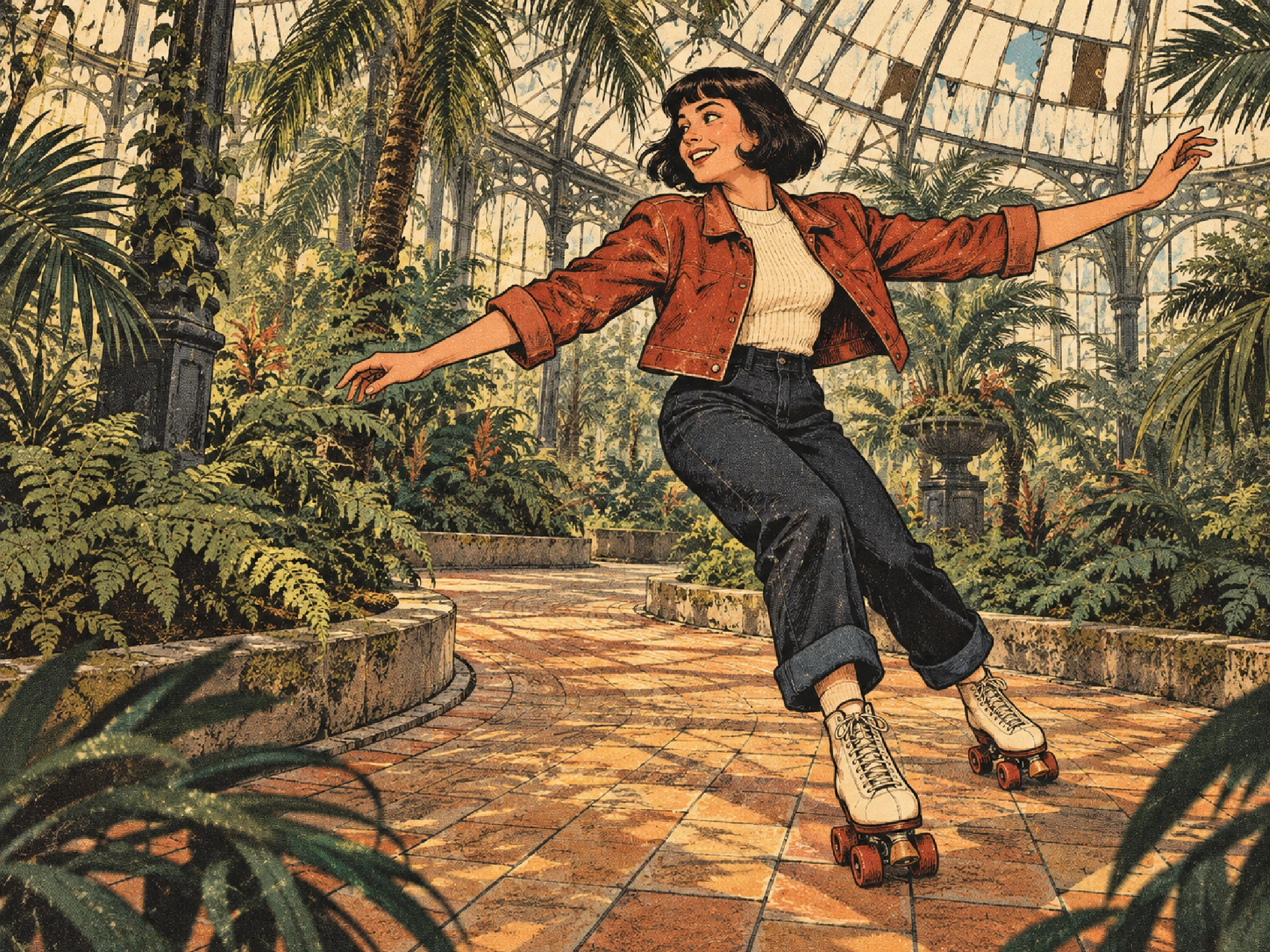
A retro comic illustration with bold brush contours and coarse printed halftones. A skater spreads her arms through a sweeping turn on a tiled path inside a lush palm house.
Remix this referenceSkater in the Palm House
- Form language
- Simplify forms into broad graphic masses with angular structural rhythms and scalloped organic edges; preserve small irregularities rather than polishing every shape.
- Contour
- Use assertive brush-ink outlines that swell through long curves and taper into abrupt dry breaks; interior contours are lighter and selectively omitted.
- Mark-making
- Combine visibly coarse halftone dots with sparse hooked brush flicks and broken diagonal hatching. Let ink spread and mark spacing vary naturally.
- Surface rendering
- Build tones from printed plates, screened midtones and pooled ink darks. Slight plate misregistration and uneven ink bite retain a tactile offset-print character.
Priority
Rendering medium: Retro halftone comic illustration using brush ink and offset printing.
What to avoid & what to check
Exact prompt for this example
MODULE OWNERSHIP
subject: Subject count, type, stable proportions and landmarks, resting face geometry, hair shape, physical materials, garment construction and permanent marks. No emotion, movement, color assignment or rendering recipe.
expression: Facial soft-tissue displacement and pupil direction, muscle coordination, regional intensity, asymmetry and onset/peak/release. No head/body pose, stable appearance, skin color or rendering.
gesture: Head/neck/body/limb orientation, joint movement, support, contact and pose-caused occlusion using existing anatomy. No eye/pupil movement, emotion, identity, props inventory or camera.
props: Prop count, type, construction, physical material and scale relative to the subject. Holding/contact belongs to gesture, position to composition, color to palette.
scene: Environment elements, terrain, backdrop/floor presence and structural detail. No canvas positions, camera, lighting, assigned colors or render texture.
camera: Projection, focal-length impression, camera elevation/yaw/roll, viewing distance and crop. No actor pose, world placement, lighting or canvas aspect ratio.
composition: Normalized 0-100% canvas positions, scale in frame, depth/overlap, focal hierarchy and margins. No joint pose, camera projection, rendering, subject/prop inventory or emotion.
palette: Color anchors, hue/saturation/value ranges, colors assigned to parts and approximate color coverage. No illumination direction, shading algorithm, physical material or layout.
lighting: Light-source direction/softness/intensity, ambient illumination, physical shadow direction/length and highlight position. Absence of directional illumination is allowed. No shading technique, palette or material changes.
style: Reusable form abstraction, contour weight/taper/edge quality, medium and mark scale/density/direction, surface rendering and tonal transition technique. No fixed subject proportions, anatomy, identity, expression, pose, palette, light-source direction, camera or layout.
output: Image count, aspect ratio, size, file/alpha requirements and global lettering/logo/watermark restrictions. No background scenery, crop, style, identity or pose.

SUBJECT
inventory: A is one adult woman wearing quad roller skates. No other people or animals are present.
geometry: A has a compact torso, long lower legs and substantial skate boots with paired wheels beneath the heel and forefoot.
resting-face: Her resting face has a broad forehead, softly squared chin, oval eyes, a rounded nose tip and a wide mouth.
appearance: A curved fringe joins a chin-length bob. She wears a short canvas jacket, ribbed top, cuffed trousers and leather skate boots with metal trucks and urethane wheels.

PRIORITY


AVOID


CHECK


EXPRESSION — ACTOR A
brows: Both brows lift gently, with the viewer-left brow slightly higher.
lids: Upper lids remain open; lower lids rise slightly with the cheeks.
cheeks: Cheeks lift into rounded mounds, more strongly on the viewer-left side.
nose: The nose bridge stays relaxed; nostrils show only a slight widening.
mouth: Mouth corners pull outward and upward around a small open smile.
jaw: The jaw releases slightly without dropping into a broad laugh.
gaze: Both pupils shift toward viewer-left while remaining clearly visible.
coordination: Cheek lift and mouth widening carry the delight; the upper face stays lightly engaged.
timing: Hold the apex of a spontaneous smile, before the mouth opens further.

PRIORITY


AVOID


CHECK


GESTURE
head: A turns her head toward the bend, keeping her neck elongated and chin slightly raised.
torso: Her torso leans into the turn, with a small counter-rotation between shoulders and hips.
limbs: Both knees flex; one skate leads the other. Her arms spread in a broad uneven arc, one hand higher than the other.
contact: Both skates maintain rolling contact with the path. Hands touch nothing; the leading forearm crosses a small part of the jacket.

PRIORITY


AVOID


CHECK


PROPS
inventory: No separate props.
construction: No prop construction applies.

PRIORITY


AVOID


CHECK


SCENE
inventory: An old palm house contains a winding tiled path, recessed fern beds, tall palms and a domed glass roof.
structure: Low masonry curbs separate the path from damp beds. Iron roof ribs rise above interwoven fronds; a few panes are missing.

PRIORITY


AVOID


CHECK


CAMERA
projection: Use perspective with a moderately wide lens impression and restrained edge distortion.
viewpoint: View from roughly hip height, looking obliquely along the path toward A's front three-quarter side; keep the camera level.
crop: Show the complete figure and both skates within a generous environmental view; allow nearby foliage to leave the frame.

PRIORITY


AVOID


CHECK


COMPOSITION
placement: Place A near 60% canvas width, spanning about two-thirds of its height. Her existing arm silhouette is the primary focus, followed by her face.
depth: Cropped foreground fronds overlap the lower corners. The path curls from lower left behind A into successive beds and distant roof arches.
spacing: Leave an open pocket around the face and hands. Dense plant overlaps alternate with broad breathing spaces along the path. Keep the canvas undivided.

PRIORITY


AVOID


CHECK


PALETTE
colors: Anchor the image in muted jade, vermilion, buttery cream, warm ochre and blue-black, with moderate overall saturation.
assignment: Use jade for foliage, vermilion for the jacket, ochre for tiles and skin, cream for roof glass and boots, and blue-black for hair, trousers and ink.
balance: Jade and cream occupy most of the image; vermilion remains a compact accent, with blue-black providing firm dark anchors.

PRIORITY


AVOID


CHECK


LIGHTING
sources: Broad daylight enters through the upper-left roof, softened by glass and leaves; ambient fill keeps the interior legible.
shadows: Soft cast shadows fall toward lower right, with shorter contact shadows beneath the skate wheels and curbs.
highlights: Broad highlights touch the upper-left forehead, shoulder and boot toes; roof ribs interrupt illumination across the path.

PRIORITY


AVOID


CHECK


STYLE GUIDE
form-language: Simplify forms into broad graphic masses with angular structural rhythms and scalloped organic edges; preserve small irregularities rather than polishing every shape.
contour: Use assertive brush-ink outlines that swell through long curves and taper into abrupt dry breaks; interior contours are lighter and selectively omitted.
mark-making: Combine visibly coarse halftone dots with sparse hooked brush flicks and broken diagonal hatching. Let ink spread and mark spacing vary naturally.
surface-rendering: Build tones from printed plates, screened midtones and pooled ink darks. Slight plate misregistration and uneven ink bite retain a tactile offset-print character.

PRIORITY
Rendering medium: Retro halftone comic illustration using brush ink and offset printing.

AVOID


CHECK


OUTPUT
format: One finished illustration, landscape 4:3, 2048 × 1536 pixels, opaque PNG.
restrictions: No lettering, dialogue balloons, logos or watermarks.

PRIORITY


AVOID


CHECK


FINAL INTEGRATION
expression + gesture + style: Keep facial acting and the gesture readable through selective contour simplification and printed tonal marks.
scene + composition + camera: Let environmental structure support the layered spatial rhythm while preserving the focal silhouette.
Model information comes from image provenance. The same prompt may produce a different result.