Text to imageArt stylesStyle guide
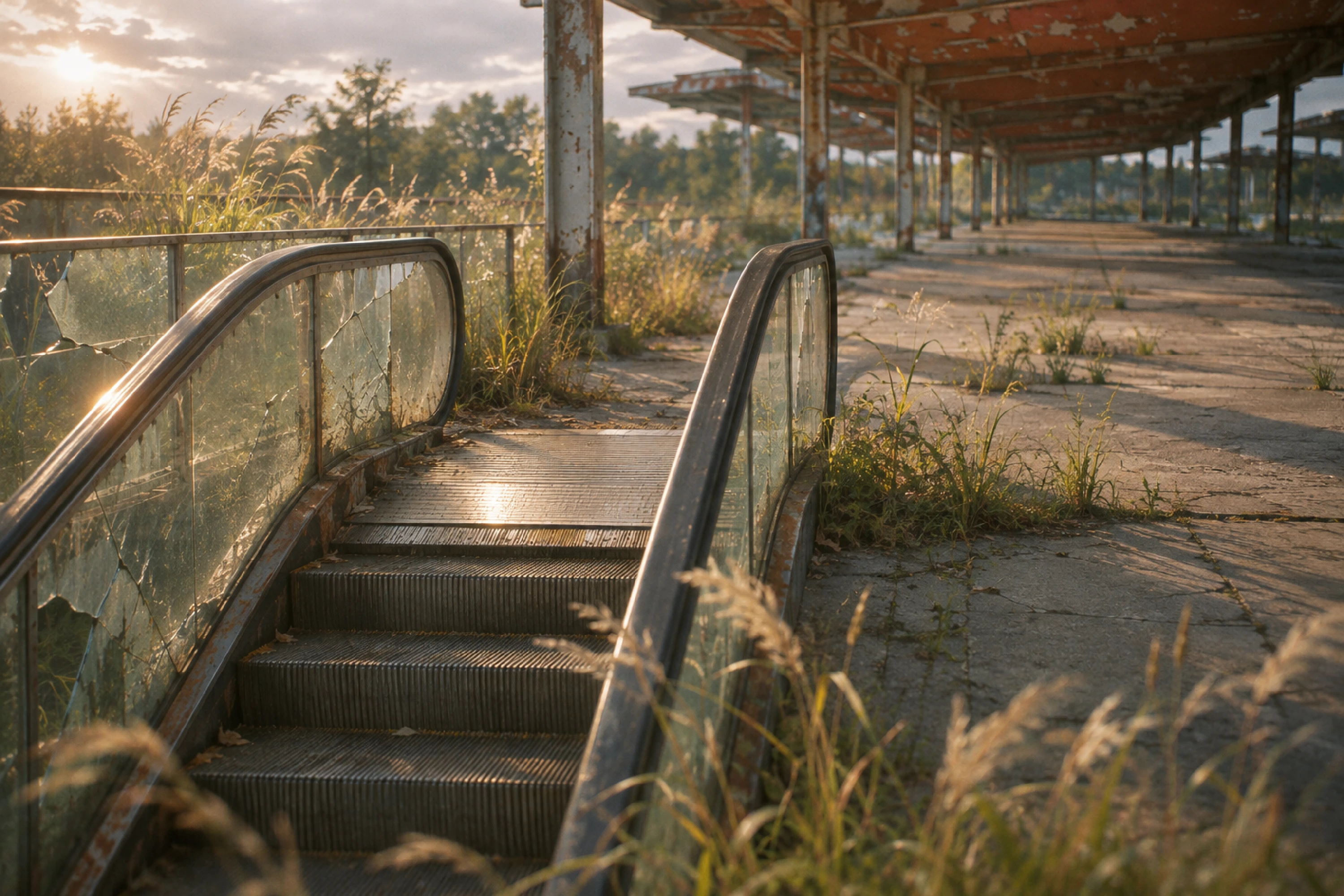
Grass at the Escalator Landing
Tall grass has overtaken the exit of an abandoned outdoor escalator. Near seed heads and a distant platform create expressive depth, while analog grain and light bloom give the quiet scene a sense of elapsed time.
Remix this referenceGrass at the Escalator Landing
- Form language
- Keep photographic specificity while allowing minor wear and irregular growth to remain naturally unresolved.
- Contour
- Let optical focus define edges: lucid detail at the focal plane, dissolving boundaries ahead and behind it.
- Mark-making
- Use fine irregular film grain embedded in image detail, becoming more apparent in quiet midtones.
- Surface rendering
- Use analog print-like tonal compression, gentle highlight bloom and open shadow transitions without artificial edge sharpening.
Priority
Make analog photographic depth and tonal response visibly integral to the image.
What to avoid & what to check
Exact prompt for this example
MODULE OWNERSHIP
subject: Subject count, type, stable proportions and landmarks, resting face geometry, hair shape, physical materials, garment construction and permanent marks. No emotion, movement, color assignment or rendering recipe.
expression: Facial soft-tissue displacement and pupil direction, muscle coordination, regional intensity, asymmetry and onset/peak/release. No head/body pose, stable appearance, skin color or rendering.
gesture: Head/neck/body/limb orientation, joint movement, support, contact and pose-caused occlusion using existing anatomy. No eye/pupil movement, emotion, identity, props inventory or camera.
props: Prop count, type, construction, physical material and scale relative to the subject. Holding/contact belongs to gesture, position to composition, color to palette.
scene: Environment elements, terrain, backdrop/floor presence and structural detail. No canvas positions, camera, lighting, assigned colors or render texture.
camera: Projection, focal-length impression, camera elevation/yaw/roll, viewing distance and crop. No actor pose, world placement, lighting or canvas aspect ratio.
composition: Normalized 0-100% canvas positions, scale in frame, depth/overlap, focal hierarchy and margins. No joint pose, camera projection, rendering, subject/prop inventory or emotion.
palette: Color anchors, hue/saturation/value ranges, colors assigned to parts and approximate color coverage. No illumination direction, shading algorithm, physical material or layout.
lighting: Light-source direction/softness/intensity, ambient illumination, physical shadow direction/length and highlight position. Absence of directional illumination is allowed. No shading technique, palette or material changes.
style: Reusable form abstraction, contour weight/taper/edge quality, medium and mark scale/density/direction, surface rendering and tonal transition technique. No fixed subject proportions, anatomy, identity, expression, pose, palette, light-source direction, camera or layout.
output: Image count, aspect ratio, size, file/alpha requirements and global lettering/logo/watermark restrictions. No background scenery, crop, style, identity or pose.

SUBJECT
inventory: One abandoned escalator is the principal architectural subject; no people or animals are present.
geometry: A narrow ribbed stairway runs between glass balustrades and ends at a broad comb plate.
resting-face: No face is present.
appearance: Weathered steel steps, rubber handrails and chipped glass panels retain recognizable transit construction.

PRIORITY


AVOID


CHECK


PROPS
inventory: No separate props.
construction: No prop construction applies.

PRIORITY


AVOID


CHECK


SCENE
inventory: An abandoned open-air concourse contains tall grasses, a cracked landing and a platform canopy.
structure: Grass grows through landing joints and around the escalator exit; canopy posts define the remaining platform bays.

PRIORITY


AVOID


CHECK


CAMERA
projection: Use a natural moderate-wide photographic perspective with a 40 mm lens impression.
viewpoint: Look obliquely across the upper landing from just above handrail height, with a level horizon.
crop: Use a medium-wide view; let the descending stairway continue beyond the lower edge.

PRIORITY


AVOID


CHECK


COMPOSITION
placement: The escalator climbs along the left third toward its landing; spacious concourse opens across the right.
depth: Near seed heads overlap the lower edge; the landing is the focal plane, with the canopy receding far behind.
spacing: A dense foreground fringe gives way to broad gaps between distant posts, keeping the landing the first read.

PRIORITY


AVOID


CHECK


PALETTE
colors: Use straw gold, dusty olive, weathered silver and a small amount of faded terracotta.
assignment: Grass carries gold and olive, metal stays silver, and the canopy underside carries terracotta.
balance: Keep most colors subdued and middle-valued, with pale metallic accents and a few deep recesses.

PRIORITY


AVOID


CHECK


LIGHTING
sources: Low sunlight enters from the left through thin cloud, balanced by soft open-sky ambient light.
shadows: Long softened grass and post shadows extend rightward across the landing.
highlights: Light catches left-facing rail edges and seed heads, with a broad glint across the comb plate.

PRIORITY


AVOID


CHECK


STYLE GUIDE
form-language: Keep photographic specificity while allowing minor wear and irregular growth to remain naturally unresolved.
contour: Let optical focus define edges: lucid detail at the focal plane, dissolving boundaries ahead and behind it.
mark-making: Use fine irregular film grain embedded in image detail, becoming more apparent in quiet midtones.
surface-rendering: Use analog print-like tonal compression, gentle highlight bloom and open shadow transitions without artificial edge sharpening.

PRIORITY
Make analog photographic depth and tonal response visibly integral to the image.

AVOID


CHECK


OUTPUT
format: Deliver one finished image, landscape 3:2, 3000 × 2000 pixels, opaque PNG.
restrictions: No readable lettering, logos or watermarks.

PRIORITY


AVOID


CHECK


FINAL INTEGRATION
composition + style: Use optical separation to strengthen the established depth hierarchy without losing environmental continuity.
Model information comes from image provenance. The same prompt may produce a different result.