Text to imageCharacterStyle guide
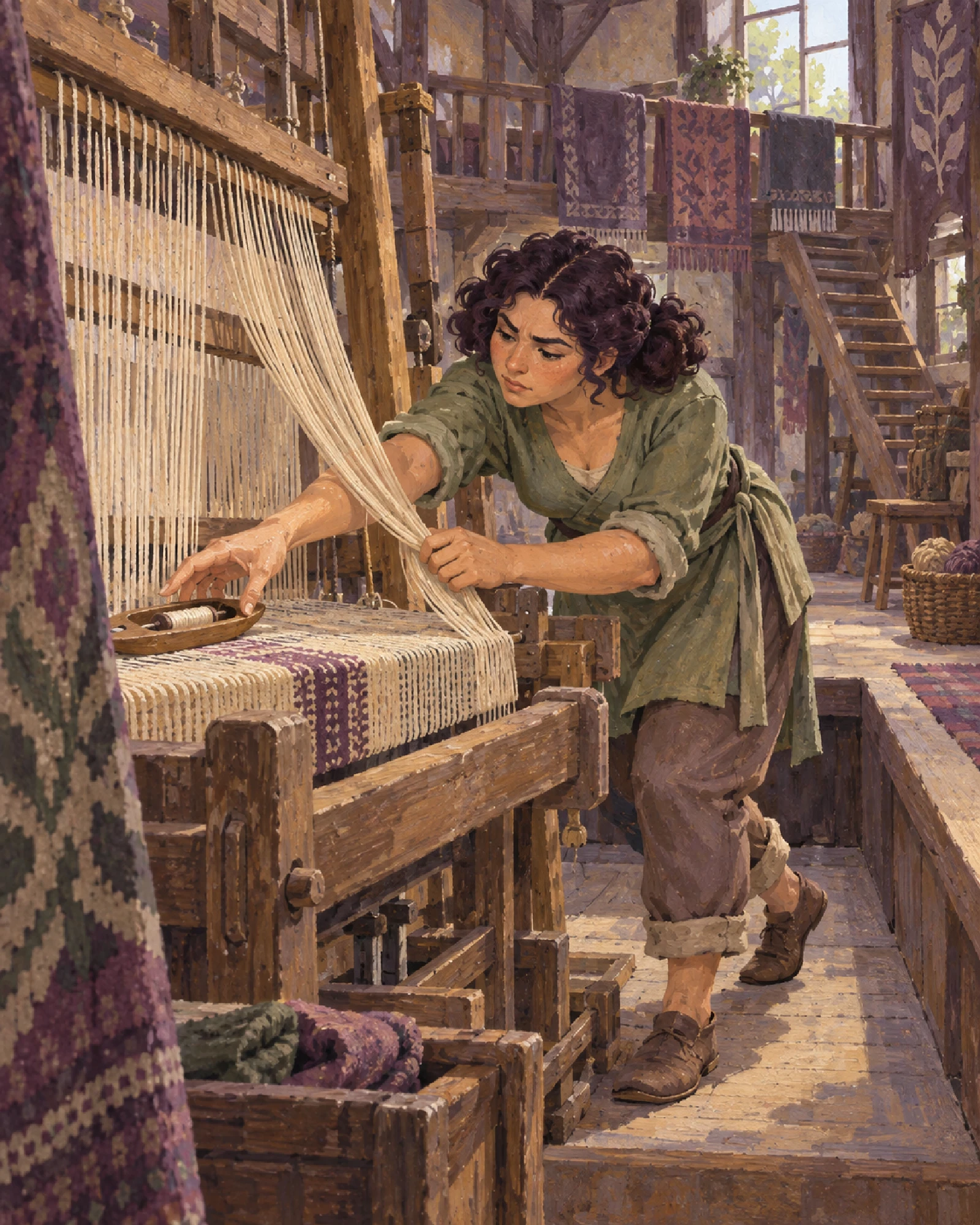
Weaver Reaching Through the Warp
A small weaver with long arms leans through her loom to retrieve a shuttle. Loose opaque gouache makes the layered workshop feel inhabited, with her reaching gesture holding the scene together.
Remix this referenceWeaver Reaching Through the Warp
- Form language
- Build forms from broad, slightly lopsided painted blocks; compress small detail into suggestive grouped shapes.
- Contour
- Let brush edges define most boundaries, alternating soft overlaps with occasional blunt, decisive accents.
- Mark-making
- Leave opaque gouache strokes plainly visible, mixing broad dragged passes with quick broken dabs that vary naturally.
- Surface rendering
- Layer dry opaque patches over earlier strokes; use scumbled transitions and occasional exposed underpainting instead of uniform blending.
Priority
Preserve the unmistakable appearance of loose gouache with visible opaque brushwork.
What to avoid & what to check
Exact prompt for this example
MODULE OWNERSHIP
subject: Subject count, type, stable proportions and landmarks, resting face geometry, hair shape, physical materials, garment construction and permanent marks. No emotion, movement, color assignment or rendering recipe.
expression: Facial soft-tissue displacement and pupil direction, muscle coordination, regional intensity, asymmetry and onset/peak/release. No head/body pose, stable appearance, skin color or rendering.
gesture: Head/neck/body/limb orientation, joint movement, support, contact and pose-caused occlusion using existing anatomy. No eye/pupil movement, emotion, identity, props inventory or camera.
props: Prop count, type, construction, physical material and scale relative to the subject. Holding/contact belongs to gesture, position to composition, color to palette.
scene: Environment elements, terrain, backdrop/floor presence and structural detail. No canvas positions, camera, lighting, assigned colors or render texture.
camera: Projection, focal-length impression, camera elevation/yaw/roll, viewing distance and crop. No actor pose, world placement, lighting or canvas aspect ratio.
composition: Normalized 0-100% canvas positions, scale in frame, depth/overlap, focal hierarchy and margins. No joint pose, camera projection, rendering, subject/prop inventory or emotion.
palette: Color anchors, hue/saturation/value ranges, colors assigned to parts and approximate color coverage. No illumination direction, shading algorithm, physical material or layout.
lighting: Light-source direction/softness/intensity, ambient illumination, physical shadow direction/length and highlight position. Absence of directional illumination is allowed. No shading technique, palette or material changes.
style: Reusable form abstraction, contour weight/taper/edge quality, medium and mark scale/density/direction, surface rendering and tonal transition technique. No fixed subject proportions, anatomy, identity, expression, pose, palette, light-source direction, camera or layout.
output: Image count, aspect ratio, size, file/alpha requirements and global lettering/logo/watermark restrictions. No background scenery, crop, style, identity or pose.

SUBJECT
inventory: One original adult woman character, actor A; no additional figures.
geometry: A compact torso, long forearms, broad hands and sturdy short legs give her a distinctive working silhouette.
resting-face: A gently hooked nose, rounded cheeks, low straight brows and a small wide mouth define her face.
appearance: Dense curls form two low side puffs; she wears a wrap-front linen tunic, cuffed trousers and soft leather shoes.

PRIORITY


AVOID


CHECK


EXPRESSION — ACTOR A
brows: Inner brows draw slightly together, with the nearer brow sitting lower.
lids: Upper lids lower a little while the lower lids firm without a hard squint.
cheeks: Cheeks remain mostly relaxed with a small tightening beside the mouth.
nose: Keep the bridge smooth with a faint widening of the nostrils.
mouth: Lips press together, with one corner pulled inward slightly.
jaw: The jaw is lightly set, without protrusion or visible teeth.
gaze: Pupils fix on the shuttle just beyond her reaching fingertips.
coordination: Concentrate effort around brows and lids while keeping the lower face comparatively quiet.
timing: Hold the apex of concentration.

PRIORITY


AVOID


CHECK


GESTURE
head: Extend the neck through the opened threads and tilt the head just enough to clear them.
torso: Bend the torso forward from the hips with a slight sideways twist toward the reaching arm.
limbs: One arm reaches through the warp while the other parts it; bent knees and one lifted heel sustain the stretch.
contact: The separating hand gathers a soft bundle of threads; the reaching fingertips barely touch the shuttle.

PRIORITY


AVOID


CHECK


PROPS
inventory: One floor loom taller than the woman and one wooden boat shuttle about the length of her hand.
construction: The timber loom has taut warp and a partly woven cloth panel; the hollow shuttle carries a small thread bobbin.

PRIORITY


AVOID


CHECK


SCENE
inventory: A weaving loft with timber galleries, a recessed work floor, hanging textile lengths and a high open window.
structure: A short stair connects the work floor to an upper walkway; exposed beams and hanging textiles form nested openings.

PRIORITY


AVOID


CHECK


CAMERA
projection: Use gently expansive natural perspective with a moderate wide-lens impression.
viewpoint: Look slightly downward from a three-quarter side view, with a level camera roll.
crop: Show the complete figure and most of the loom; allow the uppermost frame to leave the image. Crop a foreground textile at the image boundary.

PRIORITY


AVOID


CHECK


COMPOSITION
placement: Place the figure near 65% canvas width, with her reaching hand crossing toward the middle.
depth: A foreground textile overlaps the near edge; loom, figure and upper gallery make successive layers with visible gaps.
spacing: The reaching hand leads, the face follows and the loft recedes; reserve a clear pocket around their connection.

PRIORITY


AVOID


CHECK


PALETTE
colors: Use dusty aubergine, apricot, pale oat and restrained leaf green, with deep plum accents.
assignment: Give the tunic leaf green, skin apricot, warp pale oat, loft aubergine and hair deep plum.
balance: Broad muted violet and oat passages support smaller warm notes; keep green distinct but subdued.

PRIORITY


AVOID


CHECK


LIGHTING
sources: Soft daylight enters from high left, with generous ambient fill throughout the loft.
shadows: Broad shadows fall down-right under the loom and gallery; thread shadows remain faint.
highlights: Light gathers on the upper reaching forearm, cheek ridge and top edges of the loom.

PRIORITY


AVOID


CHECK


STYLE GUIDE
form-language: Build forms from broad, slightly lopsided painted blocks; compress small detail into suggestive grouped shapes.
contour: Let brush edges define most boundaries, alternating soft overlaps with occasional blunt, decisive accents.
mark-making: Leave opaque gouache strokes plainly visible, mixing broad dragged passes with quick broken dabs that vary naturally.
surface-rendering: Layer dry opaque patches over earlier strokes; use scumbled transitions and occasional exposed underpainting instead of uniform blending.

PRIORITY
Preserve the unmistakable appearance of loose gouache with visible opaque brushwork.

AVOID


CHECK


OUTPUT
format: One image, 4:5 aspect ratio, 1600 × 2000 pixels, opaque PNG; no lettering, logos or watermarks.
restrictions: One image, 4:5 aspect ratio, 1600 × 2000 pixels, opaque PNG; no lettering, logos or watermarks.

PRIORITY


AVOID


CHECK


FINAL INTEGRATION
gesture + props + composition: Keep the interaction understandable through the layered structure without diagrammatic clarification.
expression + style: Allow economical brushwork to carry the acting, preserving its small asymmetries.
expression + gesture: Synchronize the facial apex with the instant before her fingertips secure the shuttle.
Model information comes from image provenance. The same prompt may produce a different result.