Text to imagePortraitStyle guide
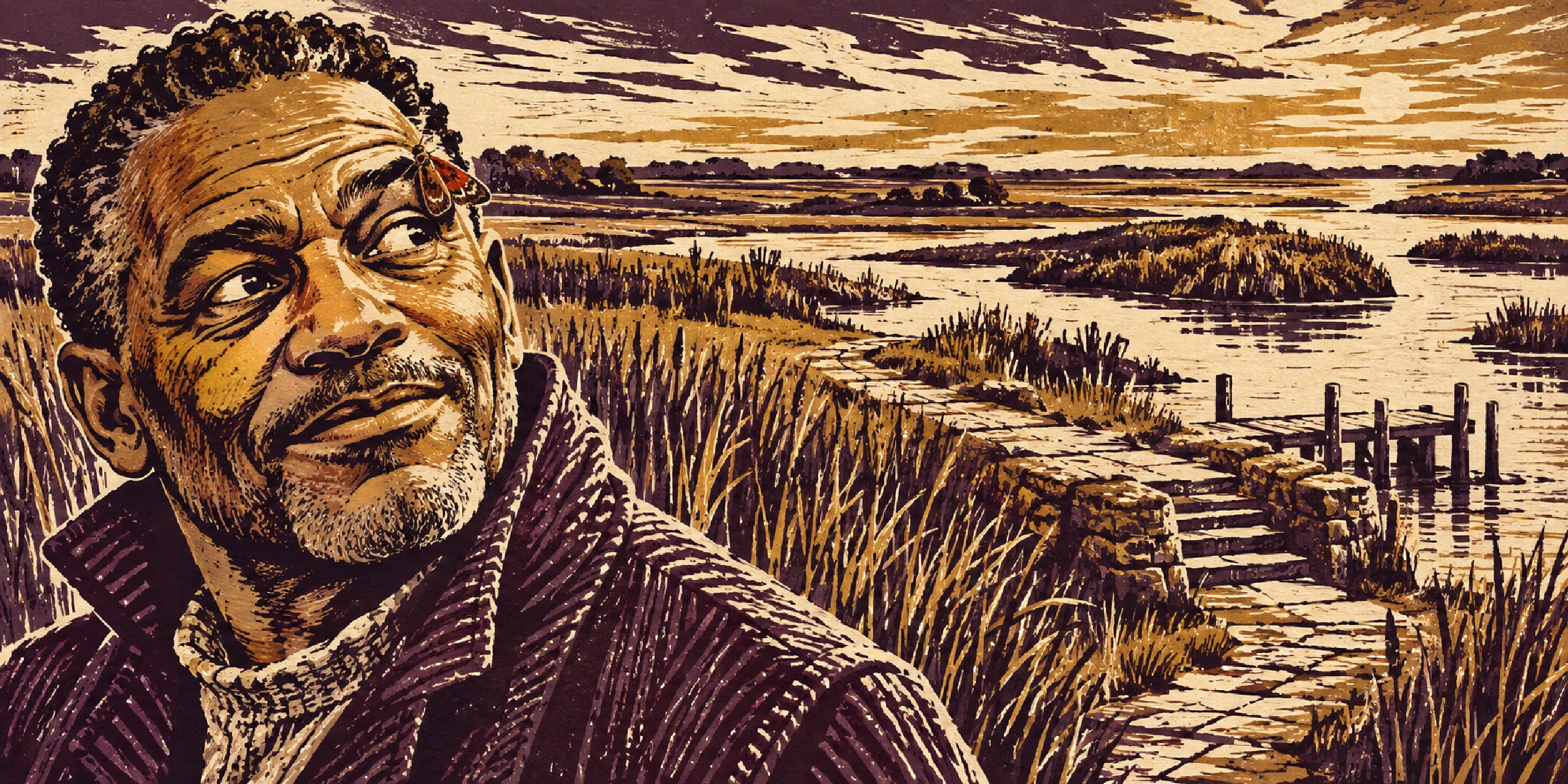
Man with a Moth on His Eyebrow
A panoramic portrait of a man noticing a small moth on his eyebrow. Bold linocut marks carry the eye from his face along a winding ferry path through reed marshes.
Remix this referenceMan with a Moth on His Eyebrow
- Form language
- Reduce volumes to interlocking wedges and rounded blocks, retaining a few irregular interruptions that keep the forms alive.
- Contour
- Use bold relief-print edges with blunt turns, occasional chipped gaps and narrow tapered cuts rather than uniform outlines.
- Mark-making
- Carve rhythmic gouge marks in loose directional families; vary their lengths and spacing so the rhythm never becomes a repeated stamp.
- Surface rendering
- Build tone from solid ink masses and exposed paper cuts, allowing uneven ink bite and slight block misregistration to remain visible.
Priority
The finished image must read as a bold linocut with carved rhythmic marks.
What to avoid & what to check
Exact prompt for this example
MODULE OWNERSHIP
subject: Subject count, type, stable proportions and landmarks, resting face geometry, hair shape, physical materials, garment construction and permanent marks. No emotion, movement, color assignment or rendering recipe.
expression: Facial soft-tissue displacement and pupil direction, muscle coordination, regional intensity, asymmetry and onset/peak/release. No head/body pose, stable appearance, skin color or rendering.
gesture: Head/neck/body/limb orientation, joint movement, support, contact and pose-caused occlusion using existing anatomy. No eye/pupil movement, emotion, identity, props inventory or camera.
props: Prop count, type, construction, physical material and scale relative to the subject. Holding/contact belongs to gesture, position to composition, color to palette.
scene: Environment elements, terrain, backdrop/floor presence and structural detail. No canvas positions, camera, lighting, assigned colors or render texture.
camera: Projection, focal-length impression, camera elevation/yaw/roll, viewing distance and crop. No actor pose, world placement, lighting or canvas aspect ratio.
composition: Normalized 0-100% canvas positions, scale in frame, depth/overlap, focal hierarchy and margins. No joint pose, camera projection, rendering, subject/prop inventory or emotion.
palette: Color anchors, hue/saturation/value ranges, colors assigned to parts and approximate color coverage. No illumination direction, shading algorithm, physical material or layout.
lighting: Light-source direction/softness/intensity, ambient illumination, physical shadow direction/length and highlight position. Absence of directional illumination is allowed. No shading technique, palette or material changes.
style: Reusable form abstraction, contour weight/taper/edge quality, medium and mark scale/density/direction, surface rendering and tonal transition technique. No fixed subject proportions, anatomy, identity, expression, pose, palette, light-source direction, camera or layout.
output: Image count, aspect ratio, size, file/alpha requirements and global lettering/logo/watermark restrictions. No background scenery, crop, style, identity or pose.

SUBJECT
inventory: One older adult man, actor A, and one small moth without separate performance controls.
geometry: A has a broad skull, a compact neck and sturdy shoulders.
resting-face: Deep-set eyes, a broad short nose, a long upper lip and a cleft chin establish A's resting face.
appearance: A has close-cropped coils, a coarse wool jacket with a standing collar and a small healed temple scar.

PRIORITY


AVOID


CHECK


EXPRESSION — ACTOR A
brows: A's left brow lifts slightly; the right brow stays nearly at rest.
lids: Upper lids lift modestly while the lower lids remain softly supported.
cheeks: One cheek gathers faintly beneath the beginning of a restrained smile.
nose: The nostrils remain relaxed, with no bridge wrinkle.
mouth: Closed lips develop a small uneven upward turn at one corner.
jaw: The jaw stays loose without dropping open.
gaze: Pupils drift upward and toward A's left.
coordination: The questioning upper face leads; the mouth follows with quiet amusement.
timing: Catch the onset of recognition before the smile fully forms.

PRIORITY


AVOID


CHECK


GESTURE
head: A turns his head slightly toward his left shoulder and holds his chin level.
torso: His shoulders remain settled while his upper torso turns less than his head.
limbs: No arm action is prescribed; the moth holds its wings folded in a tent shape.
contact: The moth's feet rest on A's left outer eyebrow, leaving the eye unobstructed.

PRIORITY


AVOID


CHECK


PROPS
inventory: No separate props.
construction: No prop construction applies.

PRIORITY


AVOID


CHECK


SCENE
inventory: An open reed marsh contains an old stone ferry path, shallow tidal channels and a wooden landing.
structure: The path bends around low islands and descends by worn steps to the landing; no enclosing backdrop.

PRIORITY


AVOID


CHECK


CAMERA
projection: Use a natural perspective with a moderately wide lens impression and restrained near-field distortion.
viewpoint: View from A's eye height with a slight three-quarter yaw and no camera roll.
crop: Work at upper-chest portrait distance, retaining the whole head and an expansive environmental view; keep the arms outside the crop.

PRIORITY


AVOID


CHECK


COMPOSITION
placement: A fills the left third; his eye and the moth form the first focal stop, followed by the ferry path.
depth: The near shoulder overlaps reeds; the winding path recedes through successive islands to the small landing.
spacing: Keep air above the moth and a broad open interval across the right side of the panorama.

PRIORITY


AVOID


CHECK


PALETTE
colors: Anchor the image in deep aubergine, chalk cream, muted ochre and a restrained vermilion accent.
assignment: Use ochre and cream for the face, aubergine for jacket and reeds, and vermilion for the moth's wing patch.
balance: Let cream and aubergine dominate, with ochre as a bridge and vermilion confined to a small accent.

PRIORITY


AVOID


CHECK


LIGHTING
sources: Broad low daylight arrives from the upper right, supported by soft open-sky ambient light.
shadows: The nose casts a short shadow to the left; reeds cast longer shadows across the path in that direction.
highlights: Light catches the right cheekbone, brow ridge and upper edges of the moth's wings.

PRIORITY


AVOID


CHECK


STYLE GUIDE
form-language: Reduce volumes to interlocking wedges and rounded blocks, retaining a few irregular interruptions that keep the forms alive.
contour: Use bold relief-print edges with blunt turns, occasional chipped gaps and narrow tapered cuts rather than uniform outlines.
mark-making: Carve rhythmic gouge marks in loose directional families; vary their lengths and spacing so the rhythm never becomes a repeated stamp.
surface-rendering: Build tone from solid ink masses and exposed paper cuts, allowing uneven ink bite and slight block misregistration to remain visible.

PRIORITY
The finished image must read as a bold linocut with carved rhythmic marks.

AVOID


CHECK


OUTPUT
format: One finished image, 2:1 aspect ratio, 2400 × 1200 pixels, opaque PNG.
restrictions: No lettering, logos, signatures or watermarks.

PRIORITY


AVOID


CHECK


FINAL INTEGRATION
expression + style: Let the print abstraction preserve the small differences between the facial regions.
Model information comes from image provenance. The same prompt may produce a different result.