Text to imageIllustrationStyle guide
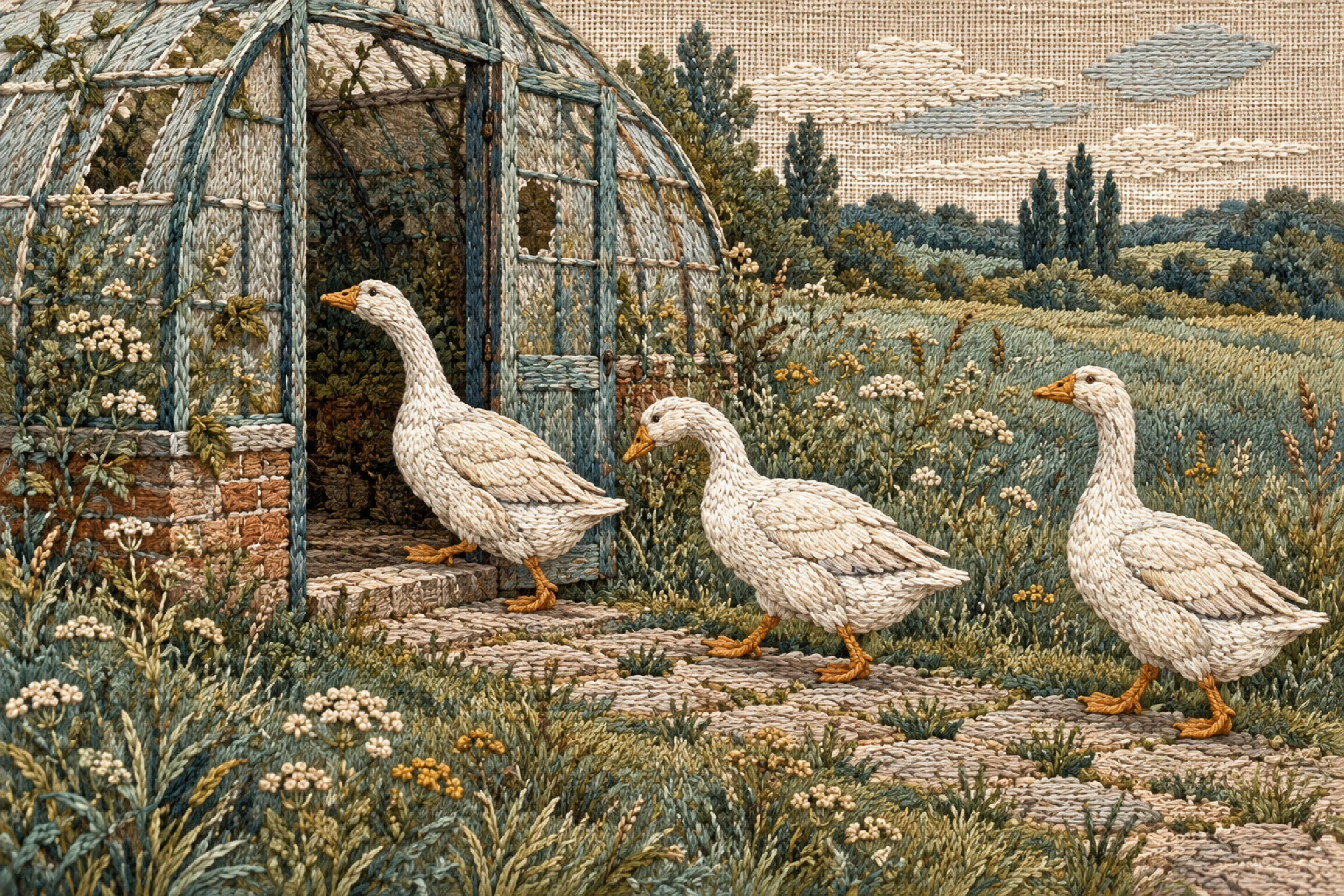
Geese Through the Greenhouse Door
Three geese pass in sequence through the open threshold of an old greenhouse. Raised embroidery and exposed ground cloth create a spacious rhythm between the glazing frame and meadow.
Remix this referenceGeese Through the Greenhouse Door
- Form language
- Translate forms into rounded appliqué-like fields and slender linked structures; simplify details while allowing irregular edges.
- Contour
- Use slightly wandering couched-thread outlines of naturally varying thickness, interrupted where stitched fields meet directly.
- Mark-making
- Lay directional satin stitches across filled forms and loose running stitches through sparse passages; vary their length and spacing by hand.
- Surface rendering
- Build padded thread relief against exposed woven cloth; interleave strands for tonal transitions and permit occasional small gaps.
Priority
Make the illustration read as raised embroidery with visible thread relief and exposed cloth.
What to avoid & what to check
Exact prompt for this example
MODULE OWNERSHIP
subject: Subject count, type, stable proportions and landmarks, resting face geometry, hair shape, physical materials, garment construction and permanent marks. No emotion, movement, color assignment or rendering recipe.
expression: Facial soft-tissue displacement and pupil direction, muscle coordination, regional intensity, asymmetry and onset/peak/release. No head/body pose, stable appearance, skin color or rendering.
gesture: Head/neck/body/limb orientation, joint movement, support, contact and pose-caused occlusion using existing anatomy. No eye/pupil movement, emotion, identity, props inventory or camera.
props: Prop count, type, construction, physical material and scale relative to the subject. Holding/contact belongs to gesture, position to composition, color to palette.
scene: Environment elements, terrain, backdrop/floor presence and structural detail. No canvas positions, camera, lighting, assigned colors or render texture.
camera: Projection, focal-length impression, camera elevation/yaw/roll, viewing distance and crop. No actor pose, world placement, lighting or canvas aspect ratio.
composition: Normalized 0-100% canvas positions, scale in frame, depth/overlap, focal hierarchy and margins. No joint pose, camera projection, rendering, subject/prop inventory or emotion.
palette: Color anchors, hue/saturation/value ranges, colors assigned to parts and approximate color coverage. No illumination direction, shading algorithm, physical material or layout.
lighting: Light-source direction/softness/intensity, ambient illumination, physical shadow direction/length and highlight position. Absence of directional illumination is allowed. No shading technique, palette or material changes.
style: Reusable form abstraction, contour weight/taper/edge quality, medium and mark scale/density/direction, surface rendering and tonal transition technique. No fixed subject proportions, anatomy, identity, expression, pose, palette, light-source direction, camera or layout.
output: Image count, aspect ratio, size, file/alpha requirements and global lettering/logo/watermark restrictions. No background scenery, crop, style, identity or pose.

SUBJECT
inventory: Three domestic geese.
geometry: Long flexible necks, deep rounded bodies, wedge-shaped bills and broad webbed feet establish goose construction.
resting-face: Small lateral eyes and simple bill profiles; finer facial geometry remains unresolved at this scale.
appearance: Layered wing feathers and short neck down; minor feather irregularities may vary naturally.

PRIORITY


AVOID


CHECK


GESTURE
head: The lead goose extends its neck, the middle curves it lower, and the trailing goose turns slightly toward the meadow.
torso: All three bodies follow the route into the greenhouse, with small differences in forward inclination.
limbs: The lead goose lifts a foot over the threshold, the middle steps, and the last plants both feet; wings stay folded.
contact: Planted feet bear weight on the path or threshold; the geese touch neither one another nor the doorframe.

PRIORITY


AVOID


CHECK


PROPS
inventory: No separate props.
construction: No prop construction applies.

PRIORITY


AVOID


CHECK


SCENE
inventory: An old greenhouse, a narrow flagstone path and uneven meadow grasses with scattered seed heads.
structure: An arched glazing frame, low brick base, a few missing panes and an open doorway with a shallow threshold.

PRIORITY


AVOID


CHECK


CAMERA
projection: Gently compressed perspective with a mild long-lens impression.
viewpoint: View from a slightly elevated oblique position with no camera roll.
crop: Show the full geese and doorway in a broad environmental view; let part of the greenhouse extend beyond the crop.

PRIORITY


AVOID


CHECK


COMPOSITION
placement: Anchor the doorway near 30% across and 60% down; the geese lead from the open right toward this focal opening.
depth: The lead goose overlaps the doorway, the middle bridges doorway and meadow, and the last stands against open ground.
spacing: Keep unequal gaps between birds and generous space above the meadow; scattered grass clusters punctuate the intervals.

PRIORITY


AVOID


CHECK


PALETTE
colors: Flax beige, chalk white, faded teal, ochre and restrained charcoal.
assignment: Beige ground and sky, white geese, teal meadow and glazing, ochre feet and bills, charcoal doorway.
balance: Beige occupies the broadest area; teal supports the pale birds, with ochre limited to small accents.

PRIORITY


AVOID


CHECK


LIGHTING
sources: Soft daylight arrives from the upper left with enough lateral direction to reveal shallow relief.
shadows: Delicate shadows fall lower right beneath raised edges; a broad interior shadow remains in the doorway.
highlights: Small soft highlights catch upper stitch ridges without glossy glare.

PRIORITY


AVOID


CHECK


STYLE GUIDE
form-language: Translate forms into rounded appliqué-like fields and slender linked structures; simplify details while allowing irregular edges.
contour: Use slightly wandering couched-thread outlines of naturally varying thickness, interrupted where stitched fields meet directly.
mark-making: Lay directional satin stitches across filled forms and loose running stitches through sparse passages; vary their length and spacing by hand.
surface-rendering: Build padded thread relief against exposed woven cloth; interleave strands for tonal transitions and permit occasional small gaps.

PRIORITY
Make the illustration read as raised embroidery with visible thread relief and exposed cloth.

AVOID


CHECK


OUTPUT
format: One finished image, landscape 3:2, 2400 × 1600 pixels, opaque PNG.
restrictions: No lettering, logos or watermarks.

PRIORITY


AVOID


CHECK
Model information comes from image provenance. The same prompt may produce a different result.