Text to imageCharacterStyle guide
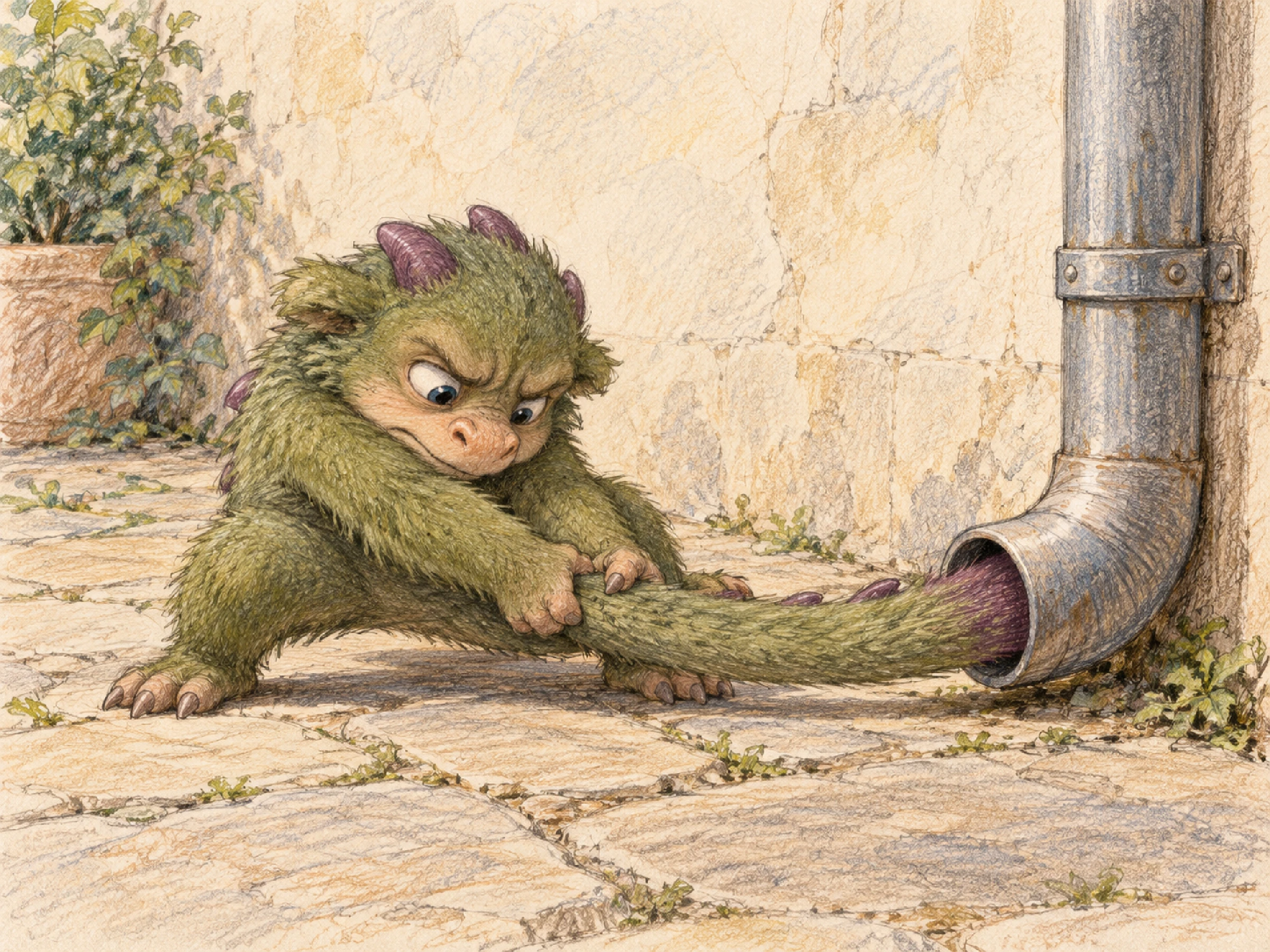
Dragon Pulling Its Tail Free
A small furry dragon uses both forepaws to tug its trapped tail from a drainpipe. Searching pencil lines, layered colored-pencil strokes, and generous exposed paper turn a minor predicament into an affectionate character scene.
Remix this referenceDragon Pulling Its Tail Free
- Form language
- Build forms from blunt interlocking masses and elastic connecting curves; simplify secondary detail without regularizing every shape.
- Contour
- Use searching graphite contours with pressure changes, occasional doubled edges, and open gaps where the line lifts.
- Mark-making
- Layer colored-pencil strokes in loose directional clusters, allowing broken tips, uneven density, and a few visible construction traces.
- Surface rendering
- Let paper tooth interrupt pigment; build tone through overlapping hatching and selective rubbing, with natural variation in unfinished edges.
Priority
Preserve the visible rough pencil and colored-pencil sketchbook character.
What to avoid & what to check
Exact prompt for this example
MODULE OWNERSHIP
subject: Subject count, type, stable proportions and landmarks, resting face geometry, hair shape, physical materials, garment construction and permanent marks. No emotion, movement, color assignment or rendering recipe.
expression: Facial soft-tissue displacement and pupil direction, muscle coordination, regional intensity, asymmetry and onset/peak/release. No head/body pose, stable appearance, skin color or rendering.
gesture: Head/neck/body/limb orientation, joint movement, support, contact and pose-caused occlusion using existing anatomy. No eye/pupil movement, emotion, identity, props inventory or camera.
props: Prop count, type, construction, physical material and scale relative to the subject. Holding/contact belongs to gesture, position to composition, color to palette.
scene: Environment elements, terrain, backdrop/floor presence and structural detail. No canvas positions, camera, lighting, assigned colors or render texture.
camera: Projection, focal-length impression, camera elevation/yaw/roll, viewing distance and crop. No actor pose, world placement, lighting or canvas aspect ratio.
composition: Normalized 0-100% canvas positions, scale in frame, depth/overlap, focal hierarchy and margins. No joint pose, camera projection, rendering, subject/prop inventory or emotion.
palette: Color anchors, hue/saturation/value ranges, colors assigned to parts and approximate color coverage. No illumination direction, shading algorithm, physical material or layout.
lighting: Light-source direction/softness/intensity, ambient illumination, physical shadow direction/length and highlight position. Absence of directional illumination is allowed. No shading technique, palette or material changes.
style: Reusable form abstraction, contour weight/taper/edge quality, medium and mark scale/density/direction, surface rendering and tonal transition technique. No fixed subject proportions, anatomy, identity, expression, pose, palette, light-source direction, camera or layout.
output: Image count, aspect ratio, size, file/alpha requirements and global lettering/logo/watermark restrictions. No background scenery, crop, style, identity or pose.

SUBJECT
inventory: A is one original small, furry, wingless dragon; no other creatures appear.
geometry: A has a low broad chest, sturdy hindquarters, grasping forepaws, blunt horn buds, and a long tapering tail.
resting-face: A has a short rounded muzzle, fleshy brow ridges, widely spaced eyes, a broad nose pad, and a small lower jaw.
appearance: Short dense fur covers A; the nose pad and paw pads are bare, and the horn buds are smooth keratin.

PRIORITY


AVOID


CHECK


EXPRESSION — ACTOR A
brows: The inner brow ridges pull down and together into a compact furrow.
lids: Both lower lids tighten; one upper lid narrows slightly more.
cheeks: The muzzle cheeks draw inward slightly without ballooning.
nose: The nostrils widen subtly while the nose bridge stays unwrinkled.
mouth: The lips press together, with one corner pulled a little farther sideways.
jaw: The jaw remains closed with a small visible tightening beneath the muzzle.
gaze: Both pupils aim down toward the tail between the forepaws.
coordination: The firm brow and compressed mouth carry effort; the eyes remain attentive rather than panicked.
timing: Hold the apex of a sustained tug, before the face relaxes.

PRIORITY


AVOID


CHECK


GESTURE
head: A lowers its chin toward its forepaws while keeping the muzzle clear of them.
torso: A crouches low and leans its chest backward away from the pipe.
limbs: The hindfeet brace apart; both bent forelegs pull the visible tail toward the belly.
contact: Both forepaws grip the tail just outside the pipe mouth; its tip disappears inside, and the hindfeet bear weight.

PRIORITY


AVOID


CHECK


PROPS
inventory: No separate props.
construction: No prop construction applies.

PRIORITY


AVOID


CHECK


SCENE
inventory: A modest courtyard contains a plaster wall, a fixed rainwater pipe, and a worn paving floor.
structure: The pipe descends along the wall and ends in an open elbow near the ground; paving joints are irregular.

PRIORITY


AVOID


CHECK


CAMERA
projection: Use gentle perspective with the natural spatial impression of a normal lens.
viewpoint: View from a three-quarter side angle, slightly above A's face, with no camera roll.
crop: Use a full-body view that includes the entire visible tail and the pipe's lower elbow.

PRIORITY


AVOID


CHECK


COMPOSITION
placement: Set A low and left of center, balanced by the pipe on the right and a broad open upper field.
depth: The face and forepaws lead attention; the tail connects them to the pipe, with the wall receding behind.
spacing: Leave generous breathing room above and around the back; keep the paw-to-tail junction easy to read.

PRIORITY


AVOID


CHECK


PALETTE
colors: Use warm ivory, muted moss green, dusty plum, graphite gray, and a small peach accent.
assignment: Give A moss fur, a peach muzzle, and plum horns and tail tip; use gray for the pipe and ivory for the courtyard.
balance: Let ivory dominate, with moss as the main colored mass and restrained plum providing contrast.

PRIORITY


AVOID


CHECK


LIGHTING
sources: Broad daylight enters from the upper left, with soft ambient fill throughout the courtyard.
shadows: A soft, short shadow falls to the lower right, with deeper contact shadows beneath the feet.
highlights: Keep broad, subdued highlights on the upper muzzle, horn buds, and exposed curve of the pipe.

PRIORITY


AVOID


CHECK


STYLE GUIDE
form-language: Build forms from blunt interlocking masses and elastic connecting curves; simplify secondary detail without regularizing every shape.
contour: Use searching graphite contours with pressure changes, occasional doubled edges, and open gaps where the line lifts.
mark-making: Layer colored-pencil strokes in loose directional clusters, allowing broken tips, uneven density, and a few visible construction traces.
surface-rendering: Let paper tooth interrupt pigment; build tone through overlapping hatching and selective rubbing, with natural variation in unfinished edges.

PRIORITY
Preserve the visible rough pencil and colored-pencil sketchbook character.

AVOID


CHECK


OUTPUT
format: Deliver one image, landscape 4:3, 2400 × 1800 pixels, as an opaque PNG.
restrictions: Include no lettering, logos, signatures, or watermarks.

PRIORITY


AVOID


CHECK


FINAL INTEGRATION
expression + gesture + composition: Let the acting and visible contact explain the predicament while the surrounding space gives it an unhurried rhythm.
Model information comes from image provenance. The same prompt may produce a different result.