Text to imageAnimationStyle guide
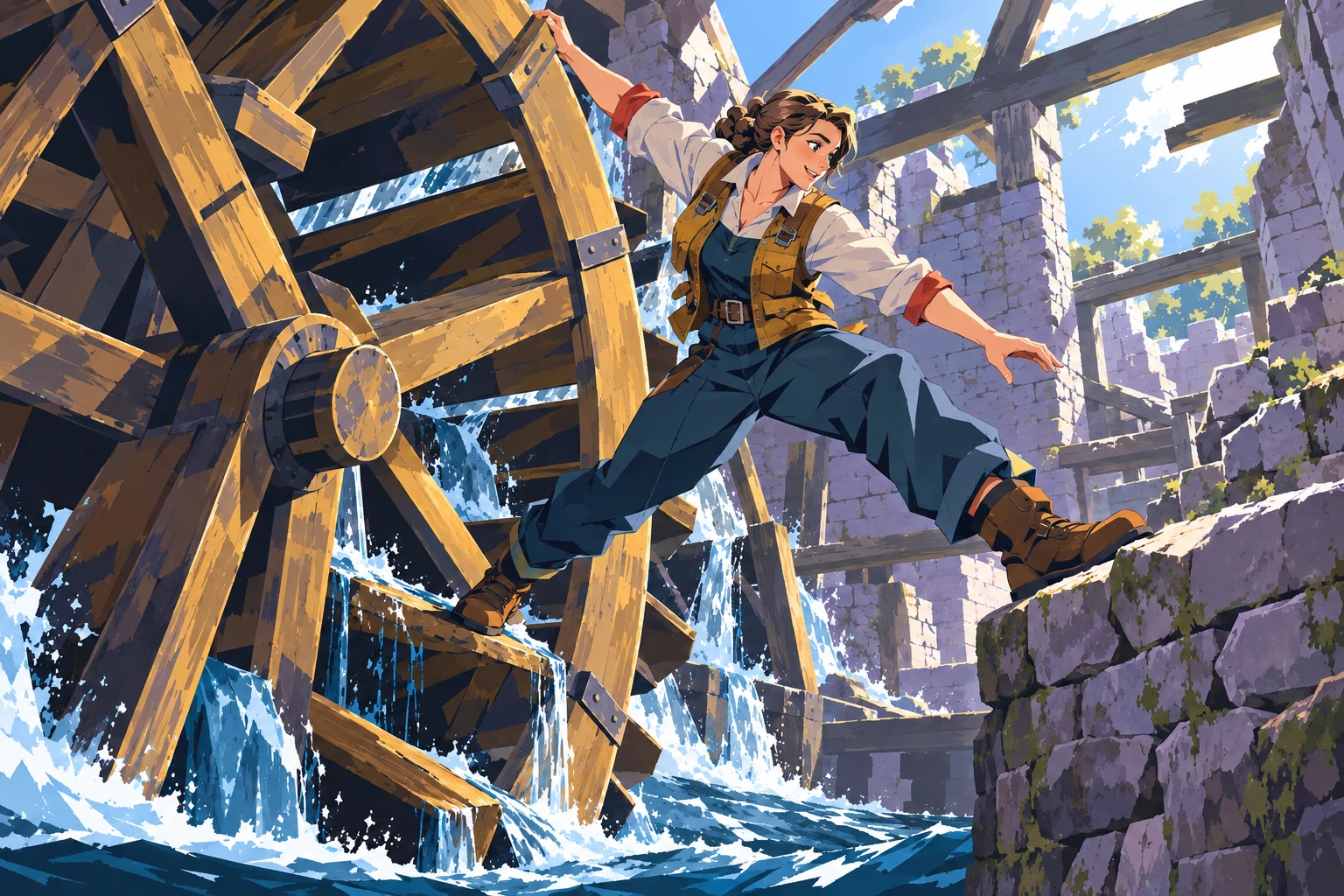
Millwright Stepping Off a Waterwheel
Inside a roofless mill, a millwright uses an enormous waterwheel to reach a stone ledge. Overlapping paddles and falling water surround the beginning of her smile in an angular graphic animation scene.
Remix this referenceMillwright Stepping Off a Waterwheel
- Form language
- Abstract broad surfaces into wedges and interlocking angular facets; vary the smaller shapes while maintaining a decisive graphic rhythm.
- Contour
- Use strong exterior weight contrast, tapering corners and short sharp interior cuts; let selected plane boundaries remain unoutlined.
- Mark-making
- Place sparse sharp strokes and small angular fragments at surface breaks; leave clean planes quiet, with naturally varied mark lengths.
- Surface rendering
- Resolve volume with a small set of sharply separated tonal planes instead of gradients; occasional broken edges prevent a mechanical finish.
Priority
Rendering medium: 2D angular Japanese anime graphic illustration; formal rendering reference: TRIGGER · 2010s · Promare (2019)
What to avoid & what to check
Exact prompt for this example
MODULE OWNERSHIP
subject: Subject count, type, stable proportions and landmarks, resting face geometry, hair shape, physical materials, garment construction and permanent marks. No emotion, movement, color assignment or rendering recipe.
expression: Facial soft-tissue displacement and pupil direction, muscle coordination, regional intensity, asymmetry and onset/peak/release. No head/body pose, stable appearance, skin color or rendering.
gesture: Head/neck/body/limb orientation, joint movement, support, contact and pose-caused occlusion using existing anatomy. No eye/pupil movement, emotion, identity, props inventory or camera.
props: Prop count, type, construction, physical material and scale relative to the subject. Holding/contact belongs to gesture, position to composition, color to palette.
scene: Environment elements, terrain, backdrop/floor presence and structural detail. No canvas positions, camera, lighting, assigned colors or render texture.
camera: Projection, focal-length impression, camera elevation/yaw/roll, viewing distance and crop. No actor pose, world placement, lighting or canvas aspect ratio.
composition: Normalized 0-100% canvas positions, scale in frame, depth/overlap, focal hierarchy and margins. No joint pose, camera projection, rendering, subject/prop inventory or emotion.
palette: Color anchors, hue/saturation/value ranges, colors assigned to parts and approximate color coverage. No illumination direction, shading algorithm, physical material or layout.
lighting: Light-source direction/softness/intensity, ambient illumination, physical shadow direction/length and highlight position. Absence of directional illumination is allowed. No shading technique, palette or material changes.
style: Reusable form abstraction, contour weight/taper/edge quality, medium and mark scale/density/direction, surface rendering and tonal transition technique. No fixed subject proportions, anatomy, identity, expression, pose, palette, light-source direction, camera or layout.
output: Image count, aspect ratio, size, file/alpha requirements and global lettering/logo/watermark restrictions. No background scenery, crop, style, identity or pose.

SUBJECT
inventory: One original adult human woman, a millwright.
geometry: A sturdy build with broad hands, a long torso and compact limbs; a square chin is her defining facial landmark.
resting-face: Straight brows, shallow upper-lid folds, a broad nose tip and a wide mouth with a fuller lower lip.
appearance: A thick braid coils at her nape; a heavy canvas vest covers a cuffed shirt, with work trousers and leather boots.

PRIORITY


AVOID


CHECK


EXPRESSION — ACTOR A
brows: Both brows lift slightly, with the left brow leading.
lids: Upper lids open a little while lower lids begin to rise.
cheeks: Cheeks begin lifting, slightly stronger on the left.
nose: Nostrils remain relaxed without a bridge wrinkle.
mouth: The left mouth corner rises first; the lips part into a small emerging smile.
jaw: The jaw releases only enough for the small lip opening.
gaze: Pupils look down and right toward the landing ledge.
coordination: The smile begins before the eyes fully narrow, preserving an alert look.
timing: Capture the onset of delight, before the smile spreads fully.

PRIORITY


AVOID


CHECK


GESTURE
head: A turns her head toward the landing and dips her chin slightly, keeping her neck extended.
torso: Her torso stretches sideways from the wheel toward the ledge, with a small counterturn through the shoulders.
limbs: Her right arm reaches overhead, her left arm opens for balance, and her leading leg extends toward the landing.
contact: Her right hand grips the rim; her trailing boot rests on a paddle while her leading boot just meets the stone edge.

PRIORITY


AVOID


CHECK


PROPS
inventory: No separate props.
construction: No prop construction applies.

PRIORITY


AVOID


CHECK


SCENE
inventory: A roofless watermill contains an enormous installed timber waterwheel, a stone landing and an open millrace.
structure: Broad paddles join a thick rim and spoke hub; water spills between them beside broken masonry walls and exposed beams.

PRIORITY


AVOID


CHECK


CAMERA
projection: Perspective with a moderately wide lens impression and clear near-to-far expansion.
viewpoint: Look slightly upward from across the millrace, obliquely along the wheel face, with a level horizon.
crop: A full-body environmental view; the waterwheel extends beyond the frame while the actor remains fully visible.

PRIORITY


AVOID


CHECK


COMPOSITION
placement: A spans the middle-right at about two-thirds frame height; the wheel dominates the left and the ledge enters from the right.
depth: Near paddles overlap the hub and distant beams; A crosses their silhouette, with her face and leading boot clearly separated.
spacing: The face leads, followed by the boot-to-ledge contact and wheel arc; an open pocket surrounds the face and outstretched hand.

PRIORITY


AVOID


CHECK


PALETTE
colors: Use deep petrol blue, muted ochre, chalk lavender and a restrained vermilion accent.
assignment: Ochre belongs to the wheel and vest, petrol blue to water and trousers, lavender to masonry, and vermilion to shirt cuffs.
balance: Petrol blue and ochre form the broad color fields; lavender gives breathing room, with warm skin and sparse vermilion accents.

PRIORITY


AVOID


CHECK


LIGHTING
sources: Broad daylight enters from the upper right through the missing roof, supported by soft open-sky ambient light.
shadows: Paddles cast overlapping shadows down and left; ambient light keeps the shadowed face readable.
highlights: Highlights gather on upper-right paddle edges, the brow ridge and the exposed water crests.

PRIORITY


AVOID


CHECK


STYLE GUIDE
form-language: Abstract broad surfaces into wedges and interlocking angular facets; vary the smaller shapes while maintaining a decisive graphic rhythm.
contour: Use strong exterior weight contrast, tapering corners and short sharp interior cuts; let selected plane boundaries remain unoutlined.
mark-making: Place sparse sharp strokes and small angular fragments at surface breaks; leave clean planes quiet, with naturally varied mark lengths.
surface-rendering: Resolve volume with a small set of sharply separated tonal planes instead of gradients; occasional broken edges prevent a mechanical finish.

PRIORITY
Rendering medium: 2D angular Japanese anime graphic illustration; formal rendering reference: TRIGGER · 2010s · Promare (2019)

AVOID


CHECK


OUTPUT
format: One finished image, 3:2 landscape, 1536 × 1024 pixels, opaque PNG.
restrictions: No lettering, logos, signatures or watermarks.

PRIORITY


AVOID


CHECK


FINAL INTEGRATION
expression + gesture + composition: Keep facial acting legible within the larger crossing action through the available silhouette gaps.
scene + lighting + style: Let environmental construction and illumination guide the graphic simplification while retaining their separate roles.
Art direction
트리거 / TRIGGER · 2010s · 프로메어(2019) / Promare (2019) ↗- Abstract form surfaces into wedges, triangles and angular facets
- Strong exterior weight contrast with short sharp interior cuts
- Small angular facets and sharp marks, with no marks in clean planes
- A small set of sharply separated tonal planes in place of gradients
Model information comes from image provenance. The same prompt may produce a different result.