Text to imageCafe & brandStyle guide
Long Table with an Open Place
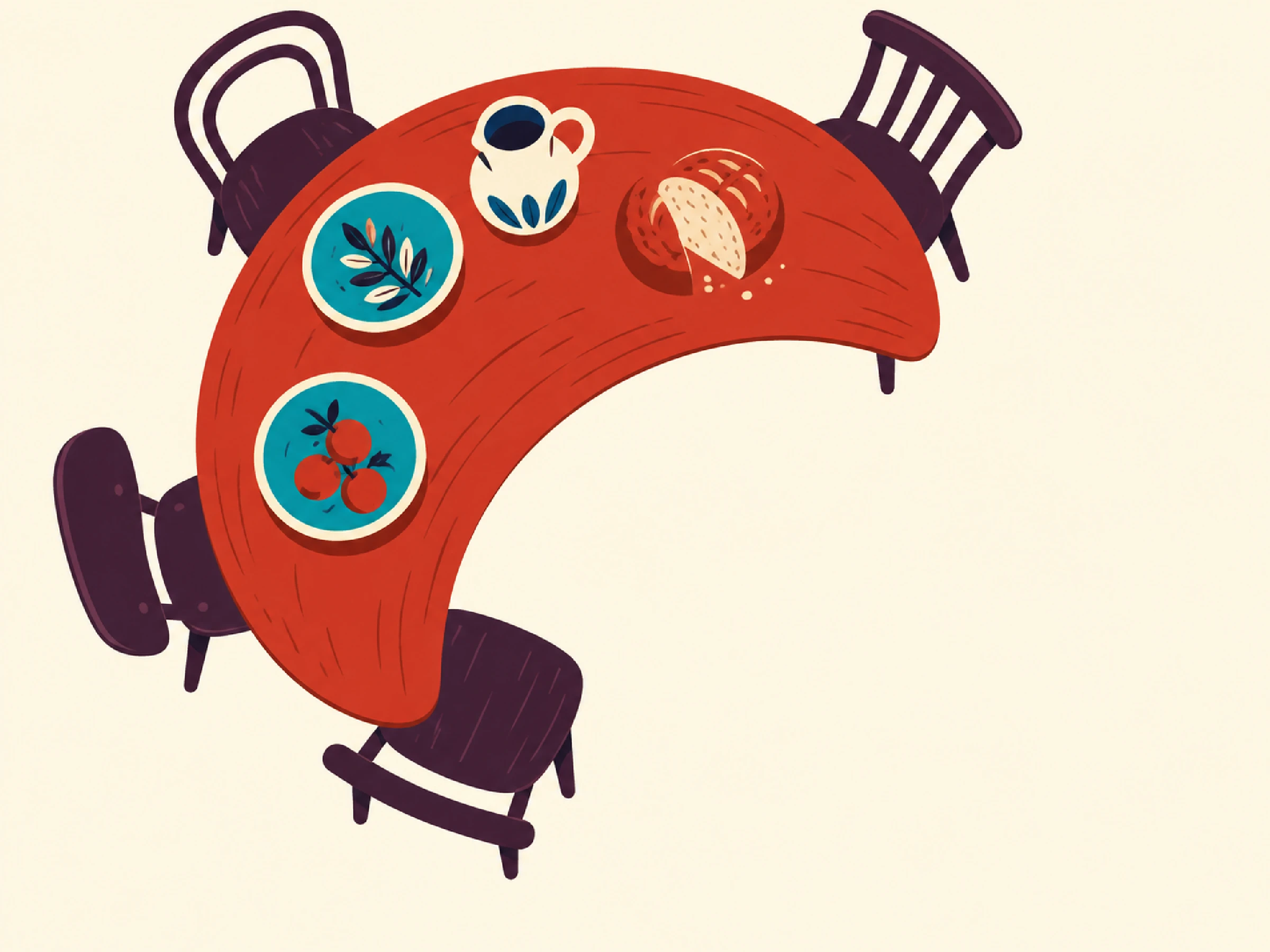
A brand key visual for a neighborhood communal supper. A crescent table and mismatched chairs surround a generous open place, using crisp vector shapes and playful asymmetry to suggest an invitation.
Remix this referenceLong Table with an Open Place
- Form language
- Reduce forms to bold closed vector masses, using offbeat curves and unequal cutouts; keep small details freely variable.
- Contour
- Use crisp, smooth silhouette edges and only a few short interior strokes; allow rounded bends to meet abrupt cuts.
- Mark-making
- Build the image from economical vector paths; sparse wedge-shaped notches and curved dashes provide playful punctuation.
- Surface rendering
- Use solid fields with occasional inset patches for surface distinctions; keep transitions graphic and decisively edged.
Priority
Preserve crisp vector abstraction and playful asymmetry throughout.
What to avoid & what to check
Exact prompt for this example
MODULE OWNERSHIP
subject: Subject count, type, stable proportions and landmarks, resting face geometry, hair shape, physical materials, garment construction and permanent marks. No emotion, movement, color assignment or rendering recipe.
expression: Facial soft-tissue displacement and pupil direction, muscle coordination, regional intensity, asymmetry and onset/peak/release. No head/body pose, stable appearance, skin color or rendering.
gesture: Head/neck/body/limb orientation, joint movement, support, contact and pose-caused occlusion using existing anatomy. No eye/pupil movement, emotion, identity, props inventory or camera.
props: Prop count, type, construction, physical material and scale relative to the subject. Holding/contact belongs to gesture, position to composition, color to palette.
scene: Environment elements, terrain, backdrop/floor presence and structural detail. No canvas positions, camera, lighting, assigned colors or render texture.
camera: Projection, focal-length impression, camera elevation/yaw/roll, viewing distance and crop. No actor pose, world placement, lighting or canvas aspect ratio.
composition: Normalized 0-100% canvas positions, scale in frame, depth/overlap, focal hierarchy and margins. No joint pose, camera projection, rendering, subject/prop inventory or emotion.
palette: Color anchors, hue/saturation/value ranges, colors assigned to parts and approximate color coverage. No illumination direction, shading algorithm, physical material or layout.
lighting: Light-source direction/softness/intensity, ambient illumination, physical shadow direction/length and highlight position. Absence of directional illumination is allowed. No shading technique, palette or material changes.
style: Reusable form abstraction, contour weight/taper/edge quality, medium and mark scale/density/direction, surface rendering and tonal transition technique. No fixed subject proportions, anatomy, identity, expression, pose, palette, light-source direction, camera or layout.
output: Image count, aspect ratio, size, file/alpha requirements and global lettering/logo/watermark restrictions. No background scenery, crop, style, identity or pose.

SUBJECT
inventory: One communal dining table and four mismatched dining chairs; no people or animals.
geometry: The table has a broad crescent top; the chairs have loop, slat, solid paddle and low rail backs.
resting-face: No facial anatomy applies to the furniture.
appearance: Wooden furniture with rounded edges and ordinary fitted joints; minor construction details may vary.

PRIORITY


AVOID


CHECK


PROPS
inventory: Two shallow serving dishes, one squat pitcher and one split round loaf, all sized for the table.
construction: The dishes and pitcher are ceramic; the loaf has a firm crust and an exposed soft interior.

PRIORITY


AVOID


CHECK


SCENE
inventory: A continuous backdrop with no room architecture, floor boundary or environmental decoration.
structure: The backdrop remains uninterrupted, allowing the furniture arrangement to function as a graphic design.

PRIORITY


AVOID


CHECK


CAMERA
projection: Orthographic projection with no perspective convergence.
viewpoint: Look directly down from above, with no camera roll.
crop: Show the complete furniture arrangement and all serving objects in a spacious overall view.

PRIORITY


AVOID


CHECK


COMPOSITION
placement: The table sweeps across the upper-left and middle; its open inner curve faces the lower-right.
depth: Chairs partly tuck beneath the outer table edge; serving objects overlap the tabletop in a loose cluster.
spacing: The crescent silhouette leads; leave the lower-right broadly empty, with unequal chair gaps and clear margins.

PRIORITY


AVOID


CHECK


PALETTE
colors: Warm ivory, tomato red, deep aubergine and bright turquoise form a compact, expressive palette.
assignment: Ivory backdrop and ceramics, red tabletop and bread accents, aubergine chairs, turquoise dish interiors.
balance: Ivory occupies the largest area; red supplies the main color mass, with restrained dark and turquoise accents.

PRIORITY


AVOID


CHECK


LIGHTING
sources: Use nondirectional illumination with no visible light-source cue.
shadows: No physical cast shadows are present.
highlights: No localized illumination highlights are present.

PRIORITY


AVOID


CHECK


STYLE GUIDE
form-language: Reduce forms to bold closed vector masses, using offbeat curves and unequal cutouts; keep small details freely variable.
contour: Use crisp, smooth silhouette edges and only a few short interior strokes; allow rounded bends to meet abrupt cuts.
mark-making: Build the image from economical vector paths; sparse wedge-shaped notches and curved dashes provide playful punctuation.
surface-rendering: Use solid fields with occasional inset patches for surface distinctions; keep transitions graphic and decisively edged.

PRIORITY
Preserve crisp vector abstraction and playful asymmetry throughout.

AVOID


CHECK


OUTPUT
format: One finished image, landscape 4:3, 2400 × 1800 pixels, opaque PNG.
restrictions: No lettering, logos or watermarks.

PRIORITY


AVOID


CHECK


FINAL INTEGRATION
subject + composition + style: Keep furniture recognizable while letting its structural differences become an inviting graphic rhythm.
Model information comes from image provenance. The same prompt may produce a different result.