Text to imageProductStyle guide
Recorder on the Reed Walk
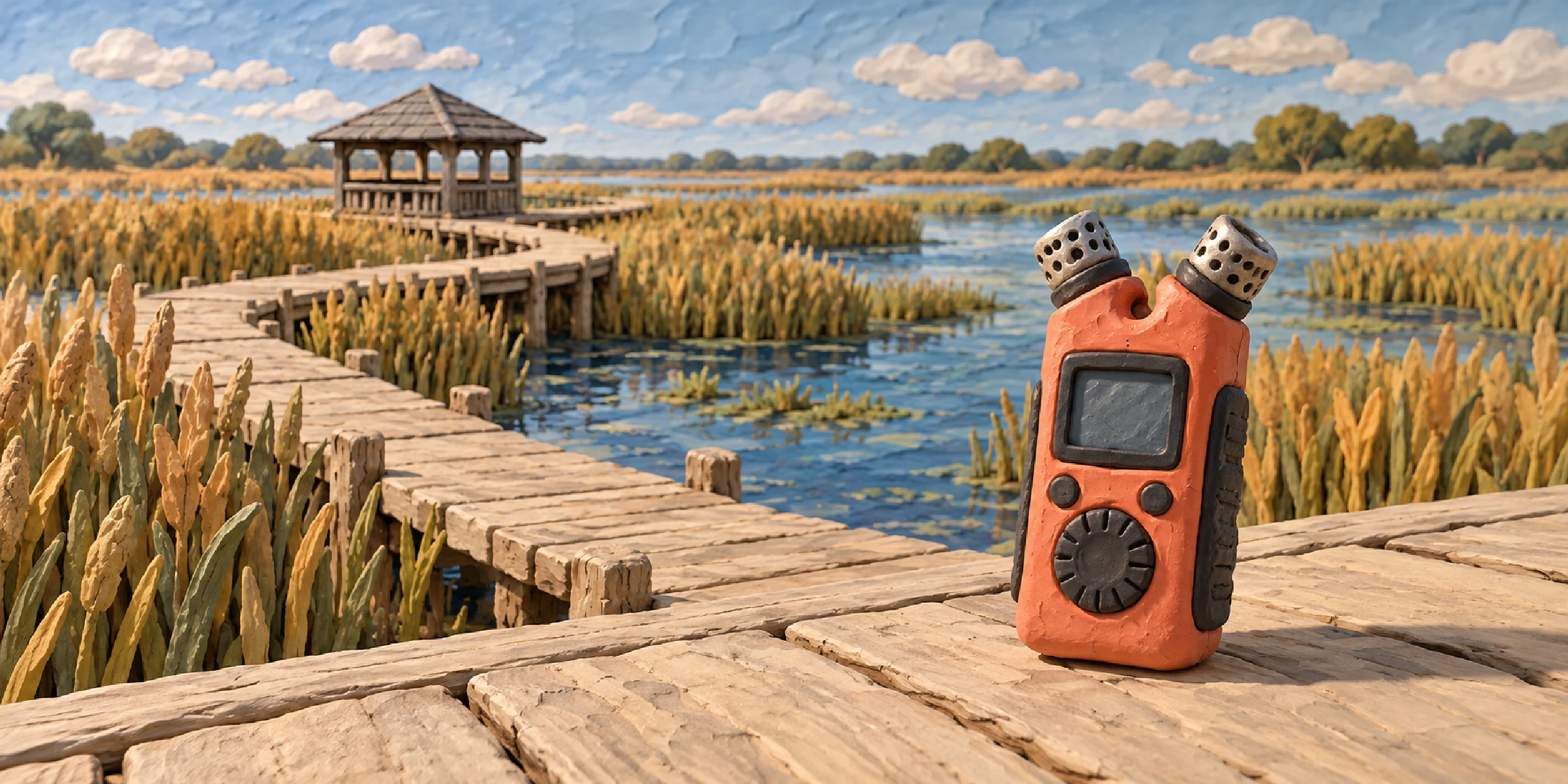
An original portable recorder beside a winding wetland boardwalk. A handmade clay miniature treatment connects its tactile construction to a landscape that invites a journey of listening.
Remix this referenceRecorder on the Reed Walk
- Form language
- Translate forms into hand-built slabs, rounded extrusions and pinched clusters; retain small asymmetries within a coherent sculptural language.
- Contour
- Use rounded, slightly wavering silhouettes and softly compressed junctions; contours come from sculpted edges rather than drawn outlines.
- Mark-making
- Leave selective thumb presses and broad tool drags; vary their spacing naturally and simplify small detail into a few confident impressions.
- Surface rendering
- Render matte clay with softly mottled pigment, shallow smears and gradual tonal rolls; retain handmade surface irregularity without uniform texture.
Priority
The finished image must visibly read as a tactile, hand-built clay miniature.
What to avoid & what to check
Exact prompt for this example
MODULE OWNERSHIP
subject: Subject count, type, stable proportions and landmarks, resting face geometry, hair shape, physical materials, garment construction and permanent marks. No emotion, movement, color assignment or rendering recipe.
expression: Facial soft-tissue displacement and pupil direction, muscle coordination, regional intensity, asymmetry and onset/peak/release. No head/body pose, stable appearance, skin color or rendering.
gesture: Head/neck/body/limb orientation, joint movement, support, contact and pose-caused occlusion using existing anatomy. No eye/pupil movement, emotion, identity, props inventory or camera.
props: Prop count, type, construction, physical material and scale relative to the subject. Holding/contact belongs to gesture, position to composition, color to palette.
scene: Environment elements, terrain, backdrop/floor presence and structural detail. No canvas positions, camera, lighting, assigned colors or render texture.
camera: Projection, focal-length impression, camera elevation/yaw/roll, viewing distance and crop. No actor pose, world placement, lighting or canvas aspect ratio.
composition: Normalized 0-100% canvas positions, scale in frame, depth/overlap, focal hierarchy and margins. No joint pose, camera projection, rendering, subject/prop inventory or emotion.
palette: Color anchors, hue/saturation/value ranges, colors assigned to parts and approximate color coverage. No illumination direction, shading algorithm, physical material or layout.
lighting: Light-source direction/softness/intensity, ambient illumination, physical shadow direction/length and highlight position. Absence of directional illumination is allowed. No shading technique, palette or material changes.
style: Reusable form abstraction, contour weight/taper/edge quality, medium and mark scale/density/direction, surface rendering and tonal transition technique. No fixed subject proportions, anatomy, identity, expression, pose, palette, light-source direction, camera or layout.
output: Image count, aspect ratio, size, file/alpha requirements and global lettering/logo/watermark restrictions. No background scenery, crop, style, identity or pose.

SUBJECT
inventory: One original portable field recorder with a compact enclosure and two exposed microphone capsules.
geometry: A broad rounded body divides into a short fork at the top; an inset screen sits above a generous circular thumb wheel.
resting-face: An inanimate product with no facial anatomy or face-like arrangement of controls.
appearance: A polymer shell, rubber side grips, perforated metal microphone caps and recessed glass screen form the permanent assembly.

PRIORITY


AVOID


CHECK


PROPS
inventory: No separate props.
construction: No prop construction applies.

PRIORITY


AVOID


CHECK


SCENE
inventory: A reed wetland with a timber boardwalk, shallow open-water channels and a small roofed listening shelter.
structure: Broad planks widen into a modest landing; the continuing walkway bends between reed islands toward the shelter.

PRIORITY


AVOID


CHECK


CAMERA
projection: Moderately wide perspective with gentle distance recession and restrained near-object enlargement.
viewpoint: Look slightly downward from just above landing height, with a three-quarter view of the recorder and a level horizon.
crop: An environmental product view includes the entire recorder, its supporting planks and the distant shelter.

PRIORITY


AVOID


CHECK


COMPOSITION
placement: The recorder anchors the lower right near 72% across, occupying about one third of the image height.
depth: Read the recorder first, follow the boardwalk through overlapping reed masses, then discover the small distant shelter.
spacing: Keep a clear interval around the microphone fork; broad water openings interrupt the denser route across the panorama.

PRIORITY


AVOID


CHECK


PALETTE
colors: Use chalky coral, muted petrol blue, reed ochre and warm limestone, with narrow charcoal accents.
assignment: Coral defines the recorder shell; charcoal marks grips and screen; petrol blue fills water, ochre reeds and limestone planks.
balance: Let restrained landscape colors dominate the area while the smaller, more saturated shell supplies the strongest color accent.

PRIORITY


AVOID


CHECK


LIGHTING
sources: A broad soft source from upper left illuminates the miniature, supported by gentle ambient fill.
shadows: Short shadows fall toward the right, with firmer contact beneath the recorder and softer separation between reed clusters.
highlights: Broad highlights sit on upper-left shell curves and microphone rims without sharp glare.

PRIORITY


AVOID


CHECK


STYLE GUIDE
form-language: Translate forms into hand-built slabs, rounded extrusions and pinched clusters; retain small asymmetries within a coherent sculptural language.
contour: Use rounded, slightly wavering silhouettes and softly compressed junctions; contours come from sculpted edges rather than drawn outlines.
mark-making: Leave selective thumb presses and broad tool drags; vary their spacing naturally and simplify small detail into a few confident impressions.
surface-rendering: Render matte clay with softly mottled pigment, shallow smears and gradual tonal rolls; retain handmade surface irregularity without uniform texture.

PRIORITY
The finished image must visibly read as a tactile, hand-built clay miniature.

AVOID


CHECK


OUTPUT
format: One finished image, panoramic 2:1 aspect ratio, 2400 × 1200 pixels, opaque PNG.
restrictions: Deliver one finished image at 2:1, 2400 × 1200 pixels, as an opaque PNG; no lettering, logos or watermarks.

PRIORITY


AVOID


CHECK
Model information comes from image provenance. The same prompt may produce a different result.