Text to imageCharacterStyle guide
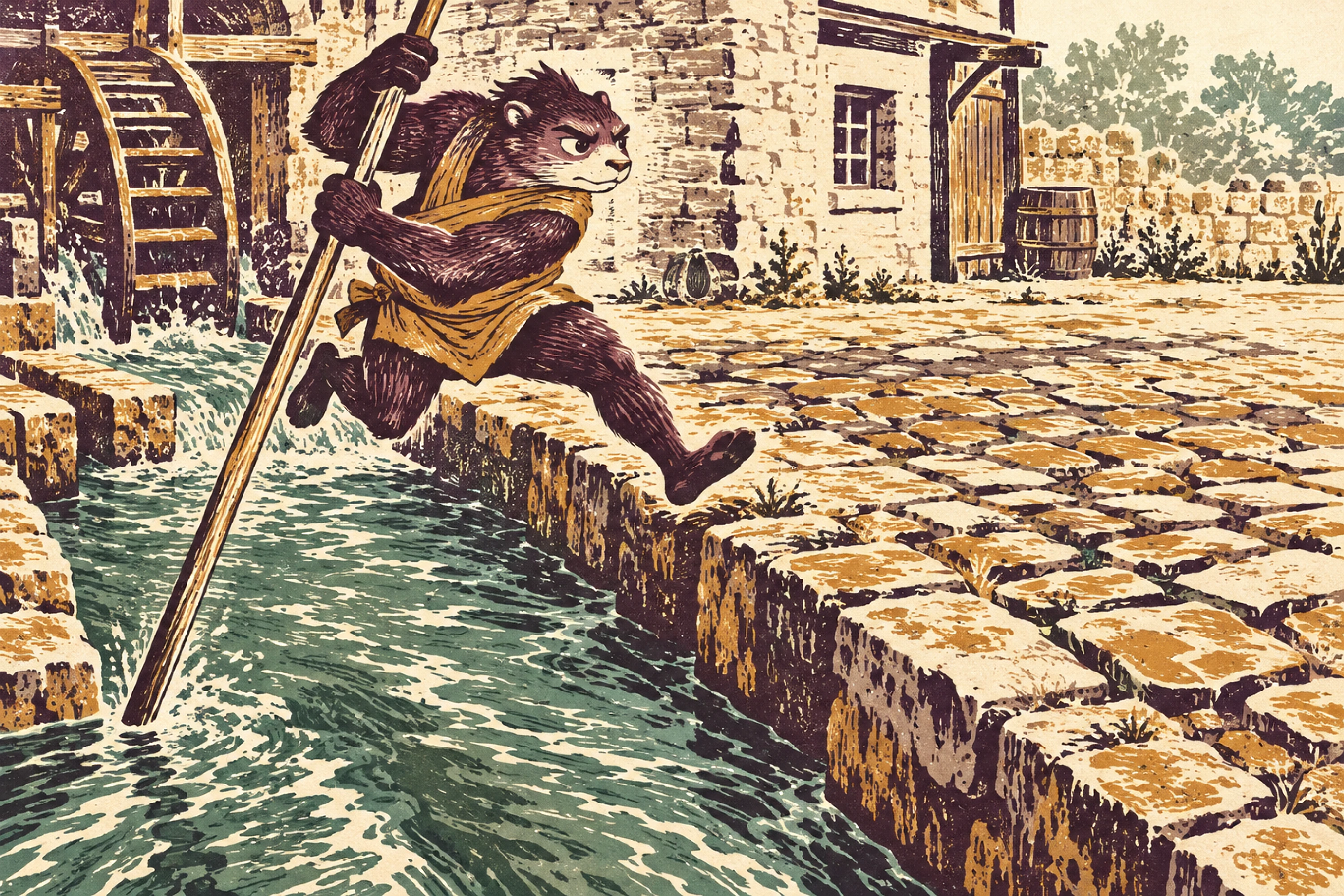
A Bristled Creature Vaulting a Millrace
A bristled creature rides a pole across a millrace. Bold linocut masses and curving gouge marks carry the leap through a spacious mill yard.
Remix this referenceA Bristled Creature Vaulting a Millrace
- Form language
- Reduce forms to interlocking bold masses and open cutouts; preserve small irregularities that keep the shapes lively rather than diagrammatic.
- Contour
- Use forceful relief-print edges with blunt turns and occasional chipped interruptions; avoid uniform outline bands.
- Mark-making
- Carve sweeping gouge rhythms through larger masses, alternating broad scoops with short broken cuts and naturally uneven spacing.
- Surface rendering
- Build tone through cut density and inked reserves, leaving open passages unprinted; allow slight ink starvation and modest registration drift to reveal the pulled print.
Priority
Preserve the bold linocut identity through carved rhythmic marks and substantial inked masses.
What to avoid & what to check
Exact prompt for this example
MODULE OWNERSHIP
subject: Subject count, type, stable proportions and landmarks, resting face geometry, hair shape, physical materials, garment construction and permanent marks. No emotion, movement, color assignment or rendering recipe.
expression: Facial soft-tissue displacement and pupil direction, muscle coordination, regional intensity, asymmetry and onset/peak/release. No head/body pose, stable appearance, skin color or rendering.
gesture: Head/neck/body/limb orientation, joint movement, support, contact and pose-caused occlusion using existing anatomy. No eye/pupil movement, emotion, identity, props inventory or camera.
props: Prop count, type, construction, physical material and scale relative to the subject. Holding/contact belongs to gesture, position to composition, color to palette.
scene: Environment elements, terrain, backdrop/floor presence and structural detail. No canvas positions, camera, lighting, assigned colors or render texture.
camera: Projection, focal-length impression, camera elevation/yaw/roll, viewing distance and crop. No actor pose, world placement, lighting or canvas aspect ratio.
composition: Normalized 0-100% canvas positions, scale in frame, depth/overlap, focal hierarchy and margins. No joint pose, camera projection, rendering, subject/prop inventory or emotion.
palette: Color anchors, hue/saturation/value ranges, colors assigned to parts and approximate color coverage. No illumination direction, shading algorithm, physical material or layout.
lighting: Light-source direction/softness/intensity, ambient illumination, physical shadow direction/length and highlight position. Absence of directional illumination is allowed. No shading technique, palette or material changes.
style: Reusable form abstraction, contour weight/taper/edge quality, medium and mark scale/density/direction, surface rendering and tonal transition technique. No fixed subject proportions, anatomy, identity, expression, pose, palette, light-source direction, camera or layout.
output: Image count, aspect ratio, size, file/alpha requirements and global lettering/logo/watermark restrictions. No background scenery, crop, style, identity or pose.

SUBJECT
inventory: One original bipedal creature, actor A; no other figures.
geometry: A compact pear-shaped torso, long legs, mitten-like hands and a short wedge-shaped head form its distinctive build.
resting-face: The face has wide-set oval eyes, low straight brows, a broad square muzzle and a short horizontal mouth.
appearance: Coarse fur forms a short ridge from crown to back; small rounded ears and a woven wrap tunic complete the design.

PRIORITY


AVOID


CHECK


EXPRESSION — ACTOR A
brows: The brows lower inward into a shallow concentrated V.
lids: Upper lids lower slightly while the lower lids remain firm.
cheeks: The cheeks tighten subtly without bunching upward.
nose: The nostrils open slightly; the bridge remains unwrinkled.
mouth: The lips press into a short firm line, with one corner drawn slightly back.
jaw: The jaw is set without baring teeth.
gaze: Both pupils fix on the approaching landing edge.
coordination: Keep the eye tension stronger than the mouth tension, suggesting practiced concentration.
timing: Hold the apex of concentration before the facial tension begins to ease.

PRIORITY


AVOID


CHECK


GESTURE
head: The neck reaches forward and the head turns enough to expose the face beyond the near shoulder.
torso: The torso arches sideways around the planted pole, carrying the belly across the open channel.
limbs: Both arms bear against the pole; one leg reaches toward the landing while the other folds beneath the torso.
contact: The hands grip separate stretches of the pole; its tip braces on the channel bed while both feet remain airborne.

PRIORITY


AVOID


CHECK


PROPS
inventory: One vaulting pole, substantially longer than the creature's standing height.
construction: The pole is a single slender ash-wood shaft with a blunt worn tip and no fittings.

PRIORITY


AVOID


CHECK


SCENE
inventory: An old mill yard contains a narrow open water channel, cobbled ground and a plain masonry mill wall.
structure: Low stone lips border the millrace; uneven cobbles meet the water directly, without rails or a bridge.

PRIORITY


AVOID


CHECK


CAMERA
projection: Use a gently flattened perspective with a normal-to-long focal-length impression.
viewpoint: Look slightly downward across the channel from an oblique side view, with a level horizon.
crop: Use a wide full-figure view that includes the pole's tip and a generous stretch of landing ground.

PRIORITY


AVOID


CHECK


COMPOSITION
placement: Place the figure in the left third, with the landing yard opening broadly toward the right.
depth: The pole crosses the channel diagonally; the figure separates clearly from the distant wall and overlaps the water.
spacing: The figure's silhouette leads, the pole carries attention onward, and spacious ground pauses the rhythm before the far edge.

PRIORITY


AVOID


CHECK


PALETTE
colors: Limit the palette to deep aubergine, burnt ochre, pale jade and warm ivory.
assignment: Aubergine anchors fur and deep accents; ochre distinguishes the tunic and stones; jade belongs to water, ivory to open passages.
balance: Ivory occupies the broadest area; concentrated dark masses and restrained ochre keep the jade a quieter counterpoint.

PRIORITY


AVOID


CHECK


LIGHTING
sources: Broad daylight arrives from the upper right with moderate direction and soft ambient fill.
shadows: The figure casts a soft detached shadow toward the lower left; the stone lips cast short shadows into the channel.
highlights: Light catches the upper muzzle, shoulder ridge and the source-facing edge of the pole.

PRIORITY


AVOID


CHECK


STYLE GUIDE
form-language: Reduce forms to interlocking bold masses and open cutouts; preserve small irregularities that keep the shapes lively rather than diagrammatic.
contour: Use forceful relief-print edges with blunt turns and occasional chipped interruptions; avoid uniform outline bands.
mark-making: Carve sweeping gouge rhythms through larger masses, alternating broad scoops with short broken cuts and naturally uneven spacing.
surface-rendering: Build tone through cut density and inked reserves, leaving open passages unprinted; allow slight ink starvation and modest registration drift to reveal the pulled print.

PRIORITY
Preserve the bold linocut identity through carved rhythmic marks and substantial inked masses.

AVOID


CHECK


OUTPUT
format: Deliver one opaque 3:2 image at 3000 × 2000 pixels.
restrictions: No lettering, logos or watermarks.

PRIORITY


AVOID


CHECK


FINAL INTEGRATION
gesture + composition + style: Let the carved rhythms reinforce the movement while preserving separation between the figure and its surroundings.
Model information comes from image provenance. The same prompt may produce a different result.