Text to imageProductStyle guide
Metronome on the Basketball Court
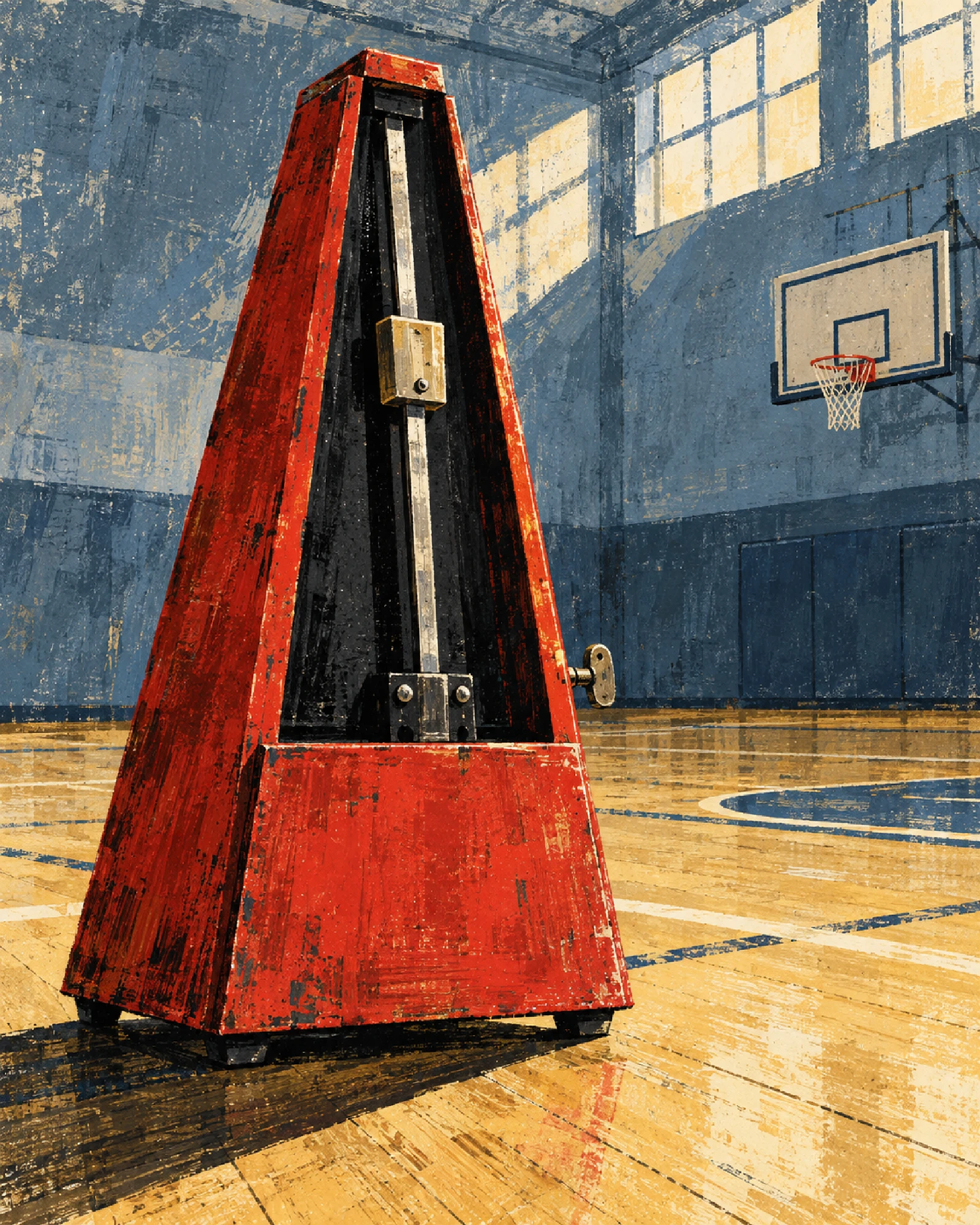
A mechanical metronome enlarged to basketball-hoop scale becomes a product poster of rough ink and displaced print layers.
Remix this referenceMetronome on the Basketball Court
- Form language
- Reduce forms to assertive wedges, bars, and open shapes; interrupt broad masses with narrow cutouts.
- Contour
- Use loaded ink edges that thicken, fray, and occasionally break; let selected boundaries emerge from adjacent printed fields.
- Mark-making
- Mix dragged bristle streaks with blunt stamped patches; allow natural pressure variation and slight displacement between impressions.
- Surface rendering
- Build tone through translucent overprints, uneven ink deposits, and exposed paper flecks; use abrupt transitions beside rubbed passages.
Priority
Keep both spontaneous ink handling and layered print impressions visibly active.
What to avoid & what to check
Exact prompt for this example
MODULE OWNERSHIP
subject: Subject count, type, stable proportions and landmarks, resting face geometry, hair shape, physical materials, garment construction and permanent marks. No emotion, movement, color assignment or rendering recipe.
expression: Facial soft-tissue displacement and pupil direction, muscle coordination, regional intensity, asymmetry and onset/peak/release. No head/body pose, stable appearance, skin color or rendering.
gesture: Head/neck/body/limb orientation, joint movement, support, contact and pose-caused occlusion using existing anatomy. No eye/pupil movement, emotion, identity, props inventory or camera.
props: Prop count, type, construction, physical material and scale relative to the subject. Holding/contact belongs to gesture, position to composition, color to palette.
scene: Environment elements, terrain, backdrop/floor presence and structural detail. No canvas positions, camera, lighting, assigned colors or render texture.
camera: Projection, focal-length impression, camera elevation/yaw/roll, viewing distance and crop. No actor pose, world placement, lighting or canvas aspect ratio.
composition: Normalized 0-100% canvas positions, scale in frame, depth/overlap, focal hierarchy and margins. No joint pose, camera projection, rendering, subject/prop inventory or emotion.
palette: Color anchors, hue/saturation/value ranges, colors assigned to parts and approximate color coverage. No illumination direction, shading algorithm, physical material or layout.
lighting: Light-source direction/softness/intensity, ambient illumination, physical shadow direction/length and highlight position. Absence of directional illumination is allowed. No shading technique, palette or material changes.
style: Reusable form abstraction, contour weight/taper/edge quality, medium and mark scale/density/direction, surface rendering and tonal transition technique. No fixed subject proportions, anatomy, identity, expression, pose, palette, light-source direction, camera or layout.
output: Image count, aspect ratio, size, file/alpha requirements and global lettering/logo/watermark restrictions. No background scenery, crop, style, identity or pose.

SUBJECT
inventory: One original mechanical metronome with an exposed pendulum assembly.
geometry: A tapered pyramidal case surrounds a tall front opening, a slender pendulum rod, and a sliding weight.
resting-face: No face or facial landmarks.
appearance: The case is bent plywood with a solid base; the rod, weight, and small side winding key are metal.

PRIORITY
Keep the mechanical parts distinct enough for immediate metronome recognition.

AVOID


CHECK


PROPS
inventory: No separate props.
construction: No prop construction applies.

PRIORITY


AVOID


CHECK


SCENE
inventory: An empty indoor basketball court with a hoop, backboard, end wall, and timber floor.
structure: Court markings cross the floor; the backboard is wall-mounted, and high windows punctuate the end wall.

PRIORITY


AVOID


CHECK


CAMERA
projection: Perspective with a normal-lens impression and restrained convergence.
viewpoint: View from low standing height at a three-quarter angle, with a slight upward pitch and level roll.
crop: Include the complete metronome and enough surrounding court to read its extraordinary scale.

PRIORITY


AVOID


CHECK


COMPOSITION
placement: Place the metronome left of center, nearly filling the image height, with the distant hoop in the upper right.
depth: The metronome rises from the near court to roughly the hoop's height; floor markings lead toward the distant wall.
spacing: Prioritize the product silhouette, then its pendulum opening; leave breathing room around the hoop and above the case.

PRIORITY


AVOID


CHECK


PALETTE
colors: Use soot black, vermilion, pale butter yellow, and subdued blue-gray.
assignment: Give the case vermilion, the mechanism black, the floor butter yellow, and the wall and backboard blue-gray.
balance: Keep the room pale and subdued; concentrate the saturated hue on the case and dark accents on its mechanism.

PRIORITY


AVOID


CHECK


LIGHTING
sources: Strong daylight enters through the high windows on the upper right, supported by low ambient fill.
shadows: A long, clearly edged product shadow extends toward the lower left across the floor.
highlights: Light catches the right case edge and the exposed right sides of the metal mechanism.

PRIORITY


AVOID


CHECK


STYLE GUIDE
form-language: Reduce forms to assertive wedges, bars, and open shapes; interrupt broad masses with narrow cutouts.
contour: Use loaded ink edges that thicken, fray, and occasionally break; let selected boundaries emerge from adjacent printed fields.
mark-making: Mix dragged bristle streaks with blunt stamped patches; allow natural pressure variation and slight displacement between impressions.
surface-rendering: Build tone through translucent overprints, uneven ink deposits, and exposed paper flecks; use abrupt transitions beside rubbed passages.

PRIORITY
Keep both spontaneous ink handling and layered print impressions visibly active.

AVOID


CHECK


OUTPUT
format: One finished image, portrait 4:5, 1600 × 2000 pixels, opaque PNG.
restrictions: No lettering, numerals, logos, signatures, or watermarks; court markings remain nonverbal.

PRIORITY


AVOID


CHECK
Model information comes from image provenance. The same prompt may produce a different result.