Text to imageComicsStyle guide
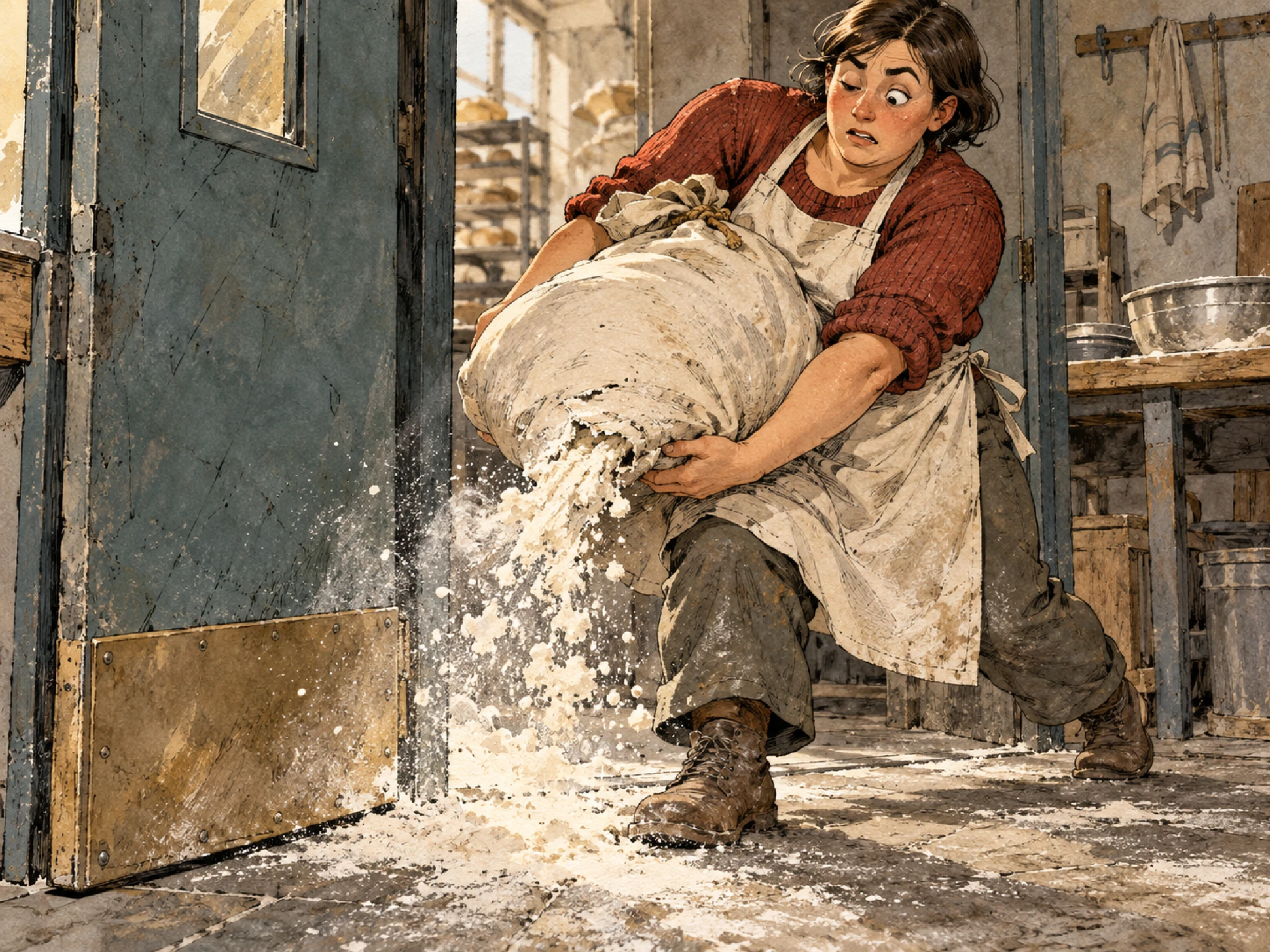
Baker Catching a Split Flour Sack
A baker shoulders a closing swing door while catching the bottom of a split sack. Overlapping arms, door and billowing flour become a comic illustration of scratchy penwork and stained washes.
Remix this referenceBaker Catching a Split Flour Sack
- Form language
- Simplify volumes into lopsided wedges and blunt curves; preserve irregular silhouettes and allow incidental details to vary coherently.
- Contour
- Use scratchy dip-pen contours with abrupt thickening, skipped stretches and occasional searching lines left beside the final edge.
- Mark-making
- Cluster short hooked hatches around compressed shapes; loosen them into scattered flicks, with natural changes in pressure and spacing.
- Surface rendering
- Float uneven diluted-ink washes beneath and across the penwork; retain tide marks, paper reserves and a few dense brush-loaded pools.
Priority
Rendering medium: rough independent-comic illustration in dip pen and diluted ink wash on paper.
What to avoid & what to check
Exact prompt for this example
MODULE OWNERSHIP
subject: Subject count, type, stable proportions and landmarks, resting face geometry, hair shape, physical materials, garment construction and permanent marks. No emotion, movement, color assignment or rendering recipe.
expression: Facial soft-tissue displacement and pupil direction, muscle coordination, regional intensity, asymmetry and onset/peak/release. No head/body pose, stable appearance, skin color or rendering.
gesture: Head/neck/body/limb orientation, joint movement, support, contact and pose-caused occlusion using existing anatomy. No eye/pupil movement, emotion, identity, props inventory or camera.
props: Prop count, type, construction, physical material and scale relative to the subject. Holding/contact belongs to gesture, position to composition, color to palette.
scene: Environment elements, terrain, backdrop/floor presence and structural detail. No canvas positions, camera, lighting, assigned colors or render texture.
camera: Projection, focal-length impression, camera elevation/yaw/roll, viewing distance and crop. No actor pose, world placement, lighting or canvas aspect ratio.
composition: Normalized 0-100% canvas positions, scale in frame, depth/overlap, focal hierarchy and margins. No joint pose, camera projection, rendering, subject/prop inventory or emotion.
palette: Color anchors, hue/saturation/value ranges, colors assigned to parts and approximate color coverage. No illumination direction, shading algorithm, physical material or layout.
lighting: Light-source direction/softness/intensity, ambient illumination, physical shadow direction/length and highlight position. Absence of directional illumination is allowed. No shading technique, palette or material changes.
style: Reusable form abstraction, contour weight/taper/edge quality, medium and mark scale/density/direction, surface rendering and tonal transition technique. No fixed subject proportions, anatomy, identity, expression, pose, palette, light-source direction, camera or layout.
output: Image count, aspect ratio, size, file/alpha requirements and global lettering/logo/watermark restrictions. No background scenery, crop, style, identity or pose.

SUBJECT
inventory: One adult human baker, actor A.
geometry: A has a compact, broad build, substantial forearms and a long nose above a short rounded chin.
resting-face: Her resting face has straight low brows, hooded eyes and a wide mouth with a shallow upper-lip notch.
appearance: Short blunt hair tucks behind her ears; she wears a knitted shirt, a canvas bib apron, loose trousers and work boots.

PRIORITY


AVOID


CHECK


EXPRESSION — ACTOR A
brows: Both brows lift, with the outer end of one rising farther.
lids: One upper lid opens wide; the other eye narrows slightly.
cheeks: The cheek beneath the narrower eye bunches upward.
nose: The nostrils flare slightly without a strong bridge wrinkle.
mouth: The lips part unevenly, one corner remaining tucked inward.
jaw: The jaw drops a little, keeping the opening compact.
gaze: Both pupils point downward toward the split in the sack.
coordination: Raised brows and the uneven mouth register surprise while the narrowed eye adds a reflexive wince.
timing: Freeze the brief peak just as she notices the flour escaping.

PRIORITY


AVOID


CHECK


GESTURE
head: Her neck draws back and her head turns slightly away from the escaping flour.
torso: Her torso twists as one shoulder presses the swing door open.
limbs: Both elbows bend beneath the sagging sack; one knee bends while the other leg braces behind her.
contact: One palm cups the torn underside and the other supports the sack's belly; shoulder and boot sole provide support.

PRIORITY


AVOID


CHECK


PROPS
inventory: One flour sack about the size of A's torso, with loose flour escaping from it.
construction: The sack is coarse woven cloth with a tied mouth and a split lower corner; flour gathers in soft clumps and airborne dust.

PRIORITY


AVOID


CHECK


SCENE
inventory: A bakery service doorway with a swing door, a worn floor and a short stretch of preparation bench.
structure: The thick door has a small glazed opening and a lower kick plate; a deep jamb separates the passage from the workroom.

PRIORITY


AVOID


CHECK


CAMERA
projection: Use perspective with a moderately wide focal-length impression and mild near-to-far exaggeration.
viewpoint: View from waist height, obliquely across the doorway, with a level camera.
crop: Show the complete figure at close environmental distance, cutting through the outer door and bench edges.

PRIORITY


AVOID


CHECK


COMPOSITION
placement: Set A right of center and the sack across the lower middle; the door forms a large interruption along the left edge.
depth: Overlap door, shoulder, forearms and sack in a compressed chain, with the bench receding beyond the doorway.
spacing: The face and supporting hands lead attention to the tear; let the flour plume open a spacious diagonal toward the lower left.

PRIORITY


AVOID


CHECK


PALETTE
colors: Use charcoal, warm ivory, subdued brick red and dusty blue-green, with restrained saturation.
assignment: Assign brick red to the shirt, blue-green to the door, ivory to flour and apron, and warm ochre to skin.
balance: Let ivory and charcoal dominate, with muted surroundings and the shirt carrying the strongest chromatic accent.

PRIORITY


AVOID


CHECK


LIGHTING
sources: Broad soft daylight enters from the left, supported by gentle ambient light throughout the room.
shadows: Soft shadows fall rightward, deepening beneath the sack and where the shoulder meets the door.
highlights: Keep broad light on the left cheek, upper forearms and outward-facing folds of the sack.

PRIORITY


AVOID


CHECK


STYLE GUIDE
form-language: Simplify volumes into lopsided wedges and blunt curves; preserve irregular silhouettes and allow incidental details to vary coherently.
contour: Use scratchy dip-pen contours with abrupt thickening, skipped stretches and occasional searching lines left beside the final edge.
mark-making: Cluster short hooked hatches around compressed shapes; loosen them into scattered flicks, with natural changes in pressure and spacing.
surface-rendering: Float uneven diluted-ink washes beneath and across the penwork; retain tide marks, paper reserves and a few dense brush-loaded pools.

PRIORITY
Rendering medium: rough independent-comic illustration in dip pen and diluted ink wash on paper.

AVOID


CHECK


OUTPUT
format: One finished image, landscape 4:3, 2048 × 1536 pixels, opaque PNG.
restrictions: No lettering, speech balloons, captions, logos or watermarks.

PRIORITY


AVOID


CHECK


FINAL INTEGRATION
expression + gesture: Coordinate facial acting and bodily reaction as one immediately readable instant.
composition + style: Let the overlap remain legible through selective contour emphasis and open passages in the washes.
Model information comes from image provenance. The same prompt may produce a different result.