Text to imagePortraitStyle guide
Short-Haired Adult · Cheek-Coupled Closed-Lip Smile
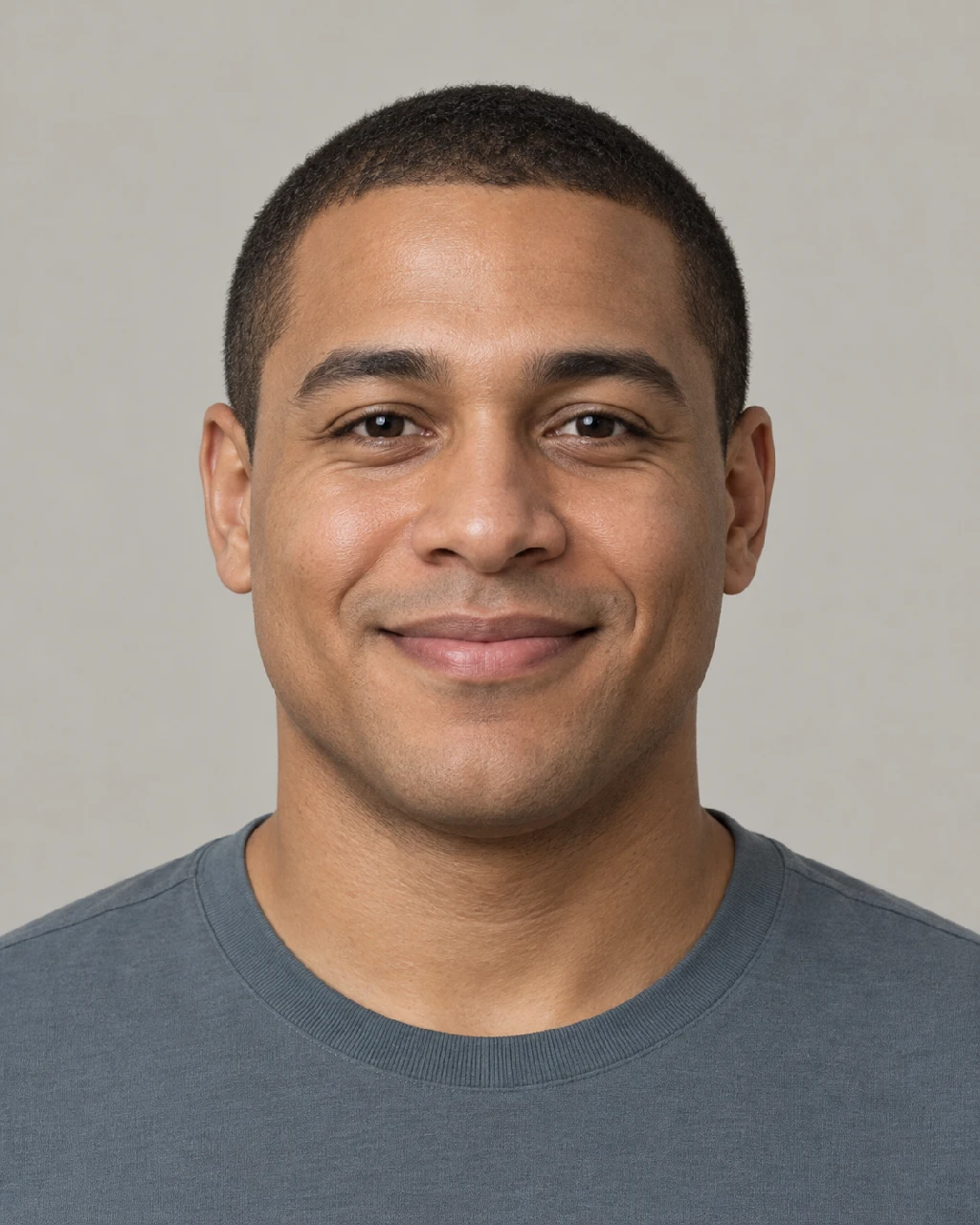
A color photographic portrait demonstrates a closed-lip smile through coordinated cheek lift, mouth-corner displacement and lower-lid compression.
Remix this referenceShort-Haired Adult · Cheek-Coupled Closed-Lip Smile
- Form language
- Use photographic form continuity, retaining actual silhouettes, curved volumes, openings and structural landmarks without geometric abstraction. Resolve major surface details larger than 0.8–1.5% of each visible component's longest dimension; retain smaller detail as low-contrast texture rather than invented crisp structures.
- Contour
- Use no drawn exterior or interior outlines. Boundaries are image edges between adjacent regions, with ordinary edge transitions spanning 0.2–0.5% of the local visible component's longest dimension. Preserve continuous silhouettes and genuine recess boundaries; add no dark tracing, tapered ink accents or doubled rims.
- Mark-making
- Use unobtrusive, irregular photographic grain with a visible grain size of 1–2 pixels at the final output scale. Grain has no preferred direction or repeated pattern and varies local channel values by 1–2%. Apply it to detail-bearing surfaces; uninterrupted featureless fields remain clean. Add no brush marks, hatch lines or film scratches.
- Surface rendering
- Use continuous, unquantized tonal interpolation rather than discrete bands. Broad value transitions span 8–20% of each visible surface region's longest dimension, while genuine structural edges retain their sharper boundaries. Keep fine texture subordinate to these gradients; exclude plastic smoothing, painted patches and embossed relief.
Priority
Keep continuous photographic tones and readable surface structure.
What to avoid & what to check
Avoid painted outlines, discrete bands and waxy smoothing.
Unoutlined volumes retain soft gradients and subordinate grain.
Exact prompt for this example
MODULE OWNERSHIP
subject: Subject count, type, stable proportions and landmarks, resting face geometry, hair shape, physical materials, garment construction and permanent marks. No emotion, movement, color assignment or rendering recipe.
expression: Facial soft-tissue displacement and pupil direction, muscle coordination, regional intensity, asymmetry and onset/peak/release. No head/body pose, stable appearance, skin color or rendering.
gesture: Head/neck/body/limb orientation, joint movement, support, contact and pose-caused occlusion using existing anatomy. No eye/pupil movement, emotion, identity, props inventory or camera.
props: Prop count, type, construction, physical material and scale relative to the subject. Holding/contact belongs to gesture, position to composition, color to palette.
scene: Environment elements, terrain, backdrop/floor presence and structural detail. No canvas positions, camera, lighting, assigned colors or render texture.
camera: Projection, focal-length impression, camera elevation/yaw/roll, viewing distance and crop. No actor pose, world placement, lighting or canvas aspect ratio.
composition: Normalized 0-100% canvas positions, scale in frame, depth/overlap, focal hierarchy and margins. No joint pose, camera projection, rendering, subject/prop inventory or emotion.
palette: Color anchors, hue/saturation/value ranges, colors assigned to parts and approximate color coverage. No illumination direction, shading algorithm, physical material or layout.
lighting: Light-source direction/softness/intensity, ambient illumination, physical shadow direction/length and highlight position. Absence of directional illumination is allowed. No shading technique, palette or material changes.
style: Reusable form abstraction, contour weight/taper/edge quality, medium and mark scale/density/direction, surface rendering and tonal transition technique. No fixed subject proportions, anatomy, identity, expression, pose, palette, light-source direction, camera or layout.
output: Image count, aspect ratio, size, file/alpha requirements and global lettering/logo/watermark restrictions. No background scenery, crop, style, identity or pose.

SUBJECT
inventory: Include exactly one original adult human, identified as A. Distinguishing anchors are a broad rounded jaw, close-cropped hair and a plain crewneck shirt. Stable anatomical left and right mean A's own left and right; no additional person or duplicate face is present.
geometry: Let H be crown-to-chin height. Face width is 0.70–0.78H and jaw width 0.56–0.64H. Crown-to-sole height is 6.8–7.2H, shoulder span 1.8–2.0H and pelvis span 1.4–1.6H. Chin underside to sternal notch is 0.30–0.40H; cropped hair extends 0.03–0.05H from the scalp.
resting-face: A's resting eye width E is 0.14–0.16H. The midpoint between each eye's corners lies 0.48–0.52H down the crown–chin axis from the crown. Oval eyes have aperture 0.30–0.35E and gap 0.9–1.1E; nearly level brows sit 0.25–0.35E above them. Jaw corners are rounded. Skin has fine pores and no permanent marks; the rounded hairline sits 0.9–1.1E above the brows.
resting-face: A's nose width is 0.9–1.1E; brow-line-to-base length is 0.22–0.28H. Its straight bridge ends in a rounded tip 0.08–0.12H anterior to the coronal plane through both alar bases. Closed level lips span 1.6–1.8E; their seam lies 30–40% down the nose-base-to-chin-tip span. Upper/lower lip thickness is 0.10–0.14E/0.14–0.18E. Oval ears span brow to nose base and protrude 0.08–0.12E from the head.
appearance: A has uniformly close-cropped hair without a part or shaved pattern, and no facial hair. One plain jersey crewneck shirt has short cut-on sleeves ending halfway from shoulder to elbow, one ribbed collar ring, two shoulder seams and two underarm side seams. It has no fasteners, patches or integrated decoration.
appearance: A wears one pair of straight-leg woven trousers with two outer seams and one elastic-waistband seam, without fasteners or patches. Two leather slip-on shoes each have a seamless one-piece low-vamp upper, rounded toe, flat heel and sole thickness 0.04–0.06H. Permanent skin marks are absent.

PRIORITY
Retain the broad jaw, cropped hair and plain crewneck.

AVOID
Avoid facial hair, altered garment layers and added permanent marks.

CHECK
One adult retains the three defining structural anchors.

EXPRESSION — ACTOR A
brows: Medial and lateral brow ends remain within 0.05 resting eye widths of rest. Inter-brow spacing stays unchanged within that tolerance, with left–right displacement difference below 0.05 eye widths; neither forehead lifting nor inward brow gathering accompanies the smile.
lids: Both lower lids rise 0.10–0.15 resting eye widths; upper lids descend 0.02–0.05 eye widths. Apertures remain open at 50–65% of resting aperture height. Left–right aperture difference stays within 10% of resting height, without complete closure or upper-lid strain.
cheeks: Both cheek mounds rise 0.15–0.25 resting eye widths and compress beneath the lower lids. Nasolabial grooves become visibly deeper without extending below the mouth corners. Left–right cheek-lift difference stays within 0.05 eye widths; the central upper lip remains released.
nose: Alar rims remain within 0.05 resting eye widths of rest, and nostril widths remain within 10% of resting widths. No nose wrinkling or alar lift occurs; cheek elevation does not recruit the central upper lip, and both nasal sides retain equivalent resting geometry.
mouth: Both corners move outward 0.04–0.06 and upward 0.06–0.09 resting mouth widths. The closed lip seam forms one upward-ended arc; its center remains within 0.02 mouth widths of rest. Lips touch without pressing flat, and teeth, gums and tongue remain fully concealed.
jaw: Keep jaw opening at zero and the chin within 0.03 resting mouth widths of its resting position. Masseter tension remains released; there is no clench, forward thrust or lateral slide. Mouth-corner movement occurs without lowering the jaw or stretching the central lower lip.
gaze: Both pupils remain centered within their sockets, allowing 0.05 resting eye widths of horizontal or vertical deviation. Their directions match without convergence or side glance; the reduced visible sclera comes only from the stated lid displacement, not pupil movement.
coordination: Zygomaticus major and cheek-lifting orbicularis oculi act together, while frontalis, corrugator, nasal elevators and jaw-clenching groups stay released. Bilateral corner and cheek recruitment match within their stated tolerances; no downward lip pull opposes the smile.
timing: Show the smile at its apex, with cheek lift, lower-lid compression and corner displacement already at their stated targets. No onset lag or release droop is visible; the upper lip and jaw retain their released states, and timing adds no second intensity multiplier.

PRIORITY
Coordinate cheek lift, lower lids and closed mouth corners.

AVOID
Avoid exposed teeth, nose wrinkling and raised brows.

CHECK
Lifted cheeks accompany an open-eyed, closed-lip smile.

GESTURE
head: Fix world +Z to A's unturned pelvis-forward direction, +Y upward and +X to A's anatomical left; these axes remain fixed. Keep head and neck aligned with the torso: relative yaw, pitch and roll are each 0°±5°. There is no independent chin lift, downward neck bend or lateral tilt.
torso: Torso and pelvis both face world +Z, with yaw, pitch and roll each 0°±5°. Maintain an upright spine without a waist twist or side bend. The center of mass stays between the support feet; shoulders remain level within 5° even where anatomy lies outside the visible image.
limbs: Both arms use palms-in standing rest as zero. Shoulder abduction and flexion are 0–8°, axial rotation 0°±5°; elbows flex 5–15°; wrist bend/deviation is 0°±5°. Palms face their thighs. Four fingers stay together with each joint flexed 10–25°; thumbs lie alongside the index fingers, unopposed, with joints flexed 0–15°.
limbs: Both legs use upright standing rest as zero. Hips abduct 5–10°; flexion and axial rotation are 0°±5°. Knees flex 0–8° without sideways bend; feet point +Z within 5°. Ankle zero is a 90° shin-to-sole angle with no coronal tilt; ankle bend and coronal tilt compensate shin inclination, each within 15° of zero, keeping soles toward −Y.
contact: Both soles are flat on the floor with heel and forefoot support, sharing 40–60% of body weight per foot. Hands hang free without touching the body or another surface. No upper-body support is present; off-image support remains physically continuous and unchanged.

PRIORITY
Keep an upright, untwisted resting body orientation.

AVOID
Avoid head tilts, raised shoulders and invented supports.

CHECK
Head and shoulders remain aligned above an upright torso.

PROPS
inventory: The prop inventory is empty: include exactly zero removable jewelry, eyewear, badges or carried objects. The portrait requires no accessories or supplementary demonstration equipment.
construction: With zero props, no prop construction target exists. Do not add detachable collar ornaments, mounting hardware or separate supports requiring additional materials, dimensions or attachments.

PRIORITY
Keep the accessory inventory completely empty.

AVOID
Avoid eyewear, jewelry and detachable costume details.

CHECK
No supplementary object or removable accessory appears.

SCENE
inventory: Include exactly one plain studio floor and one continuous studio backdrop. Exclude furniture, architectural details, plants, decorative objects and visible fixtures; no additional environmental element is present.
structure: Use a level floor joined to an upright backdrop by a seamless cove, without a horizon seam, tiles, joints or structural relief. Both surfaces extend continuously; there are no repeated environmental elements or patterned subdivisions.

PRIORITY
Maintain structurally plain continuous studio surfaces.

AVOID
Avoid furniture, fixtures and decorative surface patterns.

CHECK
The environment contains no object or structural subdivision.

CAMERA
projection: Use rectilinear perspective with an 85–105 mm full-frame-equivalent focal-length impression. Facial depth has restrained perspective, without wide-angle enlargement or lens warping; preserve ordinary nearer-to-farther size differences.
viewpoint: View from world +Z at yaw 0°±5°, with camera height level with the midpoint between brow line and nose base. Aim at that landmark with roll 0°±3°. Viewing distance is approximately 7–9 crown-to-chin heights from the face.
crop: Retain the complete crown, ears, chin and neck; the lower boundary passes through the upper sternum below the collar ring. Side boundaries may intersect the outer shoulders, while no part of the head is clipped. Anatomy below that boundary remains outside the image.

PRIORITY
Preserve the complete head with restrained facial perspective.

AVOID
Avoid wide-angle facial enlargement and clipped ears.

CHECK
Crown, both ears and chin remain completely visible.

COMPOSITION
placement: Use top-left normalized coordinates. Center A's visible head bounds at (50%,37%) within ±5 percentage points. Target crown-to-chin span at 60% of canvas height, allowed 50–70%; derive width and all connected visible bounds by uniform scaling. The backdrop covers the entire canvas.
depth: Use one borderless panel. A is the sole focal element over the backdrop, with the facial region receiving first visual rank. Preserve intrinsic self-occlusion, but include no independent obstruction or foreground layer; the backdrop remains behind every visible part of A.
spacing: Keep complete head bounds within x=5–95%, y=5–95%. Connected lower silhouette may intersect the bottom and side edges intentionally. Uniform-scale head containment overrides nominal fill when needed; derive all remaining margins without imposing separate width or lower-edge landmark targets.

PRIORITY
Keep the complete head contained above intentional edge crossings.

AVOID
Avoid independent width scaling and added panels or borders.

CHECK
Head bounds remain contained; only lower silhouette crosses edges.

PALETTE
colors: Use anchors skin #C99678, lips #A76E62, hair and pupils #302A28, shirt #58666B, eye whites #E9E3DA and environment #C9C5BD. Permit continuous mixtures among these anchors, plus #F2E9DD and #352C29 for lighter and darker variants. Add no independent saturated hue family.
assignment: Assign exposed skin and ears to skin, lips to lips, hair, brows, irises and pupils to dark-hair, and sclera to eye-white. Shirt, collar and trousers use the shirt role; shoes and soles use dark-hair. Clothing seams inherit their garment role. Floor and backdrop use environment; all variants inherit these roles.
balance: Coverage follows actual assigned-region areas and totals 100%, with mixtures inherited by their base roles. Lighter and darker anchors modify existing roles without creating separate accents. Preserve moderate saturation; no role receives fixed canvas occupancy or an additional independent hue.

PRIORITY
Preserve role assignments through all continuous mixtures.

AVOID
Avoid saturated accent hues and independently colored grain.

CHECK
Every visible region and tonal variant inherits a palette role.

LIGHTING
sources: Use one broad diffuse source from world +Z, 10–20° toward world −X and 20–30° above horizontal. Its apparent angular width is 35–45°. Set source strength to 1 and uniform ambient strength to 0.25–0.35; no second source or rim source is present.
shadows: Let H be crown-to-chin height. Nose and chin cast shadows toward world +X and downward. Nose-shadow reach is 0.10–0.16H and penumbra width 0.06–0.10H; chin-shadow reach is 0.12–0.20H and penumbra width 0.08–0.12H. Neither shadow forms a detached shape.
shadows: Sole-contact shadows remain on the supporting floor, extending toward world −Z with a +X component, 10–20° from −Z. Their reach from each sole is 0.05–0.10H and penumbra width is 0.03–0.06H. Each shadow connects continuously to its sole without a detached patch.
highlights: Broad highlights occupy the source-facing forehead, nose bridge and upper cheeks, each spanning 0.08–0.15 crown-to-chin heights. Their luminance is 1.2–1.4 times adjacent midtone luminance. Include one soft source reflection per visible eye; omit pinpoint skin glare and rim highlights.

PRIORITY
Use one broad source with restrained highlight contrast.

AVOID
Avoid hard pinpoint glare and additional rim sources.

CHECK
Broad highlights accompany attached, soft cast and contact shadows.

STYLE GUIDE
form-language: Use photographic form continuity, retaining actual silhouettes, curved volumes, openings and structural landmarks without geometric abstraction. Resolve major surface details larger than 0.8–1.5% of each visible component's longest dimension; retain smaller detail as low-contrast texture rather than invented crisp structures.
contour: Use no drawn exterior or interior outlines. Boundaries are image edges between adjacent regions, with ordinary edge transitions spanning 0.2–0.5% of the local visible component's longest dimension. Preserve continuous silhouettes and genuine recess boundaries; add no dark tracing, tapered ink accents or doubled rims.
mark-making: Use unobtrusive, irregular photographic grain with a visible grain size of 1–2 pixels at the final output scale. Grain has no preferred direction or repeated pattern and varies local channel values by 1–2%. Apply it to detail-bearing surfaces; uninterrupted featureless fields remain clean. Add no brush marks, hatch lines or film scratches.
surface-rendering: Use continuous, unquantized tonal interpolation rather than discrete bands. Broad value transitions span 8–20% of each visible surface region's longest dimension, while genuine structural edges retain their sharper boundaries. Keep fine texture subordinate to these gradients; exclude plastic smoothing, painted patches and embossed relief.

PRIORITY
Keep continuous photographic tones and readable surface structure.

AVOID
Avoid painted outlines, discrete bands and waxy smoothing.

CHECK
Unoutlined volumes retain soft gradients and subordinate grain.

OUTPUT
format: Deliver exactly one raster image as a PNG file at 1024×1280 pixels and a 4:5 aspect ratio. Use a fully opaque file without an alpha channel or transparent pixels; provide no additional portrait variants.
restrictions: Include no lettering, captions, dialogue, logos, signatures or watermarks. Exclude interface elements, embedded technical labels, comparison thumbnails and reference-sheet annotations from the image.

PRIORITY
Deliver one opaque PNG at the exact requested dimensions.

AVOID
Avoid embedded annotations and additional portrait variants.

CHECK
One opaque 1024×1280 PNG contains no text or watermark.

FINAL INTEGRATION
expression + lighting + style: Broad illumination and continuous tonal transitions reveal the cheek lift and lower-lid compression without substituting shadow patches for facial displacement. The closed lip seam remains readable as a genuine surface boundary.
camera + composition + subject: The head placement and uniform scale accommodate the complete head while the lower boundary passes through the upper sternum. The broad shoulder span permits intentional side-edge intersections without requiring the shoulders to be fully visible.
lighting + palette + style: Use permitted lighter and darker mixtures for the source-driven gradients, soft shadow transitions and eye reflections. The photographic grain stays within those same color roles, and no contour pigment is introduced.
subject + scene + style: A's skin, hair and shirt are detail-bearing surfaces that receive photographic grain. The plain studio surfaces are uninterrupted featureless fields and remain grain-free.
Model information comes from image provenance. The same prompt may produce a different result.