Text to imageComicsStyle guide
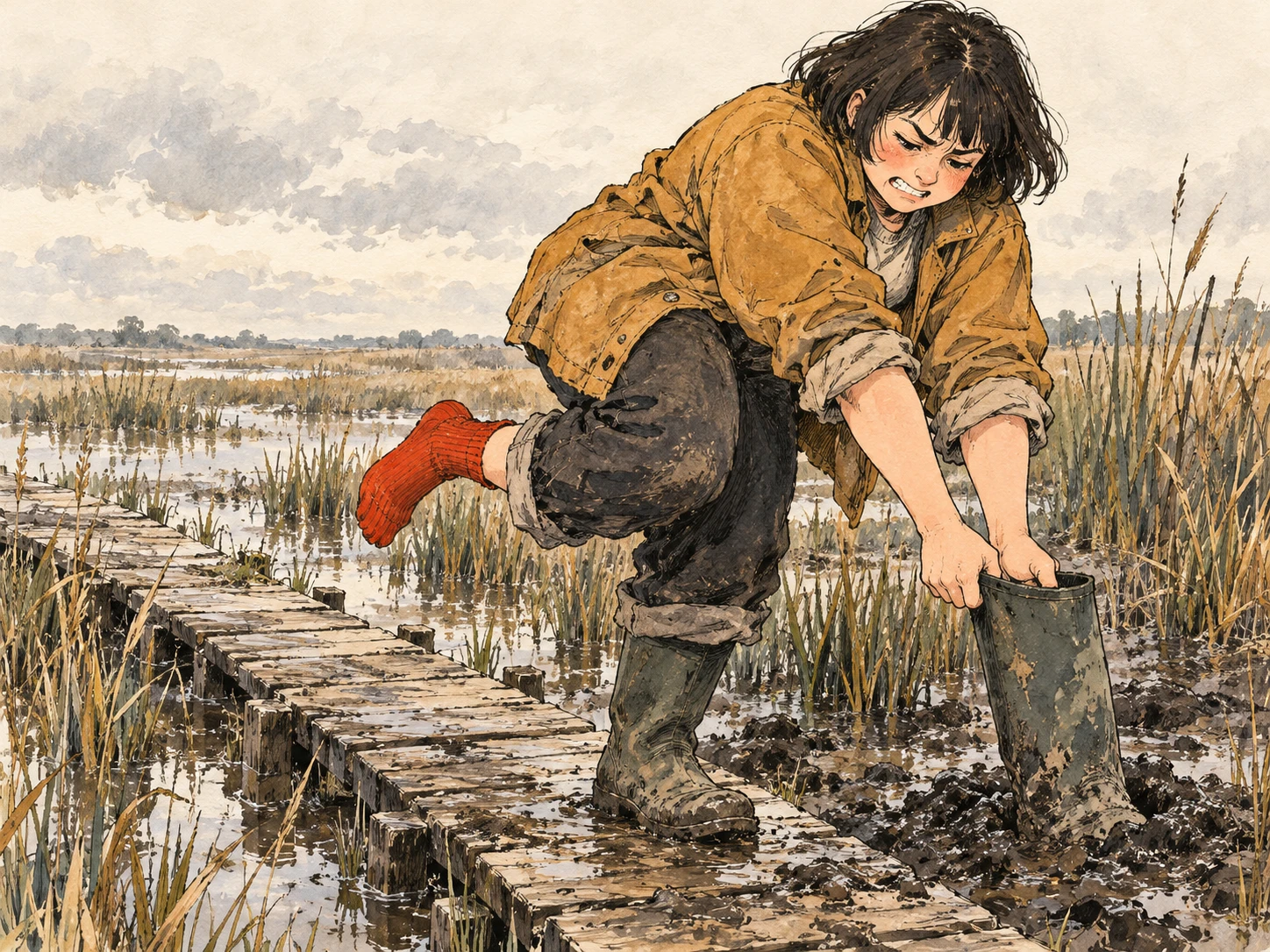
A Woman Pulling a Boot from the Mud
With one sock exposed, a woman balances on a narrow marsh walkway and wrestles with her abandoned boot. Ragged brush contours, spreading ink washes and generous open space turn a small struggle into an expansive comic moment.
Remix this referenceA Woman Pulling a Boot from the Mud
- Form language
- Compress incidental detail into broad, elastic shape statements; alternate blunt masses with wiry accents for expressive manga shorthand.
- Contour
- Use pressure-swollen brush contours that taper abruptly, split into bristles and occasionally break; retain searching strokes.
- Mark-making
- Let raking dry-brush sweeps meet sparse hooked pen scratches; vary their length and density naturally, leaving broad passages untouched.
- Surface rendering
- Pool diluted ink into irregular midtones beside concentrated ink deposits; use soft wash blooms and exposed paper instead of uniform digital fills.
Priority
Rendering medium: expressive brush-ink manga illustration with selective watercolor washes on absorbent paper.
What to avoid & what to check
Exact prompt for this example
MODULE OWNERSHIP
subject: Subject count, type, stable proportions and landmarks, resting face geometry, hair shape, physical materials, garment construction and permanent marks. No emotion, movement, color assignment or rendering recipe.
expression: Facial soft-tissue displacement and pupil direction, muscle coordination, regional intensity, asymmetry and onset/peak/release. No head/body pose, stable appearance, skin color or rendering.
gesture: Head/neck/body/limb orientation, joint movement, support, contact and pose-caused occlusion using existing anatomy. No eye/pupil movement, emotion, identity, props inventory or camera.
props: Prop count, type, construction, physical material and scale relative to the subject. Holding/contact belongs to gesture, position to composition, color to palette.
scene: Environment elements, terrain, backdrop/floor presence and structural detail. No canvas positions, camera, lighting, assigned colors or render texture.
camera: Projection, focal-length impression, camera elevation/yaw/roll, viewing distance and crop. No actor pose, world placement, lighting or canvas aspect ratio.
composition: Normalized 0-100% canvas positions, scale in frame, depth/overlap, focal hierarchy and margins. No joint pose, camera projection, rendering, subject/prop inventory or emotion.
palette: Color anchors, hue/saturation/value ranges, colors assigned to parts and approximate color coverage. No illumination direction, shading algorithm, physical material or layout.
lighting: Light-source direction/softness/intensity, ambient illumination, physical shadow direction/length and highlight position. Absence of directional illumination is allowed. No shading technique, palette or material changes.
style: Reusable form abstraction, contour weight/taper/edge quality, medium and mark scale/density/direction, surface rendering and tonal transition technique. No fixed subject proportions, anatomy, identity, expression, pose, palette, light-source direction, camera or layout.
output: Image count, aspect ratio, size, file/alpha requirements and global lettering/logo/watermark restrictions. No background scenery, crop, style, identity or pose.

SUBJECT
inventory: A is one adult woman with a compact, sturdy build; no other figures or animals.
geometry: Broad shoulders, substantial hands and a rounded face with a short nose distinguish her silhouette.
resting-face: Her resting features have straight brows, broad upper lids, full cheeks and a wide mouth.
appearance: A blunt bob, roomy canvas jacket, rolled work trousers, ribbed socks and one worn rubber boot; minor garment details may vary.

PRIORITY


AVOID


CHECK


EXPRESSION — ACTOR A
brows: Both brows draw inward, with one slightly lower.
lids: Upper lids lower into a tight, uneven squint.
cheeks: Cheeks bunch upward beside the mouth.
nose: Nostrils widen slightly under the strain.
mouth: Lips pull sideways into a crooked grimace, exposing a narrow strip of clenched teeth.
jaw: The jaw stays firmly closed with visible tension at its corners.
gaze: Pupils aim downward toward the stuck boot.
coordination: The tight eyes and crooked mouth act together as concentrated effort.
timing: Hold the apex of effort, just before her grip might slip.

PRIORITY


AVOID


CHECK


GESTURE
head: A tucks her chin slightly and turns her face enough to remain visible above her arms.
torso: She folds forward at the hips while twisting slightly against the pull.
limbs: Both elbows pull outward; her socked leg lifts behind as the booted leg bears her weight.
contact: Both hands clutch the empty boot's rim; her supporting sole presses onto a plank while the empty boot remains embedded in mud.

PRIORITY


AVOID


CHECK


PROPS
inventory: One empty tall boot, matching the worn boot and sized for A's foot.
construction: Supple rubber shaft, thick molded sole and an open cuff that can buckle under a grip.

PRIORITY


AVOID


CHECK


SCENE
inventory: An open reed marsh with wet silt, shallow puddles and a narrow timber walkway; no buildings.
structure: Uneven planks rest on low supports above the mud; scattered reed clumps give way to an indistinct marsh horizon.

PRIORITY


AVOID


CHECK


CAMERA
projection: Use moderate perspective with the natural spatial impression of a standard lens.
viewpoint: Look slightly downward from a three-quarter viewpoint, with no camera roll.
crop: A medium-wide full-figure view includes the lifted foot and the boot's entire visible shaft.

PRIORITY


AVOID


CHECK


COMPOSITION
placement: Group A and the stuck boot in the right half, around 70% across; let the walkway enter from the lower left.
depth: Her face and the hand-to-boot connection form the focal pair; overlapping planks lead into quieter marsh depth.
spacing: Keep generous breathing room across the upper left and a clear gap around the lifted foot; the figure fills roughly two-thirds of the image height.

PRIORITY


AVOID


CHECK


PALETTE
colors: Use warm paper ivory, soot black, muted ochre and a small vermilion accent, with restrained gray-green.
assignment: Ochre belongs to the jacket, vermilion to the exposed sock, gray-green to boots and reeds; hair and trousers stay near black.
balance: Ivory and black dominate; the subdued jacket carries the main color mass and the sock supplies a sharp accent.

PRIORITY


AVOID


CHECK


LIGHTING
sources: Broad overcast daylight arrives softly from the upper left with ample ambient light.
shadows: Short, diffuse shadows fall toward the lower right, with deeper contact shadows beneath soles and grips.
highlights: Soft highlights catch the upper-left boot folds and puddle surfaces.

PRIORITY


AVOID


CHECK


STYLE GUIDE
form-language: Compress incidental detail into broad, elastic shape statements; alternate blunt masses with wiry accents for expressive manga shorthand.
contour: Use pressure-swollen brush contours that taper abruptly, split into bristles and occasionally break; retain searching strokes.
mark-making: Let raking dry-brush sweeps meet sparse hooked pen scratches; vary their length and density naturally, leaving broad passages untouched.
surface-rendering: Pool diluted ink into irregular midtones beside concentrated ink deposits; use soft wash blooms and exposed paper instead of uniform digital fills.

PRIORITY
Rendering medium: expressive brush-ink manga illustration with selective watercolor washes on absorbent paper.

AVOID


CHECK


OUTPUT
format: One finished image.
restrictions: Deliver one finished 4:3 image, 2048 × 1536 pixels, opaque PNG; no lettering, speech balloons, logos or watermarks.

PRIORITY


AVOID


CHECK


FINAL INTEGRATION
style + gesture: Let broken brushwork amplify the strain while keeping the hand-to-boot contact legible.
Model information comes from image provenance. The same prompt may produce a different result.