Text to imageArt stylesStyle guide
Rainwater in a Fallen Radio Dish
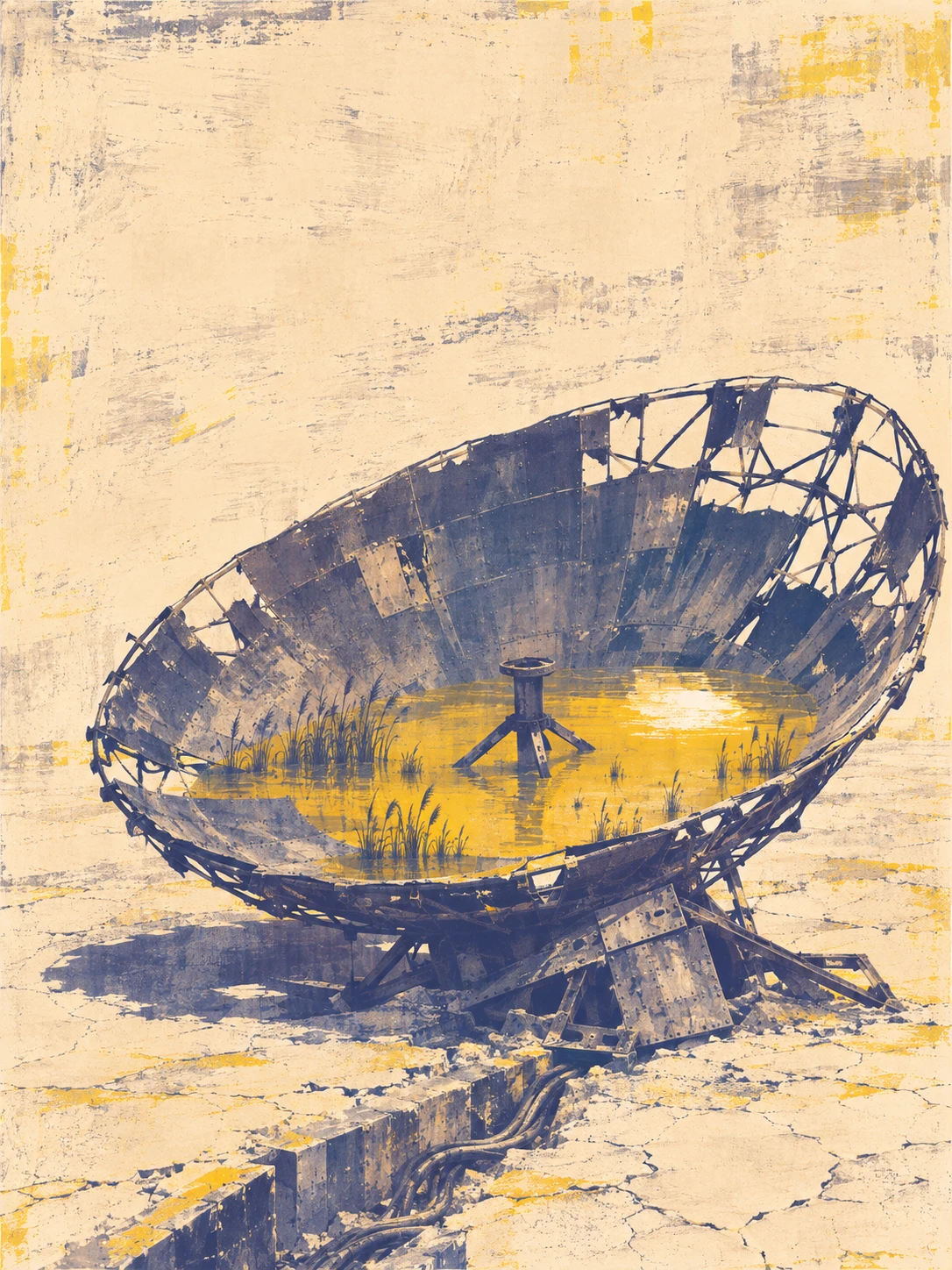
A fallen radio dish becomes a shallow pond on a salt flat, rendered as an experimental poster with dragged ink, offset print layers, and expansive negative space.
Remix this referenceRainwater in a Fallen Radio Dish
- Form language
- Compress forms into bold, unequal cut shapes; retain structural openings while allowing small details to merge or disappear.
- Contour
- Alternate blunt stencil edges with ragged ink boundaries; use occasional thin, interrupted lines rather than continuous outlines.
- Mark-making
- Drag broad monotype ink swipes across large masses, then scratch through selected passages; vary pressure and let marks end unevenly.
- Surface rendering
- Build tones through translucent overprinting and broken ink transfer; slight registration slips expose lively fringes beside dense deposits.
Priority
Make ink drag, transferred gaps, and overprint interaction visibly define the experimental poster treatment.
What to avoid & what to check
Exact prompt for this example
MODULE OWNERSHIP
subject: Subject count, type, stable proportions and landmarks, resting face geometry, hair shape, physical materials, garment construction and permanent marks. No emotion, movement, color assignment or rendering recipe.
expression: Facial soft-tissue displacement and pupil direction, muscle coordination, regional intensity, asymmetry and onset/peak/release. No head/body pose, stable appearance, skin color or rendering.
gesture: Head/neck/body/limb orientation, joint movement, support, contact and pose-caused occlusion using existing anatomy. No eye/pupil movement, emotion, identity, props inventory or camera.
props: Prop count, type, construction, physical material and scale relative to the subject. Holding/contact belongs to gesture, position to composition, color to palette.
scene: Environment elements, terrain, backdrop/floor presence and structural detail. No canvas positions, camera, lighting, assigned colors or render texture.
camera: Projection, focal-length impression, camera elevation/yaw/roll, viewing distance and crop. No actor pose, world placement, lighting or canvas aspect ratio.
composition: Normalized 0-100% canvas positions, scale in frame, depth/overlap, focal hierarchy and margins. No joint pose, camera projection, rendering, subject/prop inventory or emotion.
palette: Color anchors, hue/saturation/value ranges, colors assigned to parts and approximate color coverage. No illumination direction, shading algorithm, physical material or layout.
lighting: Light-source direction/softness/intensity, ambient illumination, physical shadow direction/length and highlight position. Absence of directional illumination is allowed. No shading technique, palette or material changes.
style: Reusable form abstraction, contour weight/taper/edge quality, medium and mark scale/density/direction, surface rendering and tonal transition technique. No fixed subject proportions, anatomy, identity, expression, pose, palette, light-source direction, camera or layout.
output: Image count, aspect ratio, size, file/alpha requirements and global lettering/logo/watermark restrictions. No background scenery, crop, style, identity or pose.

SUBJECT
inventory: One abandoned parabolic radio antenna, with no people or animals.
geometry: A broad concave reflector has a broken, exposed lattice rim, a short central feed support, and a collapsed mounting pedestal.
resting-face: No face or facial landmarks apply.
appearance: Riveted sheet-metal panels cover steel ribs; several missing panels expose the framework. Minor damage may vary.

PRIORITY


AVOID


CHECK


PROPS
inventory: No separate props.
construction: No prop construction applies.

PRIORITY


AVOID


CHECK


SCENE
inventory: An empty salt flat, a shallow pool inside the reflector, sparse reeds, and a disused cable trench.
structure: Salt crust surrounds the half-buried pedestal; water fills the reflector's lower hollow, with reeds rooted in accumulated silt.

PRIORITY


AVOID


CHECK


CAMERA
projection: Use restrained perspective with a long-lens impression and little near-to-far exaggeration.
viewpoint: Look obliquely down into the reflector from above its rim; keep the camera level in roll.
crop: Show the complete reflector and enough surrounding terrain to establish its abandonment; exclude the horizon.

PRIORITY


AVOID


CHECK


COMPOSITION
placement: Set the dish low and right, occupying roughly half the image; let the cable trench enter from the lower edge.
depth: The open rim overlaps the pool; the trench leads toward the pedestal. Make the pool the first read and the lattice the second.
spacing: Leave a broad, nearly empty upper-left field; preserve a generous outer margin around the reflector's silhouette.

PRIORITY


AVOID


CHECK


PALETTE
colors: Use warm chalk ivory, smoky indigo, and sharp sulfur yellow, with muted intermediate mixtures.
assignment: Assign ivory to the salt flat, indigo to the antenna and trench, and yellow to the pooled water; reeds share the indigo.
balance: Ivory dominates; indigo forms the main dark mass, while the concentrated yellow creates a small, forceful accent.

PRIORITY


AVOID


CHECK


LIGHTING
sources: Broad, soft daylight arrives from the upper right, supported by ample ambient light.
shadows: Short, diffuse shadows fall toward the lower left beneath the rim and exposed supports.
highlights: A broad reflection rests on the pool's upper-right side; exposed upper edges receive subdued highlights.

PRIORITY


AVOID


CHECK


STYLE GUIDE
form-language: Compress forms into bold, unequal cut shapes; retain structural openings while allowing small details to merge or disappear.
contour: Alternate blunt stencil edges with ragged ink boundaries; use occasional thin, interrupted lines rather than continuous outlines.
mark-making: Drag broad monotype ink swipes across large masses, then scratch through selected passages; vary pressure and let marks end unevenly.
surface-rendering: Build tones through translucent overprinting and broken ink transfer; slight registration slips expose lively fringes beside dense deposits.

PRIORITY
Make ink drag, transferred gaps, and overprint interaction visibly define the experimental poster treatment.

AVOID


CHECK


OUTPUT
format: No separate format rule applies.
restrictions: One finished image, portrait 3:4, 1800 × 2400 pixels, opaque PNG. No lettering, logos, or watermarks.

PRIORITY


AVOID


CHECK
Model information comes from image provenance. The same prompt may produce a different result.