Text to imagePortraitStyle guide
Buzzing a Trumpet Mouthpiece
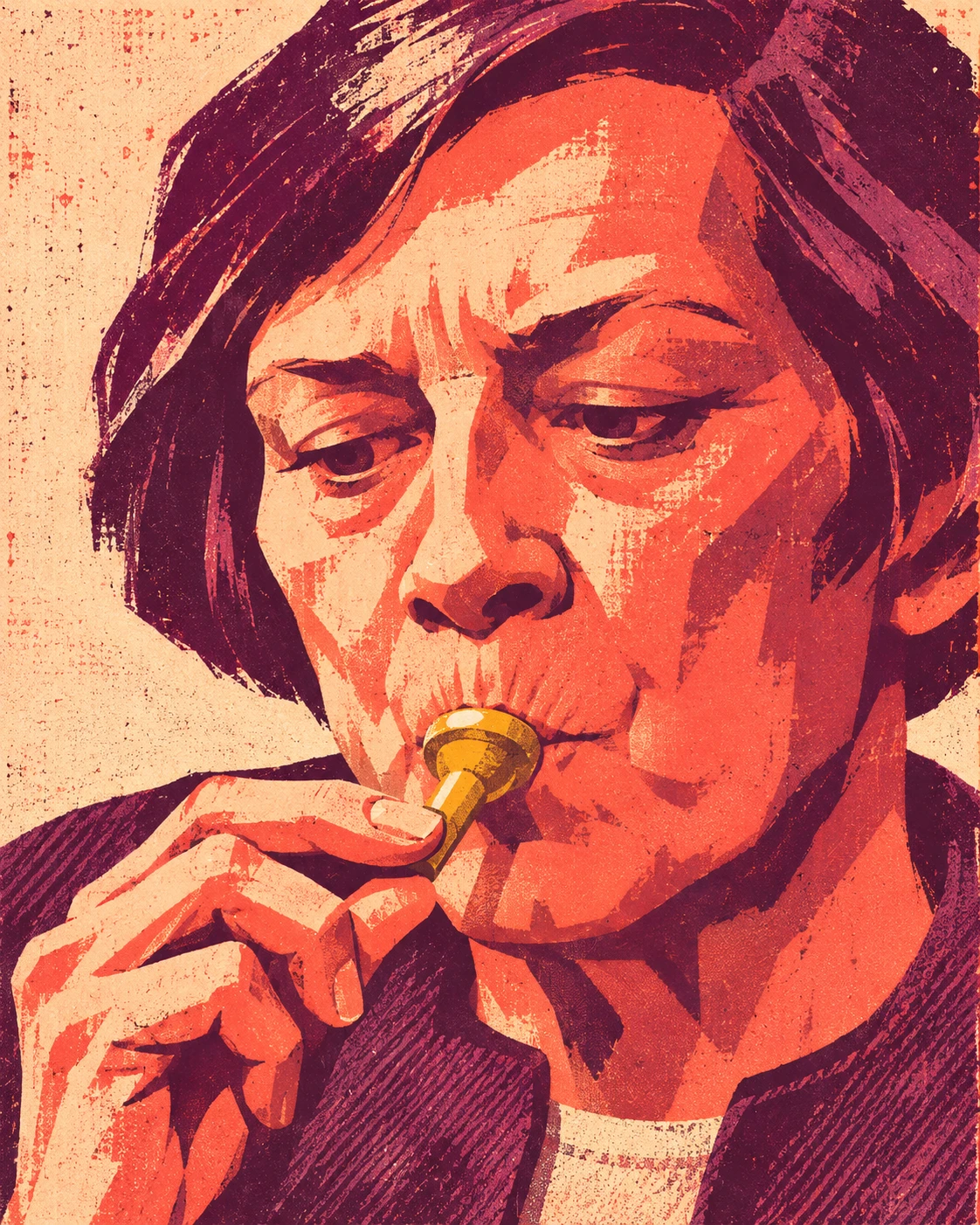
A boldly cropped screen-print portrait of a musician buzzing a trumpet mouthpiece. Fingertips and a small metal rim interrupt decisive aubergine and coral shapes.
Remix this referenceBuzzing a Trumpet Mouthpiece
- Form language
- Reduce volumes into interlocking blunt planes and curved wedges; alternate broad masses with narrow interruptions for decisive shape rhythms.
- Contour
- Use mostly unoutlined cut edges, with occasional thick tapered strokes and slight stencil roughness along selected boundaries.
- Mark-making
- Let screen-printed ink show irregular pinholes, short dragged streaks and slight registration slips; marks may vary naturally.
- Surface rendering
- Build tones with overlapping opaque ink layers and occasional broken overprints, keeping transitions stepped and tactile.
Priority
Make layered screen printing and decisive shape rhythms visibly define the finish.
What to avoid & what to check
Exact prompt for this example
MODULE OWNERSHIP
subject: Subject count, type, stable proportions and landmarks, resting face geometry, hair shape, physical materials, garment construction and permanent marks. No emotion, movement, color assignment or rendering recipe.
expression: Facial soft-tissue displacement and pupil direction, muscle coordination, regional intensity, asymmetry and onset/peak/release. No head/body pose, stable appearance, skin color or rendering.
gesture: Head/neck/body/limb orientation, joint movement, support, contact and pose-caused occlusion using existing anatomy. No eye/pupil movement, emotion, identity, props inventory or camera.
props: Prop count, type, construction, physical material and scale relative to the subject. Holding/contact belongs to gesture, position to composition, color to palette.
scene: Environment elements, terrain, backdrop/floor presence and structural detail. No canvas positions, camera, lighting, assigned colors or render texture.
camera: Projection, focal-length impression, camera elevation/yaw/roll, viewing distance and crop. No actor pose, world placement, lighting or canvas aspect ratio.
composition: Normalized 0-100% canvas positions, scale in frame, depth/overlap, focal hierarchy and margins. No joint pose, camera projection, rendering, subject/prop inventory or emotion.
palette: Color anchors, hue/saturation/value ranges, colors assigned to parts and approximate color coverage. No illumination direction, shading algorithm, physical material or layout.
lighting: Light-source direction/softness/intensity, ambient illumination, physical shadow direction/length and highlight position. Absence of directional illumination is allowed. No shading technique, palette or material changes.
style: Reusable form abstraction, contour weight/taper/edge quality, medium and mark scale/density/direction, surface rendering and tonal transition technique. No fixed subject proportions, anatomy, identity, expression, pose, palette, light-source direction, camera or layout.
output: Image count, aspect ratio, size, file/alpha requirements and global lettering/logo/watermark restrictions. No background scenery, crop, style, identity or pose.

SUBJECT
inventory: One original older woman, a trumpet player, designated actor A.
geometry: A substantial head, narrow shoulders and long fingers give her an immediately recognizable silhouette.
resting-face: A rectangular face has deep-set eyes, a broad nose bridge, a slender upper lip and a small chin cleft.
appearance: Short side-parted hair forms a blunt wedge; she wears a collarless twill jacket over a plain knit shirt.

PRIORITY


AVOID


CHECK


EXPRESSION — ACTOR A
brows: The inner brows draw together slightly, with one sitting a little higher.
lids: Upper lids lower gently while the lower lids remain lightly firm.
cheeks: The cheeks swell subtly beside the mouth, retaining small creases near the corners.
nose: The nostrils widen slightly without wrinkling the nose bridge.
mouth: Lips gather into a small tense oval, with the outer lip tissue firmly compressed.
jaw: The jaw releases just enough to keep a small opening behind the pursed lips.
gaze: Both pupils angle downward toward the fingertips.
coordination: Keep the upper face quietly attentive while the strongest muscular effort gathers around the lips.
timing: Capture the sustained apex of a steady buzz, with the facial tension already established.

PRIORITY


AVOID


CHECK


GESTURE
head: Her neck inclines forward and her head turns slightly to her right.
torso: The upper torso inclines toward the raised hand, with one shoulder gently advanced.
limbs: One forearm rises toward the mouth; thumb and forefinger make a relaxed pinch around the stem.
contact: The mouthpiece cup meets the center of her lips; the fingers support its stem without covering the cup.

PRIORITY


AVOID


CHECK


PROPS
inventory: One detached trumpet mouthpiece, short enough to fit between her lips and fingertips; no instrument body.
construction: A brass mouthpiece has a rounded cup rim, a shallow bowl and a tapered hollow stem.

PRIORITY


AVOID


CHECK


SCENE
inventory: A rehearsal-room plaster wall forms the only environmental backdrop; no floor is visible.
structure: The wall is uninterrupted, without fixtures or architectural divisions.

PRIORITY


AVOID


CHECK


CAMERA
projection: Use a mildly compressed portrait perspective with an intimate short-telephoto impression.
viewpoint: Place the camera at eye height with a nearly frontal viewpoint and no roll.
crop: Crop tightly from the upper chest through the crown, retaining the mouthpiece and supporting fingertips.

PRIORITY


AVOID


CHECK


COMPOSITION
placement: The oversized face occupies the right two-thirds; the mouthpiece and fingers enter across the lower left.
depth: The hand overlaps the jacket; the mouth and small cup form the primary focus, followed by the eyes.
spacing: Let the crown and near shoulder break the frame, leaving a narrow breathing space beside the far cheek.

PRIORITY


AVOID


CHECK


PALETTE
colors: Use deep aubergine, hot coral, muted saffron and warm ivory, with strong value separation.
assignment: Coral and ivory divide the face; aubergine anchors hair and jacket; saffron distinguishes the mouthpiece.
balance: Let coral and aubergine dominate, ivory provide relief, and saffron remain a small concentrated accent.

PRIORITY


AVOID


CHECK


LIGHTING
sources: A broad soft source from the upper left meets modest ambient illumination.
shadows: Broad shadows fall toward the lower right beneath the nose, chin and raised fingers.
highlights: Keep highlights broad on the brow and cheek, with a small brighter catch on the upper cup rim.

PRIORITY


AVOID


CHECK


STYLE GUIDE
form-language: Reduce volumes into interlocking blunt planes and curved wedges; alternate broad masses with narrow interruptions for decisive shape rhythms.
contour: Use mostly unoutlined cut edges, with occasional thick tapered strokes and slight stencil roughness along selected boundaries.
mark-making: Let screen-printed ink show irregular pinholes, short dragged streaks and slight registration slips; marks may vary naturally.
surface-rendering: Build tones with overlapping opaque ink layers and occasional broken overprints, keeping transitions stepped and tactile.

PRIORITY
Make layered screen printing and decisive shape rhythms visibly define the finish.

AVOID


CHECK


OUTPUT
format: This attribute is not applicable.
restrictions: One finished image, 4:5 portrait, 1600 × 2000 pixels, opaque PNG; no lettering, logos or watermarks.

PRIORITY


AVOID


CHECK


FINAL INTEGRATION
expression + gesture + props: Facial effort, hand support and the mouthpiece should read as one credible playing action.
style + lighting: Translate the illumination into the print language while retaining the readability of the facial action.
Model information comes from image provenance. The same prompt may produce a different result.