Text to imageIllustrationStyle guide
Folded Umbrella · Contour Hatching
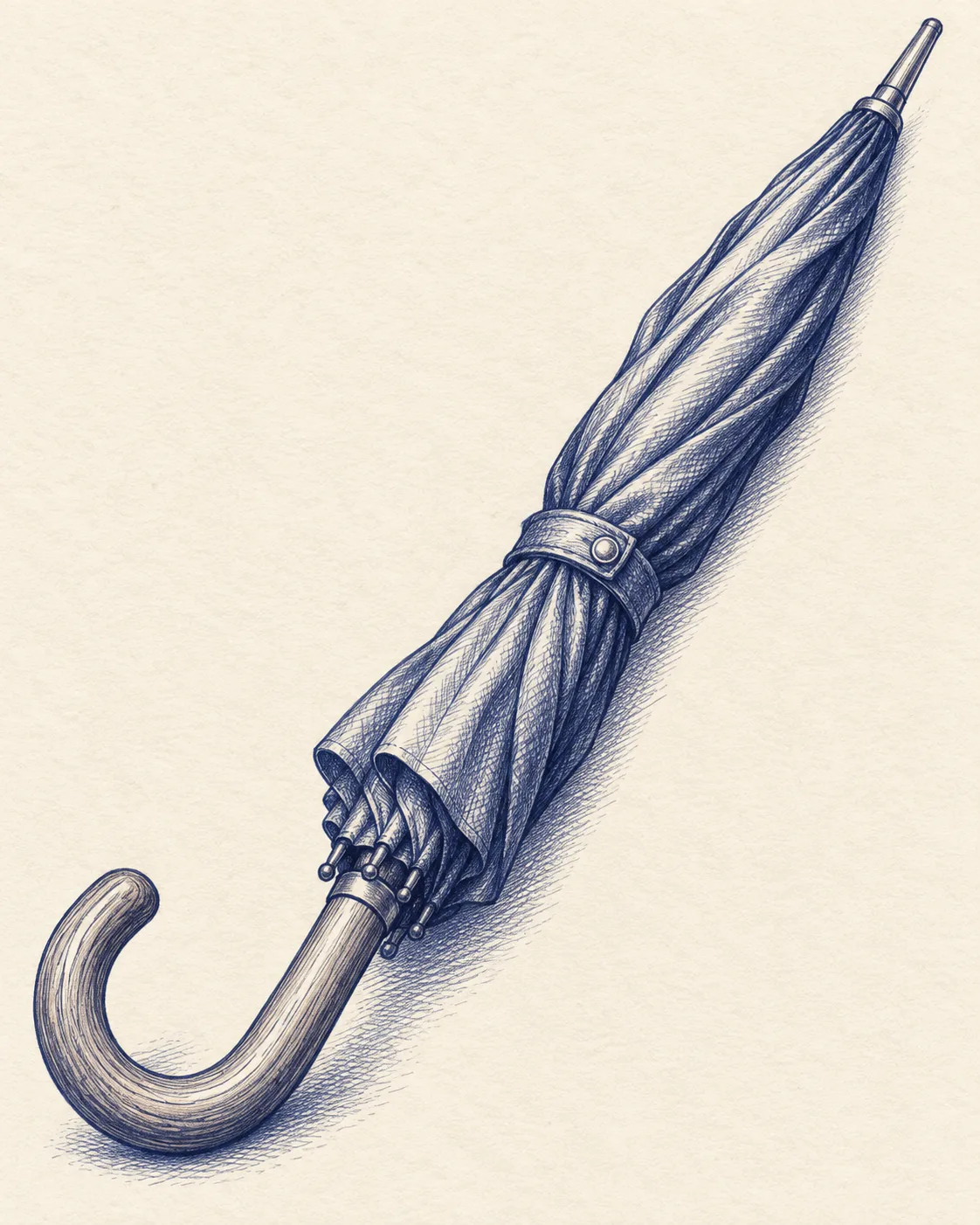
A pen illustration of one folded umbrella, using curved contour hatching to describe fabric volume and fold depth.
Folded Umbrella · Contour Hatching
- Shape & line
- Draw the outer silhouette with a firm, slightly varied pen line, then bend short parallel hatch strokes around each fabric ridge. Change their curvature as the canopy narrows, and let strokes end before bright ridge crests so the folds read as rounded forms.
- Color & light
- Use dark blue ink on warm ivory paper, with broad areas of untouched paper carrying the light. Suggest illumination from the upper left by spacing hatches widely on exposed folds and packing them more closely into the lower-right valleys; keep the deepest accents near overlapping fabric and the strap.
- Texture & material
- Describe the canopy as supple woven cloth through long soft-edged folds and small irregular breaks in the ink strokes. Give the wooden handle a few smooth grain lines following its curve, and leave the exposed metal tip mostly clear with one crisp dark edge; retain a subtle paper grain without adding a uniform noise layer.
- Composition
- Let the umbrella occupy most of the image height while leaving generous paper around both ends. Use the curved handle as the broad visual anchor and the tapering canopy as the directional lead; place a sparse patch of ground hatching beneath the lower edge to establish contact without competing with the fabric lines.
Priority
Prioritize hatch curvature that makes the gathered fabric feel rounded.
What to avoid & what to check
Avoid straight shading bands that flatten the folds or solid fills that conceal the penwork.
Check that one closed umbrella reads clearly and that the hatching follows its folds.
Exact prompt for this example
SUBJECT
Draw one closed umbrella with a curved wooden handle, a gathered fabric canopy, and a short exposed tip. A fastening strap holds the canopy near its middle; long folds converge toward the tip, while the handle extends beyond the gathered fabric.

COMPOSITION
Show the entire umbrella lying diagonally from lower left to upper right on a plain paper field, viewed slightly from above. Keep its handle opening, fastening strap, and tapered tip clearly separated and readable.

STYLE GUIDE
1. Shape & line
Draw the outer silhouette with a firm, slightly varied pen line, then bend short parallel hatch strokes around each fabric ridge. Change their curvature as the canopy narrows, and let strokes end before bright ridge crests so the folds read as rounded forms.

2. Color & light
Use dark blue ink on warm ivory paper, with broad areas of untouched paper carrying the light. Suggest illumination from the upper left by spacing hatches widely on exposed folds and packing them more closely into the lower-right valleys; keep the deepest accents near overlapping fabric and the strap.

3. Texture & material
Describe the canopy as supple woven cloth through long soft-edged folds and small irregular breaks in the ink strokes. Give the wooden handle a few smooth grain lines following its curve, and leave the exposed metal tip mostly clear with one crisp dark edge; retain a subtle paper grain without adding a uniform noise layer.

4. Composition
Let the umbrella occupy most of the image height while leaving generous paper around both ends. Use the curved handle as the broad visual anchor and the tapering canopy as the directional lead; place a sparse patch of ground hatching beneath the lower edge to establish contact without competing with the fabric lines.

PRIORITY
Preserve the requested identity, count, action, composition and output settings. Apply the style rules within those constraints; a style reference must not replace the subject or layout. Within the style: Prioritize hatch curvature that makes the gathered fabric feel rounded.

AVOID
Avoid straight shading bands that flatten the folds or solid fills that conceal the penwork.

OUTPUT
Create one portrait image in a 4:5 aspect ratio, with no lettering, labels, signature, or watermark.

SELF-CHECK
Check that one closed umbrella reads clearly and that the hatching follows its folds.
Model information comes from image provenance. The same prompt may produce a different result.