Text to imageComicsStyle guide
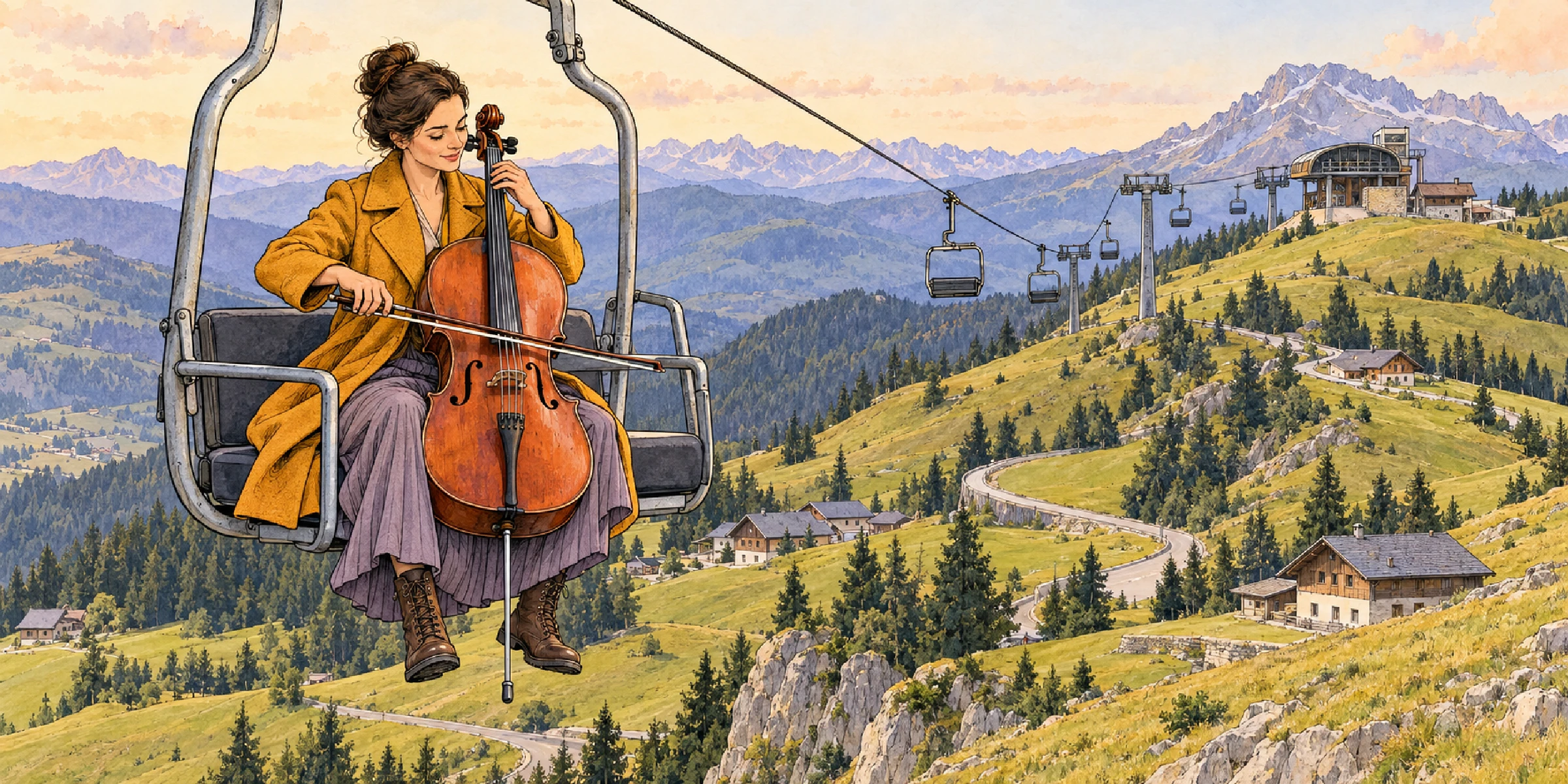
A Cellist on the Chairlift
A European clear-line comic illustration with fine pen contours and transparent watercolor planes. A woman plays her cello on a chairlift while the cable and a winding mountain road lead the eye across meadows to the distant station.
Remix this referenceA Cellist on the Chairlift
- Form language
- Reduce forms to lucid rounded volumes and economical planar shapes; retain telling irregularities without caricatured distortion.
- Contour
- Use fine, continuous near-uniform pen contours, rounded joins and only slight terminal taper; keep interior lines lighter and sparse.
- Mark-making
- Place small, deliberate pen ticks in loose clusters, with natural variation in spacing; allow broad passages to remain unmarked.
- Surface rendering
- Lay transparent watercolor within legible ink boundaries, with occasional pooled edges and simple tonal steps; let minor wash variations occur naturally.
Priority
Rendering medium: Clear-line European comic illustration in fine pen and transparent watercolor.
What to avoid & what to check
Exact prompt for this example
MODULE OWNERSHIP
subject: Subject count, type, stable proportions and landmarks, resting face geometry, hair shape, physical materials, garment construction and permanent marks. No emotion, movement, color assignment or rendering recipe.
expression: Facial soft-tissue displacement and pupil direction, muscle coordination, regional intensity, asymmetry and onset/peak/release. No head/body pose, stable appearance, skin color or rendering.
gesture: Head/neck/body/limb orientation, joint movement, support, contact and pose-caused occlusion using existing anatomy. No eye/pupil movement, emotion, identity, props inventory or camera.
props: Prop count, type, construction, physical material and scale relative to the subject. Holding/contact belongs to gesture, position to composition, color to palette.
scene: Environment elements, terrain, backdrop/floor presence and structural detail. No canvas positions, camera, lighting, assigned colors or render texture.
camera: Projection, focal-length impression, camera elevation/yaw/roll, viewing distance and crop. No actor pose, world placement, lighting or canvas aspect ratio.
composition: Normalized 0-100% canvas positions, scale in frame, depth/overlap, focal hierarchy and margins. No joint pose, camera projection, rendering, subject/prop inventory or emotion.
palette: Color anchors, hue/saturation/value ranges, colors assigned to parts and approximate color coverage. No illumination direction, shading algorithm, physical material or layout.
lighting: Light-source direction/softness/intensity, ambient illumination, physical shadow direction/length and highlight position. Absence of directional illumination is allowed. No shading technique, palette or material changes.
style: Reusable form abstraction, contour weight/taper/edge quality, medium and mark scale/density/direction, surface rendering and tonal transition technique. No fixed subject proportions, anatomy, identity, expression, pose, palette, light-source direction, camera or layout.
output: Image count, aspect ratio, size, file/alpha requirements and global lettering/logo/watermark restrictions. No background scenery, crop, style, identity or pose.

SUBJECT
inventory: One adult woman, the cellist, designated A; no other people.
geometry: A has sturdy adult proportions, a long oval face, a prominent straight nose and broad hands.
resting-face: Straight brows, gently hooded almond-shaped eyes and a broad mouth with a distinct upper-lip bow.
appearance: Hair forms a compact coiled bun; a wool coat with broad lapels covers a pleated skirt and lace-up boots.

PRIORITY


AVOID


CHECK


EXPRESSION — ACTOR A
brows: The right outer brow lifts slightly; the inner brows remain loose.
lids: Upper lids lower gently, with a small lift of the right lower lid.
cheeks: The right cheek rises subtly, leaving the left cheek nearly relaxed.
nose: The nose remains unwrinkled, with relaxed nostrils.
mouth: Closed lips form a small smile, slightly higher at the right corner.
jaw: The jaw stays loose, without opening or clenching.
gaze: Both pupils look down toward the cello fingerboard.
coordination: The right cheek, lid and mouth corner rise together; the upper face stays restrained.
timing: Hold the quiet apex of a small, sustained amused smile.

PRIORITY


AVOID


CHECK


GESTURE
head: A inclines her head toward the fingerboard, keeping her neck comfortably extended.
torso: She sits upright on the chair, with a slight forward inclination from the hips.
limbs: Her left hand fingers the neck; her right arm draws the bow across the strings; her boots hang free.
contact: The cello rests between her knees with its lower body on the seat edge; the endpin projects freely below.

PRIORITY


AVOID


CHECK


PROPS
inventory: One full-size cello and one bow, scaled naturally to A.
construction: The wooden cello has a waisted hollow body, paired f-holes, a long fingerboard and metal endpin; the bow has a slender stick and hair ribbon.

PRIORITY


AVOID


CHECK


SCENE
inventory: An open mountain chairlift crosses meadow slopes above a winding road, scattered farm buildings and a distant summit station.
structure: The two-seat chair hangs from a cable on a curved steel hanger; pylons, roadside walls and a roofed station establish the route.

PRIORITY


AVOID


CHECK


CAMERA
projection: Moderate wide-angle perspective with natural spatial recession and little edge distortion.
viewpoint: View from another chair slightly above seat height, looking obliquely across the lift route without roll.
crop: Include A, the entire cello and the seat; let the overhead cable continue beyond the frame.

PRIORITY


AVOID


CHECK


COMPOSITION
placement: Center the chair near 28% width and 57% height; the distant station sits near 84% width and 29% height.
depth: The cellist is the first focal point; the cable leads toward the station, while the road loops through lower layers of landscape.
spacing: A occupies roughly half the frame height; leave open air around the bow and broad landscape space to the right.

PRIORITY


AVOID


CHECK


PALETTE
colors: Pale apricot, muted lavender, meadow green, saffron and reddish brown, anchored by near-black ink.
assignment: Use apricot sky, green slopes, lavender distant ridges and roofs, a saffron coat and reddish-brown cello; A has warm beige skin and dark brown hair.
balance: Keep the broad environment pale and moderately desaturated; reserve the strongest warm saturation for the coat and cello.

PRIORITY


AVOID


CHECK


LIGHTING
sources: Soft sunlight enters from the upper left, with generous ambient daylight.
shadows: Short, soft-edged shadows fall toward the lower right; the underside of the chair stays readable.
highlights: Small highlights catch the cello's upper-left curves and the upper edges of the steel hanger.

PRIORITY


AVOID


CHECK


STYLE GUIDE
form-language: Reduce forms to lucid rounded volumes and economical planar shapes; retain telling irregularities without caricatured distortion.
contour: Use fine, continuous near-uniform pen contours, rounded joins and only slight terminal taper; keep interior lines lighter and sparse.
mark-making: Place small, deliberate pen ticks in loose clusters, with natural variation in spacing; allow broad passages to remain unmarked.
surface-rendering: Lay transparent watercolor within legible ink boundaries, with occasional pooled edges and simple tonal steps; let minor wash variations occur naturally.

PRIORITY
Rendering medium: Clear-line European comic illustration in fine pen and transparent watercolor.

AVOID


CHECK


OUTPUT
format: One finished illustration, 2:1 landscape, 2400 × 1200 pixels, opaque PNG.
restrictions: No lettering, dialogue balloons, logos or watermarks.

PRIORITY


AVOID


CHECK
Model information comes from image provenance. The same prompt may produce a different result.