Text to imageCharacterStyle guide
Stilt Walker Beneath a Low Lintel
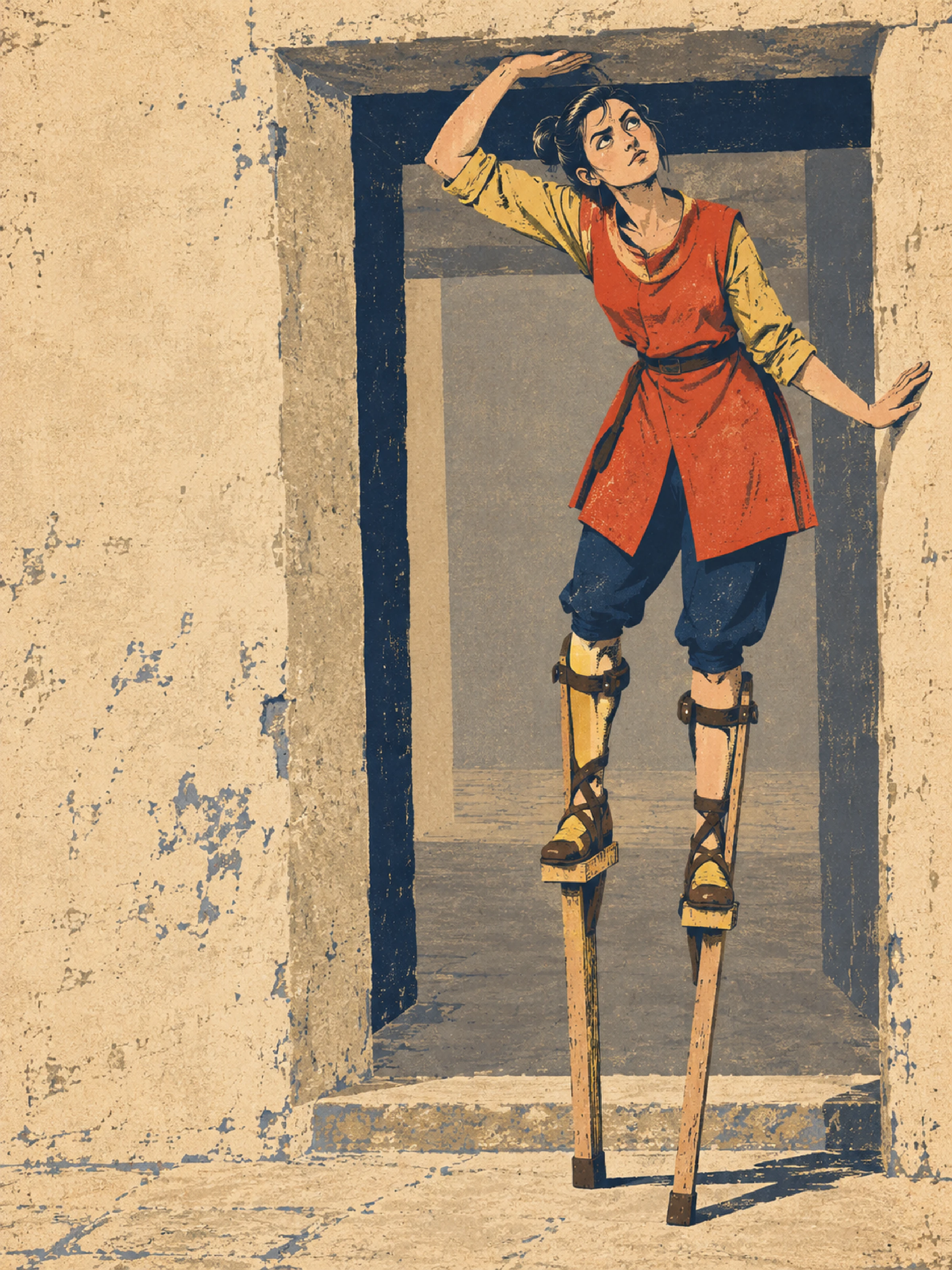
A stilt walker folds sideways beneath a low doorway, rendered as a graphic screen print with a forceful silhouette and generous negative space.
Remix this referenceStilt Walker Beneath a Low Lintel
- Form language
- Build a rhythmic vocabulary of hooked shapes, long bars and blunt wedges; retain small irregularities within each repeated shape family.
- Contour
- Let stencil edges carry the silhouette without a uniform outline; use a few thick, abruptly ending internal cuts.
- Mark-making
- Sparse broken ink drags and blunt squeegee streaks interrupt broad shapes; their length and density vary naturally.
- Surface rendering
- Use opaque screen-printed planes with occasional translucent overprints and slight registration slips; tonal changes remain discrete.
Priority
Preserve the decisive shape rhythms and visible ink character of graphic screen printing.
What to avoid & what to check
Exact prompt for this example
MODULE OWNERSHIP
subject: Subject count, type, stable proportions and landmarks, resting face geometry, hair shape, physical materials, garment construction and permanent marks. No emotion, movement, color assignment or rendering recipe.
expression: Facial soft-tissue displacement and pupil direction, muscle coordination, regional intensity, asymmetry and onset/peak/release. No head/body pose, stable appearance, skin color or rendering.
gesture: Head/neck/body/limb orientation, joint movement, support, contact and pose-caused occlusion using existing anatomy. No eye/pupil movement, emotion, identity, props inventory or camera.
props: Prop count, type, construction, physical material and scale relative to the subject. Holding/contact belongs to gesture, position to composition, color to palette.
scene: Environment elements, terrain, backdrop/floor presence and structural detail. No canvas positions, camera, lighting, assigned colors or render texture.
camera: Projection, focal-length impression, camera elevation/yaw/roll, viewing distance and crop. No actor pose, world placement, lighting or canvas aspect ratio.
composition: Normalized 0-100% canvas positions, scale in frame, depth/overlap, focal hierarchy and margins. No joint pose, camera projection, rendering, subject/prop inventory or emotion.
palette: Color anchors, hue/saturation/value ranges, colors assigned to parts and approximate color coverage. No illumination direction, shading algorithm, physical material or layout.
lighting: Light-source direction/softness/intensity, ambient illumination, physical shadow direction/length and highlight position. Absence of directional illumination is allowed. No shading technique, palette or material changes.
style: Reusable form abstraction, contour weight/taper/edge quality, medium and mark scale/density/direction, surface rendering and tonal transition technique. No fixed subject proportions, anatomy, identity, expression, pose, palette, light-source direction, camera or layout.
output: Image count, aspect ratio, size, file/alpha requirements and global lettering/logo/watermark restrictions. No background scenery, crop, style, identity or pose.

SUBJECT
inventory: A is one adult woman, an itinerant stilt performer.
geometry: A slender adult build with long forearms, broad palms and a compact head.
resting-face: An angular jaw, a rounded nose tip, low-set brows and a narrow mouth define the resting face.
appearance: Rope-twisted hair forms a small bun; she wears a linen tabard over a fitted shirt, knee breeches and leather shoes.

PRIORITY


AVOID


CHECK


EXPRESSION — ACTOR A
brows: One brow arches while the other lowers slightly toward the bridge.
lids: The lowered-brow eye narrows; the other eye stays open.
cheeks: Cheeks remain mostly relaxed with no smile lift.
nose: Keep the nose relaxed without flaring or wrinkling.
mouth: Closed lips press lightly, with one corner tucked inward.
jaw: The jaw is closed without a clenched bulge.
gaze: Pupils look upward toward the lintel.
coordination: Keep the uneven brow action stronger than the small mouth compression.
timing: Hold the apex of a brief assessing look.

PRIORITY


AVOID


CHECK


GESTURE
head: A draws her chin inward and tilts her head sideways beneath the lintel.
torso: Her torso bends strongly sideways at the waist while the hips remain over the stilts.
limbs: One arm curves over her head; the other extends outward for balance, with knees softly bent.
contact: The upper palm touches the lintel underside; strapped shoes rest on the stilt footplates, with both tips grounded.

PRIORITY


AVOID


CHECK


PROPS
inventory: One matching pair of wearable wooden stilts, each extending roughly a lower-leg length beneath the shoe.
construction: Straight timber shafts have simple footplates, calf braces and leather fastening straps.

PRIORITY


AVOID


CHECK


SCENE
inventory: A low rectangular doorway in a thick plaster wall, opening onto an unadorned passage with a continuous floor.
structure: A heavy lintel and plain jambs define the opening; a shallow threshold is the only floor detail.

PRIORITY


AVOID


CHECK


CAMERA
projection: Use weak perspective with a long focal-length impression.
viewpoint: View nearly front-on from waist height, with a slight yaw that reveals the doorway thickness and no roll.
crop: Show the full figure and both stilt tips; crop the surrounding architecture.

PRIORITY


AVOID


CHECK


COMPOSITION
placement: Place the figure around 68% canvas width, spanning most of the height; the lintel crosses the upper quarter.
depth: The figure overlaps the right jamb; the passage remains a broad, uninterrupted shape behind her.
spacing: Give the left half generous negative space; read the bent silhouette first, then the face and the lintel contact.

PRIORITY


AVOID


CHECK


PALETTE
colors: Use ink navy, vermilion, warm buff and a small acid-yellow accent.
assignment: Vermilion tabard, navy hair and breeches, buff skin and architecture; yellow marks the shirt and stilt footplates.
balance: Buff dominates the open areas; navy anchors the figure, vermilion carries the main chromatic weight and yellow stays sparse.

PRIORITY


AVOID


CHECK


LIGHTING
sources: Broad daylight comes from upper left with moderate ambient fill.
shadows: A compact cast shadow falls to the right of the stilt tips; the lintel underside remains shaded.
highlights: Restrained highlights touch the upper-left edges of the face, forearm and timber shafts.

PRIORITY


AVOID


CHECK


STYLE GUIDE
form-language: Build a rhythmic vocabulary of hooked shapes, long bars and blunt wedges; retain small irregularities within each repeated shape family.
contour: Let stencil edges carry the silhouette without a uniform outline; use a few thick, abruptly ending internal cuts.
mark-making: Sparse broken ink drags and blunt squeegee streaks interrupt broad shapes; their length and density vary naturally.
surface-rendering: Use opaque screen-printed planes with occasional translucent overprints and slight registration slips; tonal changes remain discrete.

PRIORITY
Preserve the decisive shape rhythms and visible ink character of graphic screen printing.

AVOID


CHECK


OUTPUT
format: One finished image, 3:4 aspect ratio, 2400 × 3200 pixels, PNG with an opaque background.
restrictions: Deliver one finished image at 3:4, 2400 × 3200 pixels, opaque PNG; no lettering, logos or watermarks.

PRIORITY


AVOID


CHECK


FINAL INTEGRATION
gesture + composition + style: Keep the bodily action legible through the graphic simplification, allowing the spacing to clarify its silhouette.
Model information comes from image provenance. The same prompt may produce a different result.