Text to imageIllustrationStyle guide
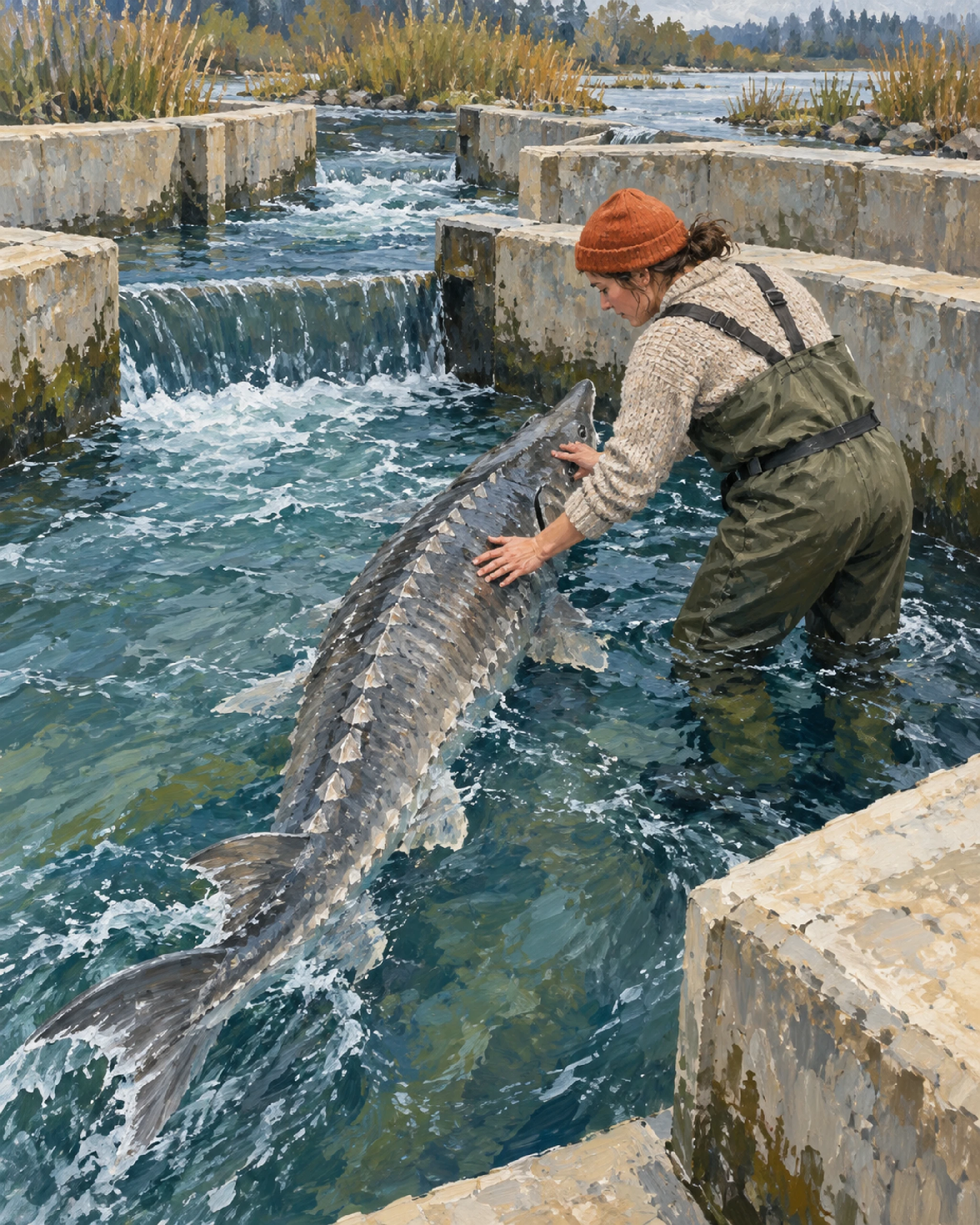
Guiding a Sturgeon Up the Fishway
A river warden guides a large sturgeon into the next fishway chamber. Layered channels and reeds surround a careful moment of contact, painted with loose, opaque gouache strokes.
Remix this referenceGuiding a Sturgeon Up the Fishway
- Form language
- Build forms from broad interlocking masses; simplify small structures into irregular wedges with coherent local variation.
- Contour
- Let painted boundaries carry the drawing, alternating blunt edges with frayed interruptions and occasional tapered accents.
- Mark-making
- Use loose gouache with visible opaque brushwork: loaded broad strokes, dragged dry edges and brisk, unblended dabs.
- Surface rendering
- Stack chalky opaque patches over darker underpainting; selective scumbles and exposed paper break stepped tonal transitions.
Priority
Keep loaded, overlapping gouache strokes visibly distinct throughout the finished painting.
What to avoid & what to check
Exact prompt for this example
MODULE OWNERSHIP
subject: Subject count, type, stable proportions and landmarks, resting face geometry, hair shape, physical materials, garment construction and permanent marks. No emotion, movement, color assignment or rendering recipe.
expression: Facial soft-tissue displacement and pupil direction, muscle coordination, regional intensity, asymmetry and onset/peak/release. No head/body pose, stable appearance, skin color or rendering.
gesture: Head/neck/body/limb orientation, joint movement, support, contact and pose-caused occlusion using existing anatomy. No eye/pupil movement, emotion, identity, props inventory or camera.
props: Prop count, type, construction, physical material and scale relative to the subject. Holding/contact belongs to gesture, position to composition, color to palette.
scene: Environment elements, terrain, backdrop/floor presence and structural detail. No canvas positions, camera, lighting, assigned colors or render texture.
camera: Projection, focal-length impression, camera elevation/yaw/roll, viewing distance and crop. No actor pose, world placement, lighting or canvas aspect ratio.
composition: Normalized 0-100% canvas positions, scale in frame, depth/overlap, focal hierarchy and margins. No joint pose, camera projection, rendering, subject/prop inventory or emotion.
palette: Color anchors, hue/saturation/value ranges, colors assigned to parts and approximate color coverage. No illumination direction, shading algorithm, physical material or layout.
lighting: Light-source direction/softness/intensity, ambient illumination, physical shadow direction/length and highlight position. Absence of directional illumination is allowed. No shading technique, palette or material changes.
style: Reusable form abstraction, contour weight/taper/edge quality, medium and mark scale/density/direction, surface rendering and tonal transition technique. No fixed subject proportions, anatomy, identity, expression, pose, palette, light-source direction, camera or layout.
output: Image count, aspect ratio, size, file/alpha requirements and global lettering/logo/watermark restrictions. No background scenery, crop, style, identity or pose.

SUBJECT
inventory: A is one adult woman river warden; B is one large sturgeon.
geometry: A has a sturdy adult build. B exceeds her height in length, with a spindle-shaped body, pointed snout and tapering tail.
resting-face: A has a broad nose and rounded chin. B has small lateral eyes and a ventral mouth beneath its elongated snout.
appearance: A wears chest waders over a knitted sweater and a fitted cap. B has leathery skin and raised rows of bony scutes.

PRIORITY


AVOID


CHECK


EXPRESSION — ACTOR A
brows: The visible brow rests without lifting or pinching.
lids: The visible upper lid lowers slightly without a squint.
cheeks: The near cheek stays relaxed without lifting.
nose: The nostril remains relaxed without flaring.
mouth: Lips meet lightly, with level, uncompressed corners.
jaw: The visible jaw rests without clenching or dropping.
gaze: The visible pupil points down toward the hand-to-fish contact.
coordination: Keep the visible facial regions quietly coordinated; the far side remains unprescribed.
timing: Hold a settled neutral expression at its quiet apex.

PRIORITY


AVOID


CHECK


EXPRESSION — ACTOR B
brows: No expressive brow action applies.
lids: No lid action applies; leave the visible eye opening at rest.
cheeks: Keep the cheek region free of expressive contraction.
nose: No visible nasal displacement is prescribed.
mouth: Mouth movement remains unprescribed.
jaw: No expressive lower-jaw movement is prescribed.
gaze: Keep the visible pupil at rest, without a deliberate sideways glance.
coordination: Maintain a neutral animal face without humanlike facial coordination.
timing: Hold the resting facial state at a quiet apex.

PRIORITY


AVOID


CHECK


GESTURE
head: A lowers and turns her head toward her hands. B's snout points into the upstream opening.
torso: A leans from the hips over the water. B bends in a shallow curve through the current.
limbs: A braces with staggered legs and reaches both arms forward; B's submerged fins remain unprescribed.
contact: A places one open palm behind B's head and the other against its flank, guiding without gripping. B's ventral mouth and lower jaw remain submerged and obscured by water.

PRIORITY


AVOID


CHECK


PROPS
inventory: No separate props.
construction: No prop construction applies.

PRIORITY


AVOID


CHECK


SCENE
inventory: A working fishway contains flowing river water, stepped concrete chambers, overflow lips and reed-lined banks.
structure: Low dividing walls connect successive pools through broad openings; the channel opens onto a reed-fringed river.

PRIORITY


AVOID


CHECK


CAMERA
projection: Use natural perspective with a moderately wide focal-length impression.
viewpoint: Look slightly downward from A's left rear quarter, revealing her near facial profile; keep the horizon level.
crop: Include A's full above-water silhouette and B's entire length within a broad view of the channel.

PRIORITY


AVOID


CHECK


COMPOSITION
placement: A occupies the right third; B extends diagonally from the lower left toward an opening near the upper middle.
depth: A cropped foreground wall leads toward the contact, with successive pools and reeds overlapping farther back.
spacing: The hands meeting the fish form the first focus; open water surrounds that junction while distant chambers recede loosely.

PRIORITY


AVOID


CHECK


PALETTE
colors: Anchor the image in deep petrol blue, muted jade, warm limestone and a small persimmon-orange accent.
assignment: Water takes petrol and jade, concrete limestone, B pewter gray, and A a persimmon cap, oatmeal sweater and dark olive waders.
balance: Cool middle values dominate; pale concrete and scutes interrupt them, with the cap as the smallest saturated note.

PRIORITY


AVOID


CHECK


LIGHTING
sources: Broad overcast daylight enters from the upper left with gentle ambient fill.
shadows: Soft, short shadows fall beneath wall lips and along the bodies' lower sides.
highlights: Broad highlights catch B's upper back and the water beside A's hands.

PRIORITY


AVOID


CHECK


STYLE GUIDE
form-language: Build forms from broad interlocking masses; simplify small structures into irregular wedges with coherent local variation.
contour: Let painted boundaries carry the drawing, alternating blunt edges with frayed interruptions and occasional tapered accents.
mark-making: Use loose gouache with visible opaque brushwork: loaded broad strokes, dragged dry edges and brisk, unblended dabs.
surface-rendering: Stack chalky opaque patches over darker underpainting; selective scumbles and exposed paper break stepped tonal transitions.

PRIORITY
Keep loaded, overlapping gouache strokes visibly distinct throughout the finished painting.

AVOID


CHECK


OUTPUT
format: One finished illustration, portrait 4:5, 2048 × 2560 pixels, opaque PNG.
restrictions: No lettering, logos or watermarks.

PRIORITY


AVOID


CHECK


FINAL INTEGRATION
gesture + composition: Keep physical contact readable as the surrounding layers establish depth.
Model information comes from image provenance. The same prompt may produce a different result.