Text to imageComicsStyle guide
Saving Tea from the Hammock
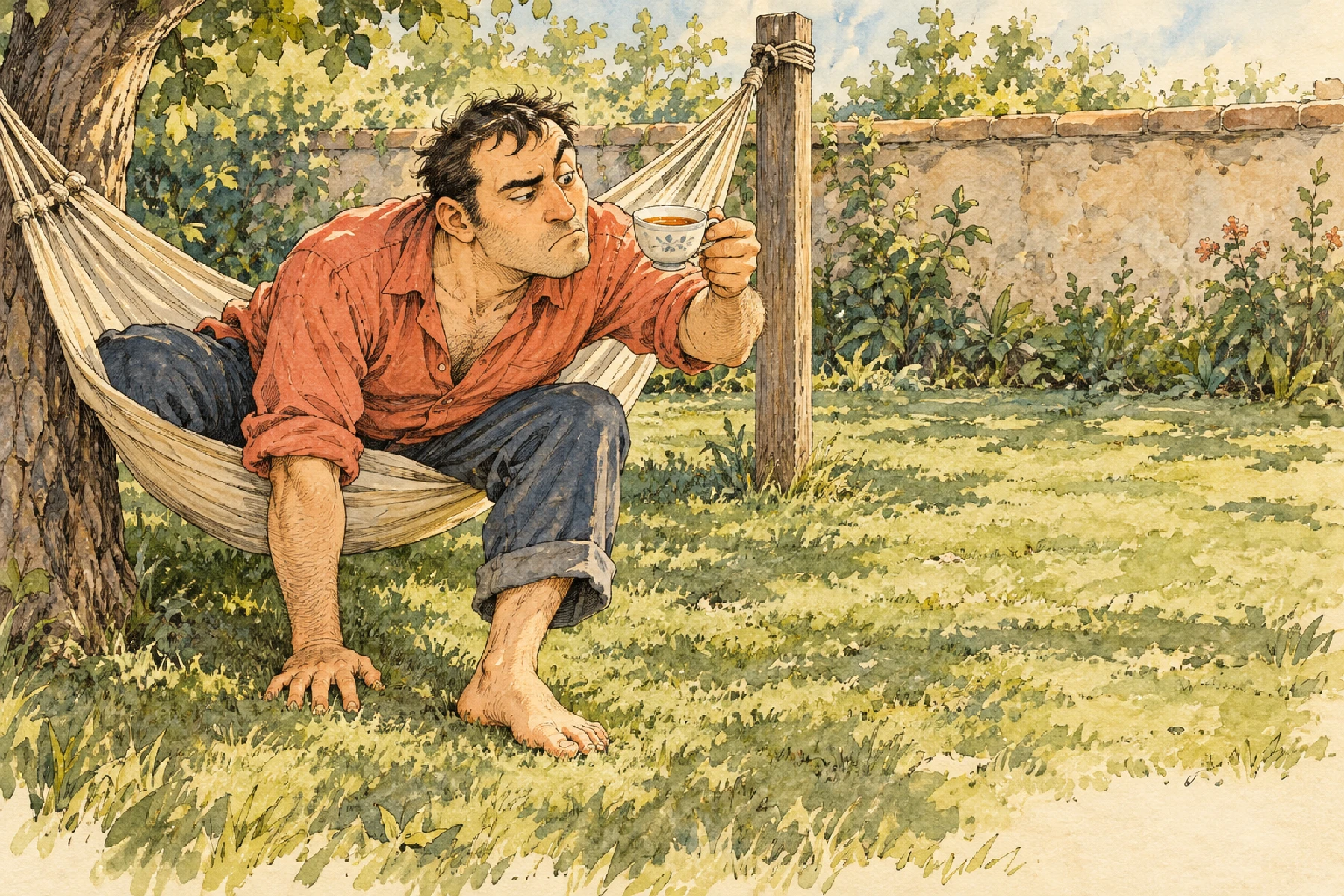
A man props himself on the grass while escaping a hammock, keeping his tea level. Rough penwork and bleeding washes give the small struggle room to breathe in a quiet garden.
Remix this referenceSaving Tea from the Hammock
- Form language
- Build forms from blunt wedges and slack rounded masses; simplify secondary detail while allowing lively irregularity.
- Contour
- Use scratchy dip-pen contours that swell, split and skip; leave occasional searching lines instead of polishing every edge.
- Mark-making
- Lay short restless hatches beside longer wandering strokes; let nib catches and changing pressure vary the marks naturally.
- Surface rendering
- Float transparent washes beyond some ink edges, allowing pooled rims, dry gaps and soft blooms to interrupt tonal transitions.
Priority
Rendering medium: rough independent-comic dip-pen and watercolor-wash illustration on absorbent paper.
What to avoid & what to check
Exact prompt for this example
MODULE OWNERSHIP
subject: Subject count, type, stable proportions and landmarks, resting face geometry, hair shape, physical materials, garment construction and permanent marks. No emotion, movement, color assignment or rendering recipe.
expression: Facial soft-tissue displacement and pupil direction, muscle coordination, regional intensity, asymmetry and onset/peak/release. No head/body pose, stable appearance, skin color or rendering.
gesture: Head/neck/body/limb orientation, joint movement, support, contact and pose-caused occlusion using existing anatomy. No eye/pupil movement, emotion, identity, props inventory or camera.
props: Prop count, type, construction, physical material and scale relative to the subject. Holding/contact belongs to gesture, position to composition, color to palette.
scene: Environment elements, terrain, backdrop/floor presence and structural detail. No canvas positions, camera, lighting, assigned colors or render texture.
camera: Projection, focal-length impression, camera elevation/yaw/roll, viewing distance and crop. No actor pose, world placement, lighting or canvas aspect ratio.
composition: Normalized 0-100% canvas positions, scale in frame, depth/overlap, focal hierarchy and margins. No joint pose, camera projection, rendering, subject/prop inventory or emotion.
palette: Color anchors, hue/saturation/value ranges, colors assigned to parts and approximate color coverage. No illumination direction, shading algorithm, physical material or layout.
lighting: Light-source direction/softness/intensity, ambient illumination, physical shadow direction/length and highlight position. Absence of directional illumination is allowed. No shading technique, palette or material changes.
style: Reusable form abstraction, contour weight/taper/edge quality, medium and mark scale/density/direction, surface rendering and tonal transition technique. No fixed subject proportions, anatomy, identity, expression, pose, palette, light-source direction, camera or layout.
output: Image count, aspect ratio, size, file/alpha requirements and global lettering/logo/watermark restrictions. No background scenery, crop, style, identity or pose.

SUBJECT
inventory: One adult man, actor A; no other figures.
geometry: A broad torso, short neck, sturdy forearms, broad cheekbones and a small rounded chin.
resting-face: Deep-set eyes beneath straight brows, a broad nose and a thin upper lip define his resting face.
appearance: Short uneven hair, an open-collar cotton shirt and loose linen trousers with rolled cuffs; bare feet.

PRIORITY


AVOID


CHECK


EXPRESSION — ACTOR A
brows: One brow draws inward while the other remains slightly raised.
lids: Upper lids narrow; lower lids tighten without squeezing shut.
cheeks: A small cheek bunch accompanies the pressed mouth corner.
nose: Nostrils stay relaxed, with no nose wrinkle.
mouth: Lips press together unevenly, one corner tucked firmly inward.
jaw: The jaw stays nearly closed without a pronounced clench.
gaze: Both pupils track the rim of the teacup.
coordination: Uneven brows and restrained mouth pressure make the effort look comically deliberate.
timing: Hold the apex of concentration for one suspended comic beat.

PRIORITY


AVOID


CHECK


GESTURE
head: The neck reaches forward and the head tips slightly toward the cup.
torso: The shoulders twist out of the hammock while the hips remain low in its sag.
limbs: The left elbow bends beneath the shoulder; the right arm extends with a level wrist; one leg reaches down.
contact: The hammock supports his hips, left forearm presses into grass, one heel finds ground, and right fingers grip the cup handle.

PRIORITY


AVOID


CHECK


PROPS
inventory: One adult-sized hammock and one small handled teacup containing tea; no saucer.
construction: The hammock is woven cloth with gathered cord ends; the cup is glazed ceramic with a rounded handle.

PRIORITY


AVOID


CHECK


SCENE
inventory: A modest garden with grass, a tree trunk, a hammock post and a low boundary wall.
structure: The hammock anchors to the trunk and post; uneven turf meets an old wall with a simple coping.

PRIORITY


AVOID


CHECK


CAMERA
projection: Use a natural perspective with a mild wide-lens impression.
viewpoint: Look diagonally across the garden from slightly above the man's seated eye level; keep the camera unrolled.
crop: A medium-wide view includes the ground contacts and whole cup, with the nearest tree trunk partly cropped.

PRIORITY


AVOID


CHECK


COMPOSITION
placement: Gather the man and hammock in the left third; place the cup just right of his face and the post near the middle.
depth: The near tree frames the hammock; the wall recedes behind the action. Face and cup form the primary visual exchange.
spacing: Keep clear breathing room around the cup and a broad, quietly irregular expanse of lawn across the right.

PRIORITY


AVOID


CHECK


PALETTE
colors: Use warm paper cream, smoky blue-black, muted olive and a small rusty coral accent.
assignment: Cream serves paper, hammock and cup; olive serves grass, coral the shirt, blue-black the trousers and ink.
balance: Let cream dominate, with restrained olive coverage and a small coral accent; keep skin a pale warm ochre.

PRIORITY


AVOID


CHECK


LIGHTING
sources: Soft daylight enters from upper left, with broad ambient light throughout the garden.
shadows: Loose, short shadows fall toward lower right, deepening where cloth and body meet.
highlights: A small highlight catches the cup's upper-left rim; other highlights remain broad and subdued.

PRIORITY


AVOID


CHECK


STYLE GUIDE
form-language: Build forms from blunt wedges and slack rounded masses; simplify secondary detail while allowing lively irregularity.
contour: Use scratchy dip-pen contours that swell, split and skip; leave occasional searching lines instead of polishing every edge.
mark-making: Lay short restless hatches beside longer wandering strokes; let nib catches and changing pressure vary the marks naturally.
surface-rendering: Float transparent washes beyond some ink edges, allowing pooled rims, dry gaps and soft blooms to interrupt tonal transitions.

PRIORITY
Rendering medium: rough independent-comic dip-pen and watercolor-wash illustration on absorbent paper.

AVOID


CHECK


OUTPUT
format: One finished illustration, landscape 3:2, 1800 × 1200 pixels, opaque PNG.
restrictions: No lettering, speech balloons, logos or watermarks.

PRIORITY


AVOID


CHECK
Model information comes from image provenance. The same prompt may produce a different result.