Text to imageProductStyle guide
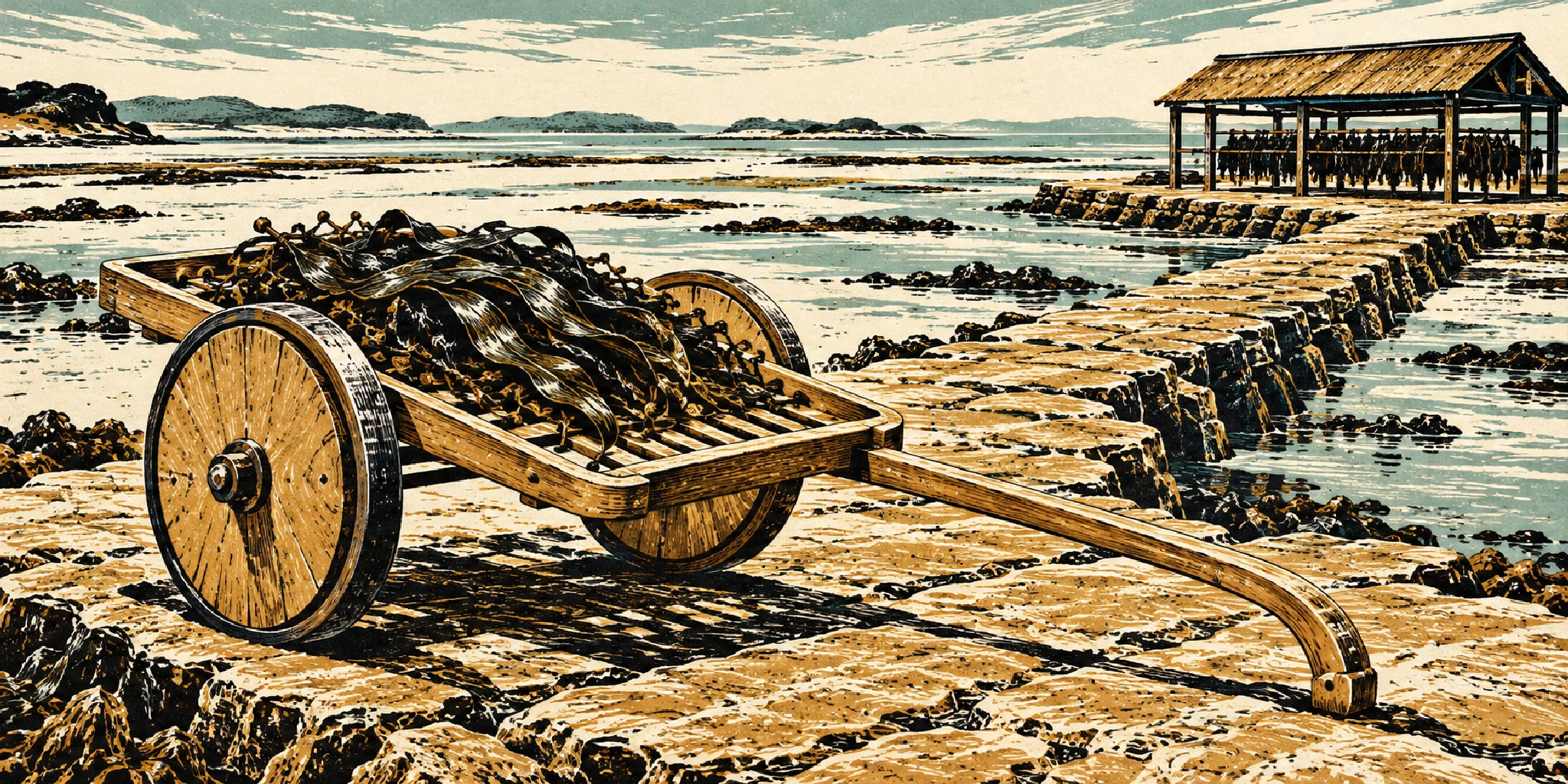
Seaweed Cart on a Tidal Causeway
A seaweed cart with broad wheels and a draining bed stands on a tidal causeway. Bold linocut marks connect the product to a panoramic route from the tidal flats to a drying shed.
Remix this referenceSeaweed Cart on a Tidal Causeway
- Form language
- Reduce forms to strong interlocking masses and open cutouts; retain identifying construction through economical shape changes.
- Contour
- Use thick, slightly wavering relief-print edges, interrupted by decisive gouged breaks rather than uniform outlines.
- Mark-making
- Carve rhythmic fans of tapered cuts and occasional broad scoops; vary spacing and pressure so the tool's movement remains visible.
- Surface rendering
- Build tone through reserved paper, solid ink and carved hatching; retain uneven ink bite and slight hand-printed misregistration.
Priority
Preserve the bold linocut character and visibly carved rhythmic marks.
What to avoid & what to check
Exact prompt for this example
MODULE OWNERSHIP
subject: Subject count, type, stable proportions and landmarks, resting face geometry, hair shape, physical materials, garment construction and permanent marks. No emotion, movement, color assignment or rendering recipe.
expression: Facial soft-tissue displacement and pupil direction, muscle coordination, regional intensity, asymmetry and onset/peak/release. No head/body pose, stable appearance, skin color or rendering.
gesture: Head/neck/body/limb orientation, joint movement, support, contact and pose-caused occlusion using existing anatomy. No eye/pupil movement, emotion, identity, props inventory or camera.
props: Prop count, type, construction, physical material and scale relative to the subject. Holding/contact belongs to gesture, position to composition, color to palette.
scene: Environment elements, terrain, backdrop/floor presence and structural detail. No canvas positions, camera, lighting, assigned colors or render texture.
camera: Projection, focal-length impression, camera elevation/yaw/roll, viewing distance and crop. No actor pose, world placement, lighting or canvas aspect ratio.
composition: Normalized 0-100% canvas positions, scale in frame, depth/overlap, focal hierarchy and margins. No joint pose, camera projection, rendering, subject/prop inventory or emotion.
palette: Color anchors, hue/saturation/value ranges, colors assigned to parts and approximate color coverage. No illumination direction, shading algorithm, physical material or layout.
lighting: Light-source direction/softness/intensity, ambient illumination, physical shadow direction/length and highlight position. Absence of directional illumination is allowed. No shading technique, palette or material changes.
style: Reusable form abstraction, contour weight/taper/edge quality, medium and mark scale/density/direction, surface rendering and tonal transition technique. No fixed subject proportions, anatomy, identity, expression, pose, palette, light-source direction, camera or layout.
output: Image count, aspect ratio, size, file/alpha requirements and global lettering/logo/watermark restrictions. No background scenery, crop, style, identity or pose.

SUBJECT
inventory: One original, unbranded hand cart designed for gathering and draining seaweed; no people.
geometry: A low, shallow tray spans two broad disc wheels; a single arched drawbar extends from its open frame.
resting-face: No face or facial landmarks apply.
appearance: The tray and drawbar are bent timber, with a metal axle and wheel rims; open bed slots provide drainage.

PRIORITY


AVOID


CHECK


GESTURE
head: No head or neck joint control targets apply.
torso: The rigid cart frame inclines slightly toward the drawbar end.
limbs: No limb joint control targets apply.
contact: The wheels and drawbar end support the cart on the causeway; the kelp bundle rests on the tray.

PRIORITY


AVOID


CHECK


PROPS
inventory: One loose bundle of harvested kelp, smaller than the cart bed.
construction: Long, wet, leathery blades join flexible branching stems; individual blade shapes may vary.

PRIORITY


AVOID


CHECK


SCENE
inventory: An exposed tidal flat, shallow channels, a stone causeway and a modest open-sided drying shed.
structure: The causeway connects the gathering shore to the shed, whose open bays contain simple horizontal drying rails.

PRIORITY


AVOID


CHECK


CAMERA
projection: Use gently compressed perspective, with a normal-to-long lens impression and stable verticals.
viewpoint: View from slightly above cart-bed height at a three-quarter angle, revealing the slotted bed and both wheels.
crop: Keep the complete cart visible within a wide environmental view that includes the shore and the drying shed.

PRIORITY


AVOID


CHECK


COMPOSITION
placement: Place the large cart left of center; let the causeway sweep behind it toward the smaller shed at the far right.
depth: Keep the tray rim and some drainage slots visible around the kelp; channels separate the route from distant flats.
spacing: Read the cart first, then follow the shore-to-shed journey; open water gaps give the wheel and drawbar silhouettes breathing room.

PRIORITY


AVOID


CHECK


PALETTE
colors: Use near-black, warm ochre, muted seafoam and chalk white as a compact print palette.
assignment: Ochre identifies the cart and causeway; seafoam belongs to water, near-black to kelp and structural accents, white to open flats.
balance: Let pale fields dominate the panorama while concentrated darks give the product a firm, readable presence.

PRIORITY


AVOID


CHECK


LIGHTING
sources: Low daylight comes broadly from the left with moderate softness and open-sky ambient fill.
shadows: The cart casts a long shadow to the right; the shed interior receives deeper, continuous shade.
highlights: Light catches the left wheel rim, the tray lip and a few kelp folds.

PRIORITY


AVOID


CHECK


STYLE GUIDE
form-language: Reduce forms to strong interlocking masses and open cutouts; retain identifying construction through economical shape changes.
contour: Use thick, slightly wavering relief-print edges, interrupted by decisive gouged breaks rather than uniform outlines.
mark-making: Carve rhythmic fans of tapered cuts and occasional broad scoops; vary spacing and pressure so the tool's movement remains visible.
surface-rendering: Build tone through reserved paper, solid ink and carved hatching; retain uneven ink bite and slight hand-printed misregistration.

PRIORITY
Preserve the bold linocut character and visibly carved rhythmic marks.

AVOID


CHECK


OUTPUT
format: One image, panoramic 2:1, 2048 × 1024 pixels, opaque PNG.
restrictions: No lettering, logos, signatures or watermarks.

PRIORITY


AVOID


CHECK
Model information comes from image provenance. The same prompt may produce a different result.