Text to imagePortraitStyle guide
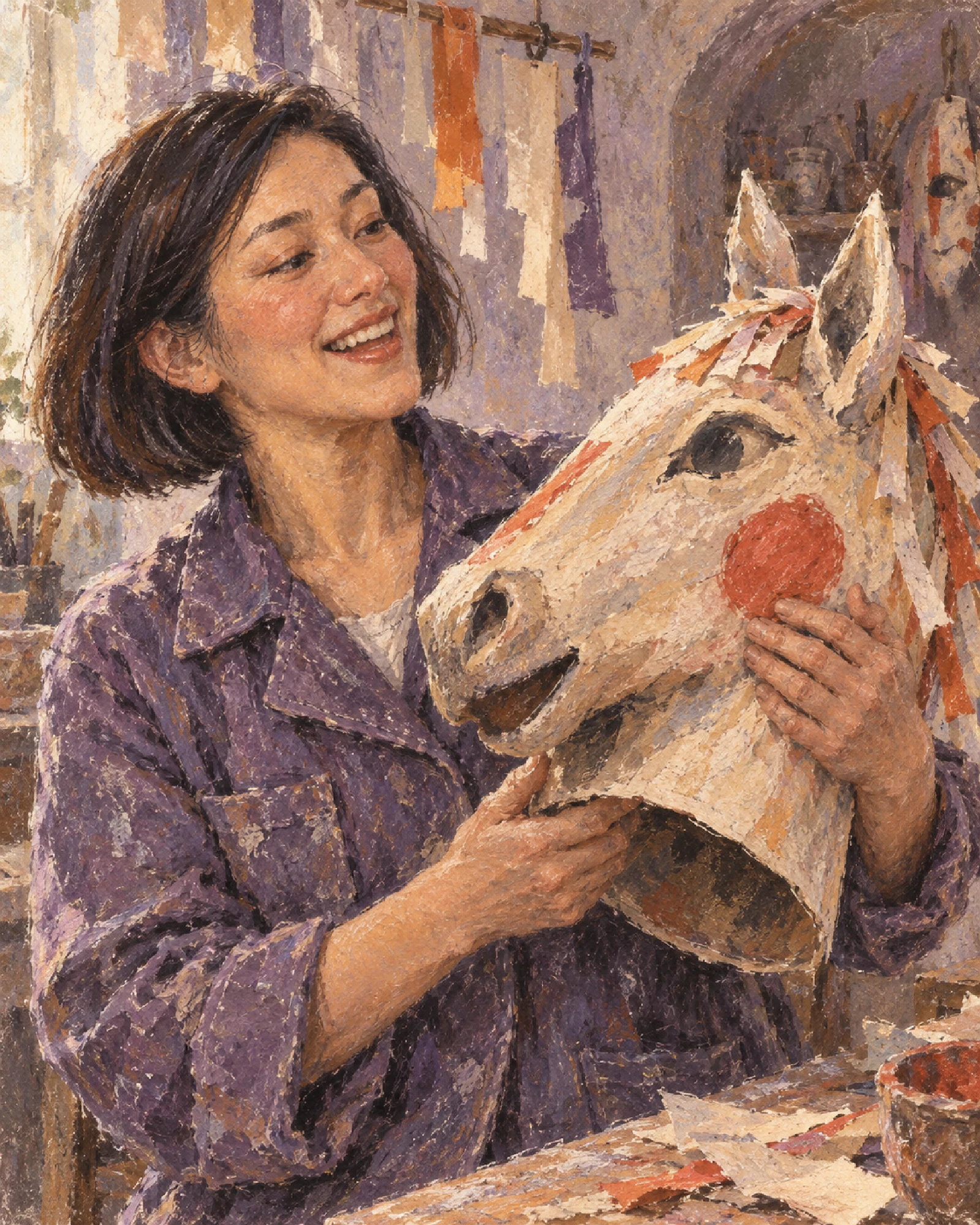
Woman Turning a Horse Mask
A mask maker on the verge of laughing as she turns a large horse mask. Her face, the mask and hanging paper overlap in a dreamlike workshop portrait made with rubbed and scratched oil pastel.
Remix this referenceWoman Turning a Horse Mask
- Form language
- Gather forms into supple, slightly swollen masses; simplify small structures into irregular wedges without losing their character.
- Contour
- Use broken, blunt pastel edges that thicken, disappear and return; reserve a few scratched cuts for decisive boundaries.
- Mark-making
- Rub broad oil-pastel strokes into hazy passages, then scratch through them with wandering short lines; let pressure vary naturally.
- Surface rendering
- Build waxy opaque layers over partially exposed underlayers; alternate rubbed tonal transitions with crumbly, unresolved patches.
Priority
The rubbed haze and exposed scratch marks must visibly define the oil-pastel medium.
What to avoid & what to check
Exact prompt for this example
MODULE OWNERSHIP
subject: Subject count, type, stable proportions and landmarks, resting face geometry, hair shape, physical materials, garment construction and permanent marks. No emotion, movement, color assignment or rendering recipe.
expression: Facial soft-tissue displacement and pupil direction, muscle coordination, regional intensity, asymmetry and onset/peak/release. No head/body pose, stable appearance, skin color or rendering.
gesture: Head/neck/body/limb orientation, joint movement, support, contact and pose-caused occlusion using existing anatomy. No eye/pupil movement, emotion, identity, props inventory or camera.
props: Prop count, type, construction, physical material and scale relative to the subject. Holding/contact belongs to gesture, position to composition, color to palette.
scene: Environment elements, terrain, backdrop/floor presence and structural detail. No canvas positions, camera, lighting, assigned colors or render texture.
camera: Projection, focal-length impression, camera elevation/yaw/roll, viewing distance and crop. No actor pose, world placement, lighting or canvas aspect ratio.
composition: Normalized 0-100% canvas positions, scale in frame, depth/overlap, focal hierarchy and margins. No joint pose, camera projection, rendering, subject/prop inventory or emotion.
palette: Color anchors, hue/saturation/value ranges, colors assigned to parts and approximate color coverage. No illumination direction, shading algorithm, physical material or layout.
lighting: Light-source direction/softness/intensity, ambient illumination, physical shadow direction/length and highlight position. Absence of directional illumination is allowed. No shading technique, palette or material changes.
style: Reusable form abstraction, contour weight/taper/edge quality, medium and mark scale/density/direction, surface rendering and tonal transition technique. No fixed subject proportions, anatomy, identity, expression, pose, palette, light-source direction, camera or layout.
output: Image count, aspect ratio, size, file/alpha requirements and global lettering/logo/watermark restrictions. No background scenery, crop, style, identity or pose.

SUBJECT
inventory: One original adult woman, a festival mask maker.
geometry: A long face, prominent cheekbones, a gently hooked nose and sturdy hands give her recognizable construction.
resting-face: At rest, her eyes are almond-shaped, brows fairly straight and lips broad with a defined upper dip.
appearance: A blunt bob tucks behind one ear; she wears a cotton work jacket with a wide collar and patch pockets.

PRIORITY


AVOID


CHECK


EXPRESSION — ACTOR A
brows: One brow rises slightly while the other stays relaxed.
lids: Lower lids lift gently; the eyes remain visibly open.
cheeks: The cheeks begin to bunch upward, slightly stronger on one side.
nose: The nose stays relaxed without a pronounced wrinkle.
mouth: The mouth opens into an uneven smile, with one corner leading.
jaw: The jaw releases a little rather than dropping fully.
gaze: Both pupils turn toward the horse mask's muzzle.
coordination: Cheek lift and mouth opening lead; the upper face follows lightly.
timing: Catch the onset of a laugh, before the eyes squeeze shut.

PRIORITY


AVOID


CHECK


GESTURE
head: A tilts her head back slightly and turns her neck toward the mask.
torso: Her torso twists gently against the direction of her working arms.
limbs: Her elbows bend at unequal heights as her hands rotate the mask toward her.
contact: One hand supports the open neck rim; the other grips the cheek edge without covering her face.

PRIORITY


AVOID


CHECK


PROPS
inventory: One hollow horse-head festival mask, roughly the size of her upper torso.
construction: Papier-mâché forms a long muzzle, upright ears, open neck rim and a short fringe of paper mane.

PRIORITY


AVOID


CHECK


SCENE
inventory: A small mask workshop with hanging paper lengths, a plaster wall and the edge of a worktable.
structure: Loose paper lengths hang from a simple rail; the wall curves into a shallow alcove.

PRIORITY


AVOID


CHECK


CAMERA
projection: Natural perspective with the mild compression of a short portrait lens.
viewpoint: View from face height, slightly around her left side, with no camera roll.
crop: An intimate upper-torso portrait includes the head, both working hands and most of the mask.

PRIORITY


AVOID


CHECK


COMPOSITION
placement: The face leads in the upper-left region; the larger mask answers across the lower-right.
depth: The mask overlaps the jacket; hanging paper passes behind the head and in front of the distant wall.
spacing: Keep a breathing pocket beside the face while allowing the mask and table to run beyond the edges.

PRIORITY


AVOID


CHECK


PALETTE
colors: Use smoky violet, apricot, chalk cream and a small sharp vermilion accent.
assignment: Apricot anchors the skin, violet the jacket and wall, cream the mask and paper, vermilion the mask's cheek.
balance: Muted middle values dominate, with pale expanses and brief saturated interruptions.

PRIORITY


AVOID


CHECK


LIGHTING
sources: Broad, soft daylight arrives from the upper left, with gentle room ambience.
shadows: Soft shadows fall down and right; the mask casts a broader shadow across the jacket.
highlights: Broad highlights touch the forehead, raised cheeks and upper ridge of the mask's muzzle.

PRIORITY


AVOID


CHECK


STYLE GUIDE
form-language: Gather forms into supple, slightly swollen masses; simplify small structures into irregular wedges without losing their character.
contour: Use broken, blunt pastel edges that thicken, disappear and return; reserve a few scratched cuts for decisive boundaries.
mark-making: Rub broad oil-pastel strokes into hazy passages, then scratch through them with wandering short lines; let pressure vary naturally.
surface-rendering: Build waxy opaque layers over partially exposed underlayers; alternate rubbed tonal transitions with crumbly, unresolved patches.

PRIORITY
The rubbed haze and exposed scratch marks must visibly define the oil-pastel medium.

AVOID


CHECK


OUTPUT
format: One finished image, portrait 4:5, 1600 × 2000 pixels, PNG with an opaque background.
restrictions: No lettering, logos or watermarks.

PRIORITY


AVOID


CHECK


FINAL INTEGRATION
expression + gesture + props: Coordinate the developing laugh with the mask-turning action so the encounter reads immediately.
composition + style + lighting: Let the overlaps and softened passages cooperate while preserving the face's readability.
Model information comes from image provenance. The same prompt may produce a different result.