Text to imageLandscapeStyle guide
Shallow Woodland Pool · View-Angle Water Transparency
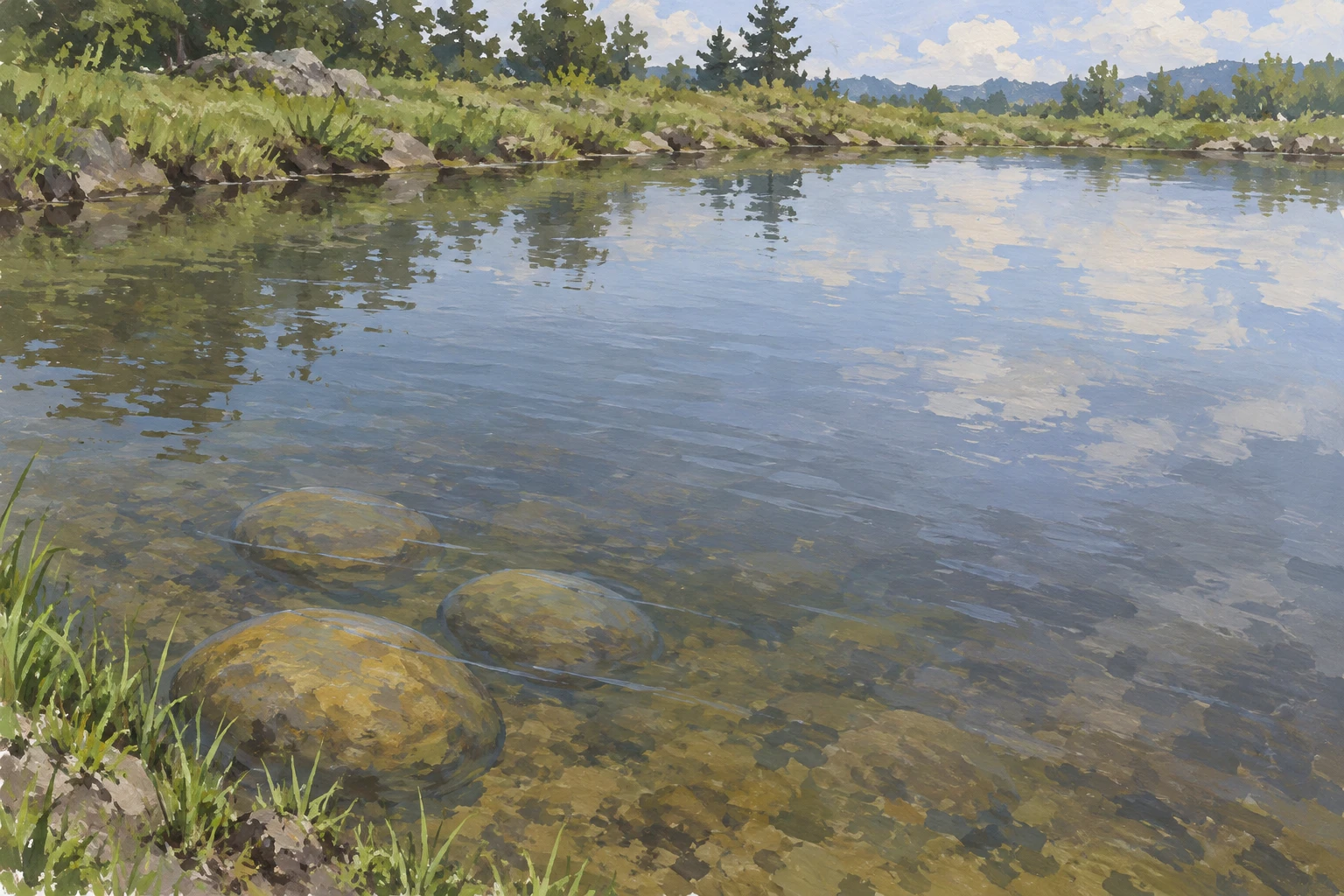
Show submerged stones through the near water and stronger sky reflections across the far water to establish the depth and orientation of a calm surface.
Shallow Woodland Pool · View-Angle Water Transparency
- Shape & line
- Draw the pool as one continuous, gently irregular basin. Give the three submerged stones distinct rounded silhouettes beneath the surface, and interrupt their contours with a few thin horizontal ripple strokes so they read as underwater forms.
- Color & light
- In the lower image, let muted ochre stones and an olive-brown bed show through transparent-looking water. Toward the upper image, gradually strengthen pale blue-gray sky reflection until it obscures the bed; keep this transition broad and continuous rather than dividing the pool into separate color bands.
- Texture & material
- Use matte gouache patches for the grassy banks and softly mottled stones. Paint the water with smoother, flatter passages and only a few subdued ripple marks; carry faint reflected sky color across the stone tops to connect them visibly to the overlying surface.
- Composition
- Lead the eye from the lower-left stone cluster across the open water to the upper-right far bank. Keep the clearest underwater edges in the lower foreground and let their visibility diminish upward, while preserving an uninterrupted stretch of reflective water between the stones and the far bank.
Priority
Make the gradual shift from visible underwater stones to sky-dominated reflection the main visual lesson.
What to avoid & what to check
Avoid a hard transparency boundary or stones that appear to sit above the water.
Confirm that all three stones read as submerged and that the upper water conceals more of the bed than the lower water.
Exact prompt for this example
SUBJECT
A small, shallow woodland pool containing exactly three rounded submerged stones clustered near its near bank; a low grassy far bank borders the water beneath a pale sky.

COMPOSITION
Use a horizontal frame viewed obliquely downward from the near bank. Near water fills the lower half, the far bank crosses the upper third, and a narrow strip of sky remains above it. Keep all three stones fully inside the lower-left water area, with open water extending toward the upper right.

STYLE GUIDE
1. Shape & line
Draw the pool as one continuous, gently irregular basin. Give the three submerged stones distinct rounded silhouettes beneath the surface, and interrupt their contours with a few thin horizontal ripple strokes so they read as underwater forms.

2. Color & light
In the lower image, let muted ochre stones and an olive-brown bed show through transparent-looking water. Toward the upper image, gradually strengthen pale blue-gray sky reflection until it obscures the bed; keep this transition broad and continuous rather than dividing the pool into separate color bands.

3. Texture & material
Use matte gouache patches for the grassy banks and softly mottled stones. Paint the water with smoother, flatter passages and only a few subdued ripple marks; carry faint reflected sky color across the stone tops to connect them visibly to the overlying surface.

4. Composition
Lead the eye from the lower-left stone cluster across the open water to the upper-right far bank. Keep the clearest underwater edges in the lower foreground and let their visibility diminish upward, while preserving an uninterrupted stretch of reflective water between the stones and the far bank.

PRIORITY
Preserve the requested identity, count, action, composition and output settings. Apply the style rules within those constraints; a style reference must not replace the subject or layout. Within the style: Make the gradual shift from visible underwater stones to sky-dominated reflection the main visual lesson.

AVOID
Avoid a hard transparency boundary or stones that appear to sit above the water.

OUTPUT
Create one landscape image in a 3:2 aspect ratio, rendered as a naturalistic opaque-gouache painting, with no lettering, captions, borders, or watermark.

SELF-CHECK
Confirm that all three stones read as submerged and that the upper water conceals more of the bed than the lower water.
Model information comes from image provenance. The same prompt may produce a different result.