Text to imageIllustrationStyle guide
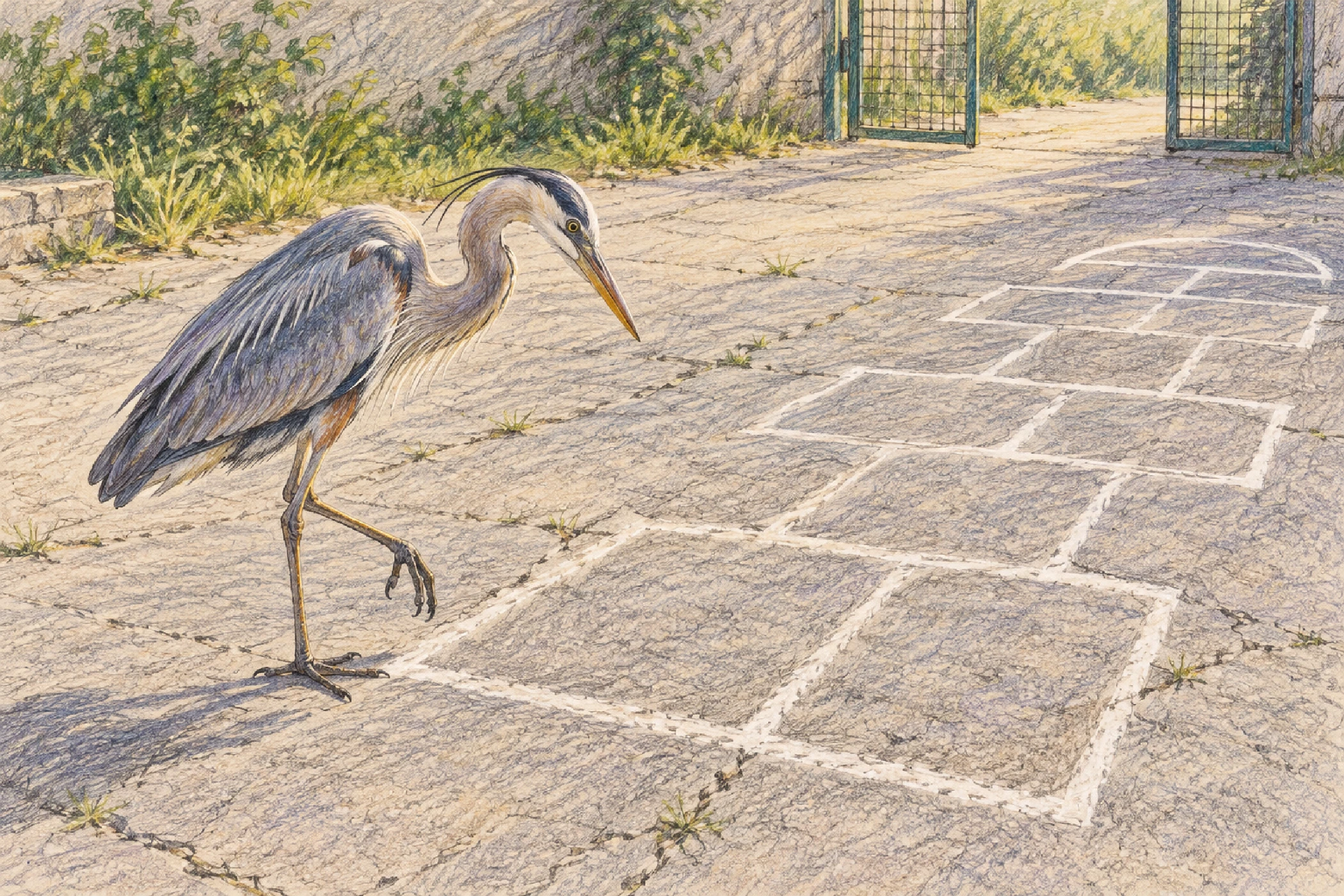
Heron on the Hopscotch Court
A heron steps across hopscotch squares in an empty courtyard. Rough pencil lines and sparse colored-pencil marks leave a small event within generous open space.
Remix this referenceHeron on the Hopscotch Court
- Form language
- Reduce forms to loosely observed envelopes and a few structural accents, letting incidental shapes remain suggestive.
- Contour
- Use searching graphite lines with broken pressure, occasional doubled edges and tapered departures instead of uniform outlines.
- Mark-making
- Combine rough graphite sweeps with short colored-pencil hatching; direction and spacing vary naturally within each passage.
- Surface rendering
- Build tones through incomplete pencil layering and broad side-of-lead rubbing, leaving paper tooth visible between denser passages.
Priority
Preserve the visibly rough pencil and colored-pencil sketchbook character.
What to avoid & what to check
Exact prompt for this example
MODULE OWNERSHIP
subject: Subject count, type, stable proportions and landmarks, resting face geometry, hair shape, physical materials, garment construction and permanent marks. No emotion, movement, color assignment or rendering recipe.
expression: Facial soft-tissue displacement and pupil direction, muscle coordination, regional intensity, asymmetry and onset/peak/release. No head/body pose, stable appearance, skin color or rendering.
gesture: Head/neck/body/limb orientation, joint movement, support, contact and pose-caused occlusion using existing anatomy. No eye/pupil movement, emotion, identity, props inventory or camera.
props: Prop count, type, construction, physical material and scale relative to the subject. Holding/contact belongs to gesture, position to composition, color to palette.
scene: Environment elements, terrain, backdrop/floor presence and structural detail. No canvas positions, camera, lighting, assigned colors or render texture.
camera: Projection, focal-length impression, camera elevation/yaw/roll, viewing distance and crop. No actor pose, world placement, lighting or canvas aspect ratio.
composition: Normalized 0-100% canvas positions, scale in frame, depth/overlap, focal hierarchy and margins. No joint pose, camera projection, rendering, subject/prop inventory or emotion.
palette: Color anchors, hue/saturation/value ranges, colors assigned to parts and approximate color coverage. No illumination direction, shading algorithm, physical material or layout.
lighting: Light-source direction/softness/intensity, ambient illumination, physical shadow direction/length and highlight position. Absence of directional illumination is allowed. No shading technique, palette or material changes.
style: Reusable form abstraction, contour weight/taper/edge quality, medium and mark scale/density/direction, surface rendering and tonal transition technique. No fixed subject proportions, anatomy, identity, expression, pose, palette, light-source direction, camera or layout.
output: Image count, aspect ratio, size, file/alpha requirements and global lettering/logo/watermark restrictions. No background scenery, crop, style, identity or pose.

SUBJECT
inventory: One original adult heron, actor A.
geometry: A slender bird with a long neck, spear-shaped bill, compact wing mass and long fine legs.
resting-face: Small round eyes with narrow rims, slit-like nares and a straight bill junction.
appearance: Layered feathers, a short rear crest, a hard bill and scaly legs; no clothing or added permanent marks.

PRIORITY


AVOID


CHECK


EXPRESSION — ACTOR A
brows: No visible brow-region displacement.
lids: The visible eyelids remain naturally open, without widening or squeezing.
cheeks: No readable cheek compression or lift.
nose: No visible displacement around the nares.
mouth: The bill edges meet in a closed line without a gape.
jaw: The lower bill rests against the upper bill without visible tension.
gaze: The visible pupil points downward toward the nearby chalk boundary.
coordination: Open lids, still facial tissues and a closed bill accompany the downward gaze.
timing: Hold the steady apex of a neutral resting expression, with no transition underway.

PRIORITY


AVOID


CHECK


GESTURE
head: A bends the neck forward and lowers the bill toward the court.
torso: The torso inclines slightly forward while the wings stay folded against it.
limbs: One leg bears the weight; the other lifts into a slow step with toes loosely gathered.
contact: Planted toes spread on the paving; the raised foot stays clear of the ground.

PRIORITY


AVOID


CHECK


PROPS
inventory: No separate props.
construction: No prop construction applies.

PRIORITY


AVOID


CHECK


SCENE
inventory: An empty paved courtyard with hopscotch markings, grass at the paving edge and an open wire-mesh gate.
structure: Single and paired squares alternate along the course; paving cracks and gate details may vary naturally.

PRIORITY


AVOID


CHECK


CAMERA
projection: Natural perspective with a mild wide-angle impression and restrained depth convergence.
viewpoint: Look gently downward from adult standing height, obliquely across the court, without roll.
crop: Show the entire heron and most of the hopscotch course; crop the outer courtyard boundary.

PRIORITY


AVOID


CHECK


COMPOSITION
placement: Place the heron in the lower-left region, with the course extending diagonally toward the upper right. The planted foot sits beside a chalk boundary.
depth: The heron is the primary focus; the course supplies a secondary rhythm and the gate stays distant.
spacing: Keep broad open paving around the bird and between the course and gate, with generous silhouette margins. Color accents gather around the bird and court edges.

PRIORITY


AVOID


CHECK


PALETTE
colors: Warm ivory, graphite gray, dusty violet, moss green and restrained ochre.
assignment: Gray and violet for heron and paving, ivory for chalk and ground, green for grass, ochre for bill and legs.
balance: Ivory remains the largest color presence; color accents stay subdued.

PRIORITY


AVOID


CHECK


LIGHTING
sources: Soft morning light enters from the upper right, supported by broad ambient daylight.
shadows: A soft, moderately extended shadow falls to the lower left, with darker contact beneath the planted foot.
highlights: Gentle highlights touch the upper-right side of the neck, back and bill.

PRIORITY


AVOID


CHECK


STYLE GUIDE
form-language: Reduce forms to loosely observed envelopes and a few structural accents, letting incidental shapes remain suggestive.
contour: Use searching graphite lines with broken pressure, occasional doubled edges and tapered departures instead of uniform outlines.
mark-making: Combine rough graphite sweeps with short colored-pencil hatching; direction and spacing vary naturally within each passage.
surface-rendering: Build tones through incomplete pencil layering and broad side-of-lead rubbing, leaving paper tooth visible between denser passages.

PRIORITY
Preserve the visibly rough pencil and colored-pencil sketchbook character.

AVOID


CHECK


OUTPUT
format: One finished image, landscape 3:2, 2100 × 1400 pixels, opaque PNG.
restrictions: One finished image, landscape 3:2, 2100 × 1400 pixels, opaque PNG. No lettering, numerals, logos or watermarks.

PRIORITY


AVOID


CHECK


FINAL INTEGRATION
expression + gesture + scene: Let facial attention and the step connect the bird to the courtyard without exaggerating its performance.
style + palette + composition: Let selective pencil buildup support the color accents and spacious visual rhythm.
Model information comes from image provenance. The same prompt may produce a different result.