Text to imageComicsStyle guide
Puppet Maker with a Paper Moth
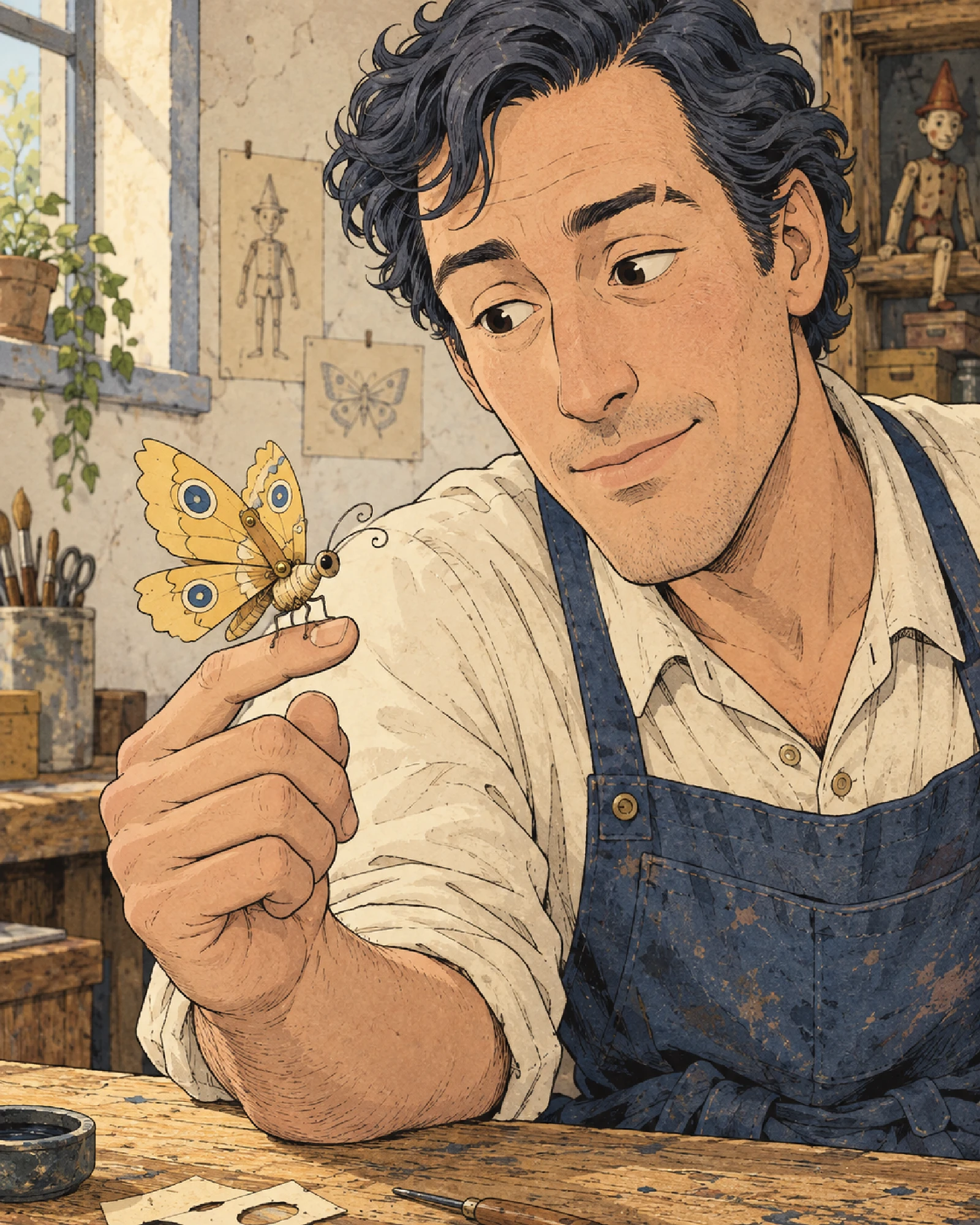
An intimate close-up of a puppet maker inspecting a paper moth balanced on a fingertip. Even, fine ink contours and subtly uneven matte color give the European clear-line comic treatment a lively, personal presence.
Remix this referencePuppet Maker with a Paper Moth
- Form language
- Reduce forms to lucid curved and angular enclosures, balancing economical silhouettes with selectively descriptive interior shapes; allow small local irregularities within this language.
- Contour
- Use fine, near-even ink contours with rounded joins and clean stops. Keep overlaps decisive, with only slight natural weight changes rather than brush-swollen outlines or heavy enclosing borders.
- Mark-making
- Add sparse short curved ticks and economical broken strokes for selected surface information, with naturally varied spacing and open passages. Keep these local marks distinct from repeated motion outlines, and omit motion ghosts.
- Surface rendering
- Use matte spot-color areas with faint uneven ink density and restrained hard-edged secondary tones. Keep tonal boundaries mostly uninked, retaining a printed-page character without glossy continuous modeling.
Priority
Rendering medium: clear-line European comic illustration in fine ink and matte spot color.
What to avoid & what to check
Avoid dense crosshatching that replaces the clear contour-and-color language.
Fine continuous contours and quiet printed color remain the dominant treatment.
Exact prompt for this example
MODULE OWNERSHIP
subject: Subject count, type, stable proportions and landmarks, resting face geometry, hair shape, physical materials, garment construction and permanent marks. No emotion, movement, color assignment or rendering recipe.
expression: Facial soft-tissue displacement and pupil direction, muscle coordination, regional intensity, asymmetry and onset/peak/release. No head/body pose, stable appearance, skin color or rendering.
gesture: Head/neck/body/limb orientation, joint movement, support, contact and pose-caused occlusion using existing anatomy. No eye/pupil movement, emotion, identity, props inventory or camera.
props: Prop count, type, construction, physical material and scale relative to the subject. Holding/contact belongs to gesture, position to composition, color to palette.
scene: Environment elements, terrain, backdrop/floor presence and structural detail. No canvas positions, camera, lighting, assigned colors or render texture.
camera: Projection, focal-length impression, camera elevation/yaw/roll, viewing distance and crop. No actor pose, world placement, lighting or canvas aspect ratio.
composition: Normalized 0-100% canvas positions, scale in frame, depth/overlap, focal hierarchy and margins. No joint pose, camera projection, rendering, subject/prop inventory or emotion.
palette: Color anchors, hue/saturation/value ranges, colors assigned to parts and approximate color coverage. No illumination direction, shading algorithm, physical material or layout.
lighting: Light-source direction/softness/intensity, ambient illumination, physical shadow direction/length and highlight position. Absence of directional illumination is allowed. No shading technique, palette or material changes.
style: Reusable form abstraction, contour weight/taper/edge quality, medium and mark scale/density/direction, surface rendering and tonal transition technique. No fixed subject proportions, anatomy, identity, expression, pose, palette, light-source direction, camera or layout.
output: Image count, aspect ratio, size, file/alpha requirements and global lettering/logo/watermark restrictions. No background scenery, crop, style, identity or pose.

SUBJECT
inventory: A is one original adult puppet maker, the only living subject taking part in the scene.
geometry: Give A a long oval face, a broad forehead, a gently squared chin and slender adult hands with recognizable knuckles.
resting-face: The resting landmarks are low arched brows, almond-shaped eye openings, a rounded nose tip and a broad upper-lip bow.
appearance: Short wavy hair forms an uneven side part. A wears a cotton work shirt and a canvas bib apron; a small notch marks one eyebrow.

PRIORITY
Keep the long face and practical workwear immediately recognizable.

AVOID
Avoid a childlike head-to-hand relationship.

CHECK
A reads as the same adult across the visible face and hand.

EXPRESSION — ACTOR A
brows: Lift the moth-side brow slightly more, leaving the inner ends separated without a worried pinch. Keep the forehead mostly smooth, with a short crease near the raised brow.
lids: Open the upper lids a little, especially on the moth side. Give the lower lids a soft attentive lift without squeezing shut or exposing a startled ring of white.
cheeks: A small cheek lift accompanies the rising mouth corner; the opposite cheek stays comparatively loose, keeping the response personal and uneven rather than a full posed smile.
nose: Keep the nose bridge unwrinkled and the nostrils relaxed, with no disgust crease or pronounced flare competing with the small attentive response elsewhere in the face.
mouth: Keep the lips gently together as the moth-side corner begins to rise; preserve a slight unevenness through the upper lip and leave the other corner nearly at rest.
jaw: Release the jaw tension without opening the mouth; the chin remains unbunched and the lower lip is neither pushed forward nor tucked tightly against the teeth. This is a quiet facial release.
gaze: Direct both pupils toward the paper moth, with a slight downward convergence suited to inspecting something nearby. Keep enough iris visible for the direction to read clearly.
coordination: Let the brow and lid response lead while the mouth only begins to answer; preserve this unequal regional strength so curiosity remains more prominent than amusement.
timing: Catch the first recognition of the tiny mechanism: the upper face has awakened, but the cheek and lip response is still arriving. Hold a single readable onset وبس.

PRIORITY
Make the uneven, emerging curiosity readable at thumbnail size.

AVOID
Avoid turning the response into a wide-eyed comedy grimace.

CHECK
The attentive eyes lead the smaller cheek and mouth response.

GESTURE
head: A bends the neck slightly forward and inclines the head toward the raised hand, keeping the face open enough to read.
torso: The upper torso leans toward the workbench, with one shoulder gently advanced rather than a rigidly level stance.
limbs: The supported forearm rises to an extended index finger; the other visible fingers curl loosely below it without a clenched fist.
contact: Rest the elbow on the bench and balance the moth's wire feet on the index-finger pad; the near wing partly overlaps the fingertip.

PRIORITY
Let the supported hand make the delicate balancing action convincing.

AVOID
Avoid a stiff pointing gesture with uniformly straight fingers.

CHECK
The supported forearm and fingertip contact explain the delicate balance, even with the elbow below.

PROPS
inventory: One palm-wide articulated paper moth is the sole featured prop; its slim body is smaller than A's index finger.
construction: Folded card wings have scalloped outer edges, exposed paper hinges and simple cutout eye-spots; a rolled-paper body carries fine wire feet.

PRIORITY
The moth should visibly reveal its charming handmade mechanism.

AVOID
Avoid turning the paper construction into a biological insect.

CHECK
Folded wings and paper hinges establish the prop at a glance.

SCENE
inventory: A compact puppet workshop contains a wooden workbench, a plaster wall and a shallow built-in storage recess.
structure: The bench has a worn rounded edge; the recess has a simple timber surround. A few wall irregularities suggest an inhabited room.

PRIORITY
Give the intimate encounter a modest, inhabited workshop context.

AVOID
Avoid a catalogue-like wall of workshop equipment.

CHECK
The rounded bench edge and timber-framed recess establish a coherent workshop.

CAMERA
projection: Use natural perspective with a mild portrait-lens impression, preserving the nearby hand without wide-angle enlargement.
viewpoint: View from approximately face height with a gentle three-quarter yaw and no roll, close enough for the facial response to be legible.
crop: Frame the face, raised hand and upper chest tightly; cut slightly into the outer hair. Include the supporting elbow and a narrow strip of bench at the lower edge; keep the floor outside the crop.

PRIORITY
Use the close crop to make the small encounter feel immediate.

AVOID
Avoid perspective distortion that overwhelms the face.

CHECK
Both the expression and the moth remain readable within the crop.

COMPOSITION
placement: Anchor the face around 65% across and 35% down; let the moth occupy the lower-left counterpoint, with the hand linking the two.
depth: The moth and hand sit foremost, the face follows, and the room recedes; keep wing overlap away from the eyes and mouth.
spacing: Make the face the first focal read and the moth the second; keep the bench and recess subordinate. Leave an airy interval between the focal elements and a broad quiet wall passage at upper left.

PRIORITY
Build an asymmetric conversation between the large face and tiny moth.

AVOID
Avoid stacking the two focal elements on a central vertical axis.

CHECK
The eye travels from face to moth through a clear, spacious interval.

PALETTE
colors: Use parchment cream, muted indigo, saffron yellow and dusty rose, with near-black ink; keep most values light to middle.
assignment: Assign indigo to apron and hair, cream to shirt and wall, dusty rose to skin, and saffron to the moth with small indigo wing accents.
balance: Cream occupies the largest share, rose and indigo support the portrait, and the compact saffron accent supplies the strongest saturation.

PRIORITY
Make the saffron moth distinct within the restrained portrait palette.

AVOID
Avoid equally saturated competing accents throughout the room.

CHECK
The small yellow accent remains legible against the larger cream areas.

LIGHTING
sources: Broad, soft daylight enters from upper left, with gentle room ambience keeping the far side of the face visible.
shadows: Short soft shadows fall down and right beneath the nose, lower lip and fingers; the moth casts a small shadow on its supporting finger.
highlights: Keep highlights broad and modest on the forehead and upper cheek; the paper wings receive gentle illumination without sharp glints.

PRIORITY
Soft lateral daylight should reveal the close encounter comfortably.

AVOID
Avoid theatrical rim light that separates every edge.

CHECK
The visible shadows agree with the broad upper-left source.

STYLE GUIDE
form-language: Reduce forms to lucid curved and angular enclosures, balancing economical silhouettes with selectively descriptive interior shapes; allow small local irregularities within this language.
contour: Use fine, near-even ink contours with rounded joins and clean stops. Keep overlaps decisive, with only slight natural weight changes rather than brush-swollen outlines or heavy enclosing borders.
mark-making: Add sparse short curved ticks and economical broken strokes for selected surface information, with naturally varied spacing and open passages. Keep these local marks distinct from repeated motion outlines, and omit motion ghosts.
surface-rendering: Use matte spot-color areas with faint uneven ink density and restrained hard-edged secondary tones. Keep tonal boundaries mostly uninked, retaining a printed-page character without glossy continuous modeling.

PRIORITY
Rendering medium: clear-line European comic illustration in fine ink and matte spot color.

AVOID
Avoid dense crosshatching that replaces the clear contour-and-color language.

CHECK
Fine continuous contours and quiet printed color remain the dominant treatment.

OUTPUT
format: Deliver one finished illustration, portrait 4:5, 1600 × 2000 pixels, as an opaque PNG.
restrictions: Use no dialogue, captions, lettering, logos, watermark or panel sequence; the image stands alone.

PRIORITY
Deliver one complete image in the specified export format.

AVOID
Avoid supplementary panels or instructional annotations.

CHECK
The single exported image is finished and free of lettering.

FINAL INTEGRATION
expression + gesture + props: Facial attention and supported contact together make the handmade encounter understandable without explanatory text.
camera + composition + scene: The framing and focal hierarchy reveal enough workshop context to make the close view feel inhabited.
style + palette + lighting: The graphic treatment translates the light into readable tones while the restrained color roles preserve the intimacy.
Model information comes from image provenance. The same prompt may produce a different result.