
Image editingIllustrationStyle guide
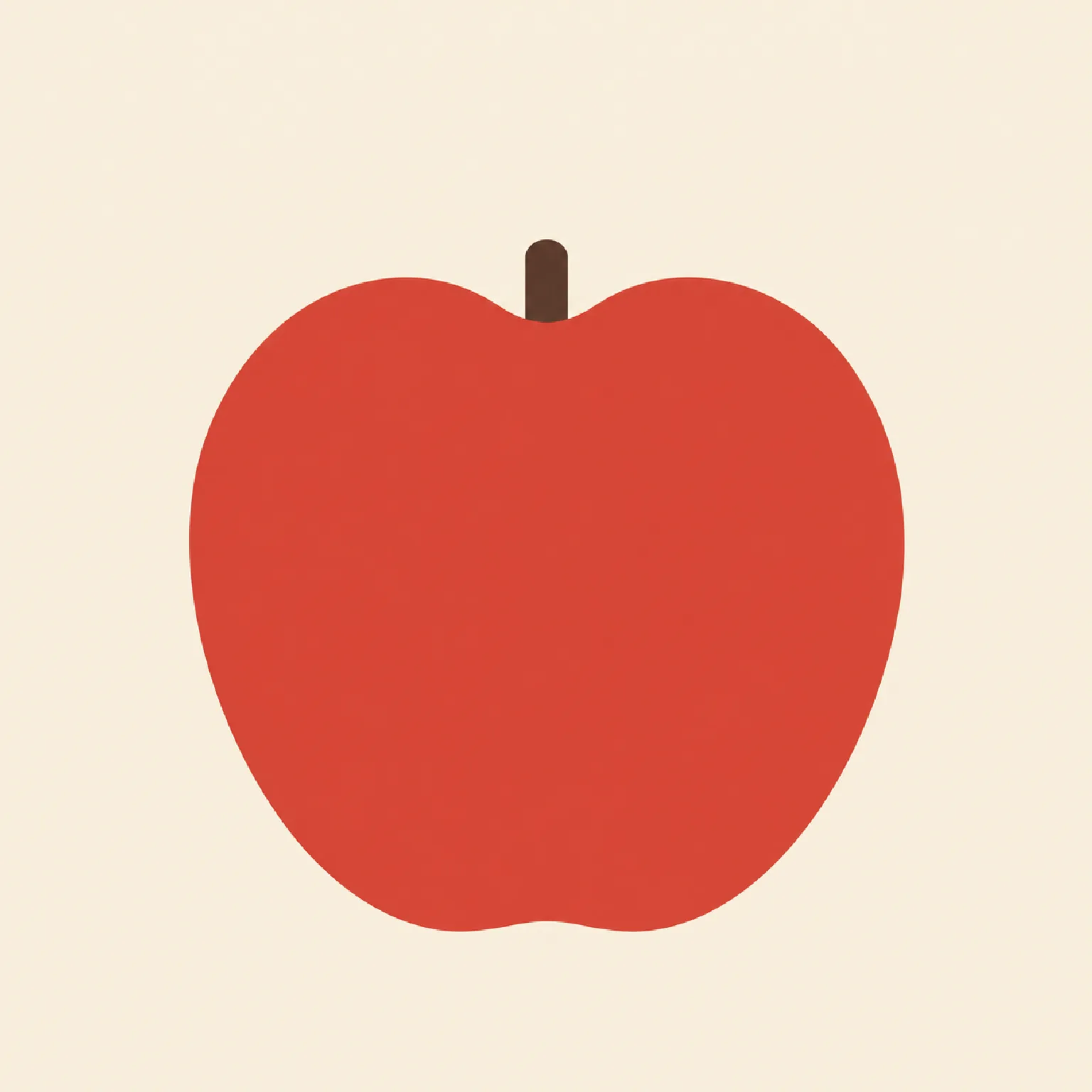
One Apple · Three-Color Flat Illustration
A three-color apple illustration using smooth solid fills and crisp single edges.
One Apple · Three-Color Flat Illustration
- Form language
- Flat editorial illustration built from smooth closed shapes. Retain the primary silhouette and essential junctions; simplify interior detail completely. Curves remain rounded and continuous, without facets or tiny subdivisions.
- Contour
- No drawn exterior or interior outline. Shape boundaries are single crisp continuous edges with a thin antialias band of no more than about two output pixels; there is no taper, doubled rim, hatching or broken boundary.
- Mark-making
- Use digital solid-color filling, not painted or paper simulation. Zero brush strokes, dots, grain, speckles, mottles or paper texture. Replace mottled interiors entirely with clean continuous unmarked fills; no deliberate repeated mark or detail pattern exists at any scale.
- Surface rendering
- Exactly one uniform tonal level within each assigned-color region, with no internal gradients or shaded bands. Region transitions occur only at the crisp shape boundary. Exclude watercolor bloom, embossed depth, gloss and photographic rendering.
Priority
Use clean digital flat fills, single crisp boundaries and no simulated painted texture or shaded interior modeling.
What to avoid & what to check
Exclude texture, shading, drawn outlines and mottles.
Check crisp single edges and unmarked uniform interiors.
Exact prompt for this example
MODULE OWNERSHIP
subject: Subject count, type, stable proportions and landmarks, resting face geometry, hair shape, physical materials, garment construction and permanent marks. No emotion, movement, color assignment or rendering recipe.
expression: Facial soft-tissue displacement and pupil direction, muscle coordination, regional intensity, asymmetry and onset/peak/release. No head/body pose, stable appearance, skin color or rendering.
gesture: Head/neck/body/limb orientation, joint movement, support, contact and pose-caused occlusion using existing anatomy. No eye/pupil movement, emotion, identity, props inventory or camera.
props: Prop count, type, construction, physical material and scale relative to the subject. Holding/contact belongs to gesture, position to composition, color to palette.
scene: Environment elements, terrain, backdrop/floor presence and structural detail. No canvas positions, camera, lighting, assigned colors or render texture.
camera: Projection, focal-length impression, camera elevation/yaw/roll, viewing distance and crop. No actor pose, world placement, lighting or canvas aspect ratio.
composition: Normalized 0-100% canvas positions, scale in frame, depth/overlap, focal hierarchy and margins. No joint pose, camera projection, rendering, subject/prop inventory or emotion.
palette: Color anchors, hue/saturation/value ranges, colors assigned to parts and approximate color coverage. No illumination direction, shading algorithm, physical material or layout.
lighting: Light-source direction/softness/intensity, ambient illumination, physical shadow direction/length and highlight position. Absence of directional illumination is allowed. No shading technique, palette or material changes.
style: Reusable form abstraction, contour weight/taper/edge quality, medium and mark scale/density/direction, surface rendering and tonal transition technique. No fixed subject proportions, anatomy, identity, expression, pose, palette, light-source direction, camera or layout.
output: Image count, aspect ratio, size, file/alpha requirements and global lettering/logo/watermark restrictions. No background scenery, crop, style, identity or pose.

SUBJECT
inventory: Exactly one whole apple and its one integral stem. No leaf, second fruit, cut section, face or garment is present.
geometry: Three anchors: rounded body height 0.9–1.1 times width; a top notch 5–10% body height deep and 10–25% body width wide between symmetric rounded shoulders (height difference at most 5% body height); one straight constant-width stem, rounded at its tip, 15% body height long (allow 5 percentage points), measured from its junction in the top notch to its tip, and 4.5% body width thick (allow 1.5 points), taper or bend absent. Stem meets the notch; base is round.
appearance: Intact fruit skin and a woody stem, without permanent scars, spots, incisions, seams or permanent surface ornament. No controlled face or human anatomy applies.

PRIORITY
Keep the three structural anchors; make the existing stem a short slender stub at the midpoint of its original length and thickness ranges.

AVOID
Exclude leaves, cut sections and permanent surface ornament.

CHECK
Check one body, a shallow notch and one connected stem.

PROPS
inventory: Exactly zero separate props; no container, utensil, stand, accessory or removable decoration is included.
construction: The empty prop inventory has no construction, dimensions, materials, seams or attachment targets to render.

PRIORITY
Keep the separate prop inventory empty.

AVOID
Do not introduce optional separate accessories.

CHECK
Verify that no separate prop is present.

SCENE
inventory: An empty continuous backdrop is the whole environment. No floor, plants, architecture, debris or scenery is present.
structure: The backdrop is one undivided continuous surface, with no joints, panels, horizon line, cracks or surface divisions.

PRIORITY
Keep one empty continuous backdrop.

AVOID
Exclude incidental environmental elements.

CHECK
Check that no environmental divisions exist.

CAMERA
projection: Use an orthographic front view, with no focal-length perspective, lens distortion or vanishing-point convergence.
viewpoint: View normal to the broad front of the body; yaw, elevation and roll are zero within ten degrees. Orthographic distance has no scale effect.
crop: Show the complete body and entire stem. No part is cropped; neither macro nor sectional views are used.

PRIORITY
Keep a complete front orthographic view.

AVOID
Avoid cropped parts or perspective distortion.

CHECK
Check complete landmarks in the front view.

COMPOSITION
placement: Top-left canvas coordinates: full motif center x=50%, y=50%, each within five percentage points. Full stem-plus-body height is 60% of canvas height within ten points; scale uniformly.
depth: The existing subject is the only focal element before the existing backdrop. The backdrop spans x=0–100% and y=0–100%. No subject occlusion or overlapping element is allowed.
spacing: Keep every motif part within x=10–90%, y=10–90%. Width follows uniform scale and the existing proportions. When width limits the nominal height, shrink uniformly until the full motif fits this containment; containment takes precedence over nominal height. One panel, no border.

PRIORITY
Keep a centered complete motif with clear margins.

AVOID
Avoid clipping, border framing and divided panels.

CHECK
Check full height and minimum edge clearances.

PALETTE
colors: Three anchors: red #D54435, dark brown #593B2D and warm cream #F5EAD7. Around each anchor allow hue ±5 degrees, saturation ±5 percentage points and value ±5 points in HSV. Derived colors may be mixtures of assigned anchors; no unrelated hue families.
assignment: Assign red to the entire fruit body, dark brown to the entire stem and cream to the whole backdrop. Any additional existing region uses cream as its categorical color default.
balance: Coverage follows actual assigned-region areas, including the cream default. Nonoverlapping attribution closes to 100%; permitted mixtures are attributed to the participating assigned color families without double counting.

PRIORITY
Keep the three complete region assignments.

AVOID
Exclude unrelated hue families and extra interior shade colors.

CHECK
Check that every region has its assigned anchor.

LIGHTING
sources: Intentionally unlit graphic artwork: zero directional light sources and no physical ambient-light simulation.
shadows: No physical cast shadow or contact shadow exists; no shadow direction, reach or penumbra is assigned.
highlights: No directional highlight, specular reflection or rim light appears. Highlight position and strength have no target.

PRIORITY
Keep directional illumination absent.

AVOID
Exclude cast shadows, highlights and rim lights.

CHECK
Check absence of physical light effects.

STYLE GUIDE
form-language: Flat editorial illustration built from smooth closed shapes. Retain the primary silhouette and essential junctions; simplify interior detail completely. Curves remain rounded and continuous, without facets or tiny subdivisions.
contour: No drawn exterior or interior outline. Shape boundaries are single crisp continuous edges with a thin antialias band of no more than about two output pixels; there is no taper, doubled rim, hatching or broken boundary.
mark-making: Use digital solid-color filling, not painted or paper simulation. Zero brush strokes, dots, grain, speckles, mottles or paper texture. Replace mottled interiors entirely with clean continuous unmarked fills; no deliberate repeated mark or detail pattern exists at any scale.
surface-rendering: Exactly one uniform tonal level within each assigned-color region, with no internal gradients or shaded bands. Region transitions occur only at the crisp shape boundary. Exclude watercolor bloom, embossed depth, gloss and photographic rendering.

PRIORITY
Use clean digital flat fills, single crisp boundaries and no simulated painted texture or shaded interior modeling.

AVOID
Exclude texture, shading, drawn outlines and mottles.

CHECK
Check crisp single edges and unmarked uniform interiors.

OUTPUT
format: Exactly one opaque PNG image, square 1:1 aspect ratio, with final dimensions 1536 by 1536 pixels and no transparent pixels.
restrictions: No lettering, caption, signature, logo or watermark occurs anywhere. No typographic annotation or output label is allowed.

PRIORITY
Deliver one opaque square text-free PNG.

AVOID
Exclude signatures, logos and typographic annotations.

CHECK
Check dimensions, alpha policy and absence of lettering.

FINAL INTEGRATION
palette + lighting + style: Render the three assigned colors as unlit uniform flat fills: no lighting-induced tone regions. The primary technique is clean color separation with single crisp boundaries.
subject + style + composition + palette: Correct the existing stem to the midpoint of its original structural ranges while retaining the existing body and placement. Replace the existing region interiors with smooth flat fills of their assigned colors, preserving single boundaries and the same full motif containment.
Model information comes from image provenance. The same prompt may produce a different result.