Text to imageLandscapeStyle guide
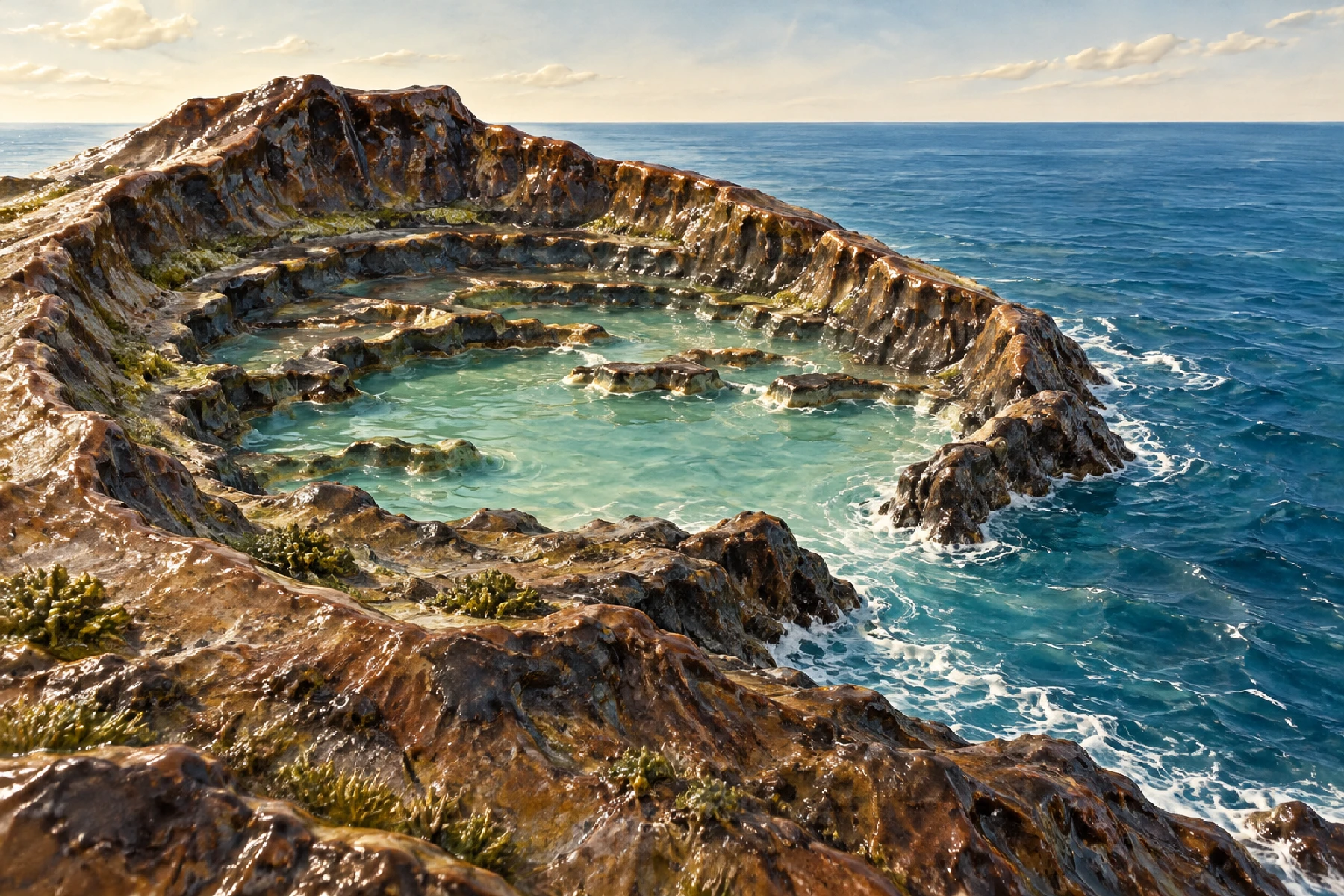
Tide in the Open Crater
The tide enters a crater open to the sea, with raised ridges and recessed waterways interpreted as a glazed ceramic relief.
Remix this referenceTide in the Open Crater
- Form language
- Translate broad masses into shallow sculpted relief, alternating rounded raised bands with scooped channels.
- Contour
- Define edges through softly rolled rims and occasional chipped interruptions, without a uniform drawn outline.
- Mark-making
- Use sparse thumb-pressed hollows and flowing tool sweeps; let their size and curvature vary naturally.
- Surface rendering
- Model glaze with pooled translucent tones in recesses, thin passages over crests, and softly swollen glossy surfaces.
Priority
Make the glaze feel fused to a hand-modeled relief.
What to avoid & what to check
Exact prompt for this example
MODULE OWNERSHIP
subject: Subject count, type, stable proportions and landmarks, resting face geometry, hair shape, physical materials, garment construction and permanent marks. No emotion, movement, color assignment or rendering recipe.
expression: Facial soft-tissue displacement and pupil direction, muscle coordination, regional intensity, asymmetry and onset/peak/release. No head/body pose, stable appearance, skin color or rendering.
gesture: Head/neck/body/limb orientation, joint movement, support, contact and pose-caused occlusion using existing anatomy. No eye/pupil movement, emotion, identity, props inventory or camera.
props: Prop count, type, construction, physical material and scale relative to the subject. Holding/contact belongs to gesture, position to composition, color to palette.
scene: Environment elements, terrain, backdrop/floor presence and structural detail. No canvas positions, camera, lighting, assigned colors or render texture.
camera: Projection, focal-length impression, camera elevation/yaw/roll, viewing distance and crop. No actor pose, world placement, lighting or canvas aspect ratio.
composition: Normalized 0-100% canvas positions, scale in frame, depth/overlap, focal hierarchy and margins. No joint pose, camera projection, rendering, subject/prop inventory or emotion.
palette: Color anchors, hue/saturation/value ranges, colors assigned to parts and approximate color coverage. No illumination direction, shading algorithm, physical material or layout.
lighting: Light-source direction/softness/intensity, ambient illumination, physical shadow direction/length and highlight position. Absence of directional illumination is allowed. No shading technique, palette or material changes.
style: Reusable form abstraction, contour weight/taper/edge quality, medium and mark scale/density/direction, surface rendering and tonal transition technique. No fixed subject proportions, anatomy, identity, expression, pose, palette, light-source direction, camera or layout.
output: Image count, aspect ratio, size, file/alpha requirements and global lettering/logo/watermark restrictions. No background scenery, crop, style, identity or pose.

SUBJECT
inventory: One breached volcanic crater is the principal landform; no figures or animals.
geometry: A horseshoe rim encloses a broad basin, with stepped inner shelves and a low opening toward the sea.
resting-face: No facial anatomy applies.
appearance: The landform consists of volcanic stone with natural fractures and occasional mineral seams.

PRIORITY


AVOID


CHECK


PROPS
inventory: No separate props.
construction: No prop construction applies.

PRIORITY


AVOID


CHECK


SCENE
inventory: An open sea, tidal water within the basin, sparse coastal grasses, and a clear sky surround the crater.
structure: Seawater connects through the breach and spreads between exposed shelves; grasses occupy sheltered rock pockets.

PRIORITY


AVOID


CHECK


CAMERA
projection: Use a gently compressed perspective with a moderate telephoto impression.
viewpoint: View obliquely from above the seaward opening, at a distance that reveals the basin and outer rim.
crop: Keep the basin and breach complete; let the nearest outer slope continue beyond the lower edge.

PRIORITY


AVOID


CHECK


COMPOSITION
placement: The crater occupies the left two-thirds; its opening leads into spacious sea on the right.
depth: Overlapping rim segments frame the recessed basin; the breach is the first focus, followed by the inner shelves.
spacing: Leave a broad quiet upper margin and irregular gaps between shelf bands; avoid evenly repeated spacing.

PRIORITY


AVOID


CHECK


PALETTE
colors: Use petrol blue, pale celadon, iron brown, and warm ivory, with restrained saturation.
assignment: Assign iron brown to rock, celadon to basin water, petrol blue to the sea, and ivory to the sky.
balance: Cool water colors dominate; warm rock provides a substantial counterweight, with grasses kept subdued.

PRIORITY


AVOID


CHECK


LIGHTING
sources: Broad soft daylight arrives from the upper left, supported by gentle ambient illumination.
shadows: Short shadows fall toward the lower right beneath ridge lips and into narrow recesses.
highlights: Soft highlights catch the upper-left ridge edges and exposed water surfaces.

PRIORITY


AVOID


CHECK


STYLE GUIDE
form-language: Translate broad masses into shallow sculpted relief, alternating rounded raised bands with scooped channels.
contour: Define edges through softly rolled rims and occasional chipped interruptions, without a uniform drawn outline.
mark-making: Use sparse thumb-pressed hollows and flowing tool sweeps; let their size and curvature vary naturally.
surface-rendering: Model glaze with pooled translucent tones in recesses, thin passages over crests, and softly swollen glossy surfaces.

PRIORITY
Make the glaze feel fused to a hand-modeled relief.

AVOID


CHECK


OUTPUT
format: One finished image, 3:2 landscape, 1800 × 1200 pixels, opaque PNG.
restrictions: No lettering, logos, signatures, or watermarks.

PRIORITY


AVOID


CHECK


FINAL INTEGRATION
scene + composition: Use the connection between enclosed water and open sea to carry the eye through the landscape.
lighting + style: Let illumination reveal the relief while glaze transitions maintain a continuous landscape.
Model information comes from image provenance. The same prompt may produce a different result.