Text to imagePortraitStyle guide
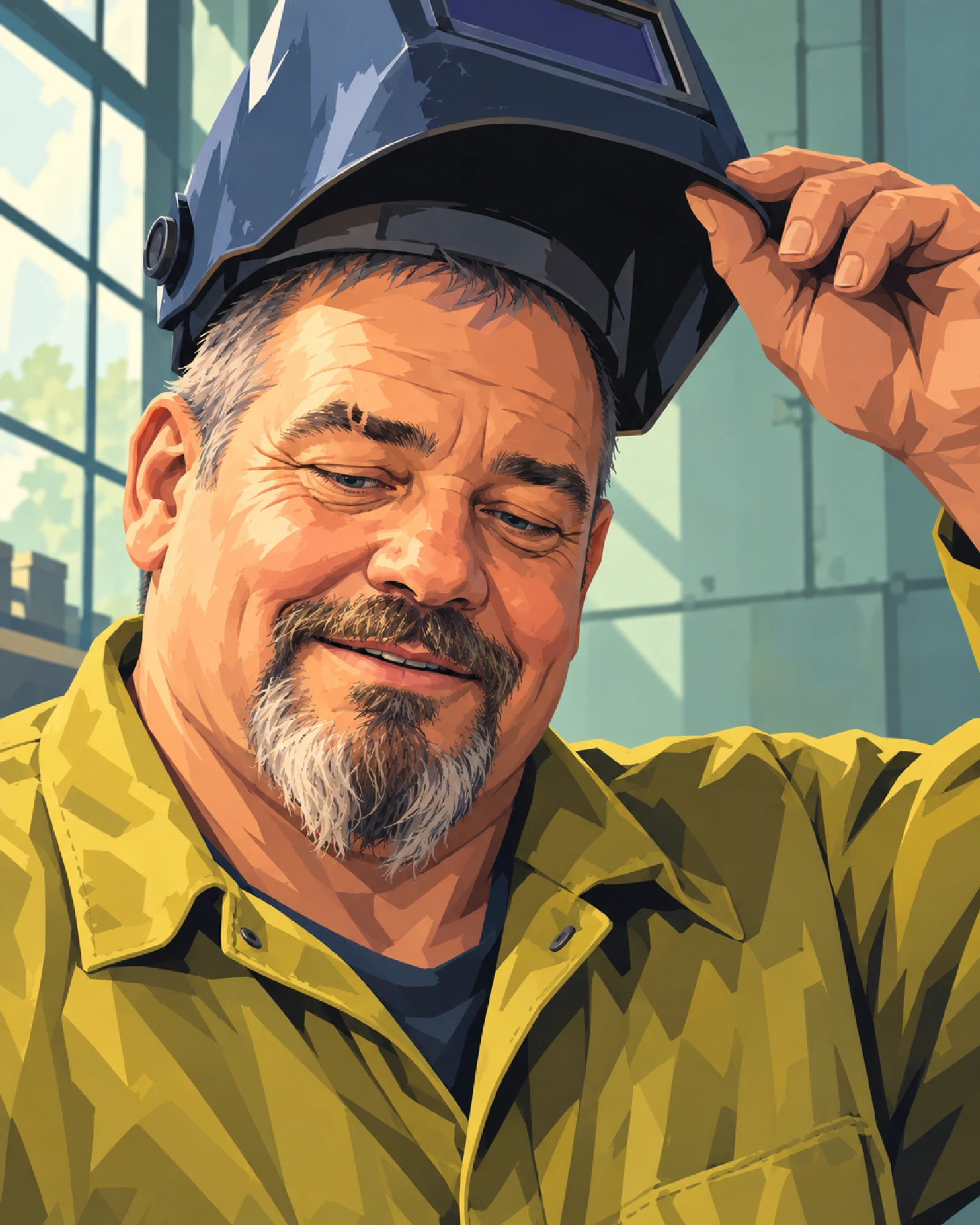
Welder Lifting His Helmet
A boldly cropped portrait of a welder lifting his helmet as tension leaves his face. Crisp vector shapes and playful asymmetry give his modest smile an unexpected warmth.
Remix this referenceWelder Lifting His Helmet
- Form language
- Build crisp vector abstractions from unequal curved masses and blunt wedges; let small shape irregularities vary naturally.
- Contour
- Let adjoining shapes define most edges; use a few tapered dark strokes and deliberate breaks instead of uniform outlines.
- Mark-making
- Use sparse comma strokes and short angular notches, with varied lengths and offbeat spacing rather than repeated patterning.
- Surface rendering
- Resolve tone through broad, hard-edged shape changes and occasional nested slivers; keep transitions decisive and surfaces mostly untextured.
Priority
Crisp vector abstraction with playful asymmetry must define the finished image.
What to avoid & what to check
Exact prompt for this example
MODULE OWNERSHIP
subject: Subject count, type, stable proportions and landmarks, resting face geometry, hair shape, physical materials, garment construction and permanent marks. No emotion, movement, color assignment or rendering recipe.
expression: Facial soft-tissue displacement and pupil direction, muscle coordination, regional intensity, asymmetry and onset/peak/release. No head/body pose, stable appearance, skin color or rendering.
gesture: Head/neck/body/limb orientation, joint movement, support, contact and pose-caused occlusion using existing anatomy. No eye/pupil movement, emotion, identity, props inventory or camera.
props: Prop count, type, construction, physical material and scale relative to the subject. Holding/contact belongs to gesture, position to composition, color to palette.
scene: Environment elements, terrain, backdrop/floor presence and structural detail. No canvas positions, camera, lighting, assigned colors or render texture.
camera: Projection, focal-length impression, camera elevation/yaw/roll, viewing distance and crop. No actor pose, world placement, lighting or canvas aspect ratio.
composition: Normalized 0-100% canvas positions, scale in frame, depth/overlap, focal hierarchy and margins. No joint pose, camera projection, rendering, subject/prop inventory or emotion.
palette: Color anchors, hue/saturation/value ranges, colors assigned to parts and approximate color coverage. No illumination direction, shading algorithm, physical material or layout.
lighting: Light-source direction/softness/intensity, ambient illumination, physical shadow direction/length and highlight position. Absence of directional illumination is allowed. No shading technique, palette or material changes.
style: Reusable form abstraction, contour weight/taper/edge quality, medium and mark scale/density/direction, surface rendering and tonal transition technique. No fixed subject proportions, anatomy, identity, expression, pose, palette, light-source direction, camera or layout.
output: Image count, aspect ratio, size, file/alpha requirements and global lettering/logo/watermark restrictions. No background scenery, crop, style, identity or pose.

SUBJECT
inventory: One original older adult man, a workshop welder.
geometry: A broad, compact face, high forehead, flattened nose bridge and short forked beard establish his recognizable construction.
resting-face: At rest, his brows are straight, upper lids heavy, cheeks full and mouth broad with a slightly fuller lower lip.
appearance: Close-cropped wiry hair, a small permanent gap in one eyebrow and a heavy canvas shirt with a folded collar.

PRIORITY


AVOID


CHECK


EXPRESSION — ACTOR A
brows: Both brows settle, with a trace of inward lift remaining.
lids: Upper lids ease downward; lower lids rise gently with the smile.
cheeks: Cheeks lift softly, slightly more on his left side.
nose: Nostrils remain relaxed, without flare or bridge wrinkling.
mouth: The lips part in a small, uneven smile, with the left corner higher.
jaw: The jaw releases slightly, leaving a narrow opening between the lips.
gaze: Pupils rest just below the viewer, without direct eye contact.
coordination: The softened upper face and uneven smile read as relief after concentration.
timing: Catch the release just after effort, before the smile fully settles.

PRIORITY


AVOID


CHECK


GESTURE
head: His chin dips slightly while the neck remains comfortably extended beneath the lifted helmet.
torso: The shoulders drop unevenly, with the working shoulder still raised and the chest slightly turned away.
limbs: One elbow lifts outward as the hand pushes the helmet upward; the other arm hangs loosely beside the torso.
contact: Fingertips press beneath the helmet rim while its headband remains seated against his head.

PRIORITY


AVOID


CHECK


PROPS
inventory: One hinged welding helmet, large enough to enclose his face.
construction: A rigid molded shell, rectangular protective window and simple internal headband joined by side pivots.

PRIORITY


AVOID


CHECK


SCENE
inventory: A workshop wall and part of a tall industrial window; no floor is visible.
structure: Use a deep window reveal and one broad wall joint; leave other workshop details unspecified.

PRIORITY


AVOID


CHECK


CAMERA
projection: A natural perspective with a short portrait-lens impression and little facial distortion.
viewpoint: View from eye height in a shallow three-quarter angle, without camera roll.
crop: An intimate head-and-shoulders crop cuts through the helmet crown, raised forearm and opposite shoulder, excluding the opposite arm.

PRIORITY


AVOID


CHECK


COMPOSITION
placement: Place the face near 40% of canvas width, slightly above midheight; the helmet breaks across the upper edge.
depth: The raised hand overlaps the helmet rim; the window and wall remain behind the uninterrupted facial silhouette.
spacing: Make the face primary, the hand secondary, and preserve an open wedge beside the lower right shoulder.

PRIORITY


AVOID


CHECK


PALETTE
colors: Use deep indigo, warm apricot, sharp citron and pale celadon as the compact color family.
assignment: Indigo belongs to helmet and hair, apricot to skin, citron to the shirt and celadon to the workshop.
balance: Apricot and celadon cover broad areas; indigo supplies weight and citron provides a smaller, vivid accent.

PRIORITY


AVOID


CHECK


LIGHTING
sources: Broad, soft window light enters from the upper left, supported by gentle ambient illumination.
shadows: Short, soft shadows fall beneath the brow, nose and helmet rim toward the lower right.
highlights: Broad highlights sit on the left forehead and cheek, with a restrained glint along the helmet lip.

PRIORITY


AVOID


CHECK


STYLE GUIDE
form-language: Build crisp vector abstractions from unequal curved masses and blunt wedges; let small shape irregularities vary naturally.
contour: Let adjoining shapes define most edges; use a few tapered dark strokes and deliberate breaks instead of uniform outlines.
mark-making: Use sparse comma strokes and short angular notches, with varied lengths and offbeat spacing rather than repeated patterning.
surface-rendering: Resolve tone through broad, hard-edged shape changes and occasional nested slivers; keep transitions decisive and surfaces mostly untextured.

PRIORITY
Crisp vector abstraction with playful asymmetry must define the finished image.

AVOID


CHECK


OUTPUT
format: One finished image, portrait 4:5, 1600 × 2000 pixels, opaque PNG.
restrictions: No lettering, logos or watermarks.

PRIORITY


AVOID


CHECK
Model information comes from image provenance. The same prompt may produce a different result.